
Catalogue Search | MBRL


Are you sure you want to remove the book from the shelf?

{{itemTitle}}
844
result(s) for
"Classifiers (Linguistics)"
Sort by:


Classifier Structures in Mandarin Chinese
This monograph addresses fundamental syntactic issues of classifier constructions, based on a thorough study of a typical classifier language, Mandarin Chinese. It shows that the contrast between count and mass is not binary. Instead, there are two independently attested features: Numerability, the ability of a noun to combine with a numeral directly, and Delimitability, the ability of a noun to be modified by a delimitive modifier, such as size, shape, or boundary modifier. Although all nouns in Chinese are non-count nouns, there is still a mass/non-mass contrast, with mass nouns selected by individuating classifiers and non-mass nouns selected by individual classifiers. Some languages have the counterparts of Chinese individuating classifiers only, some languages have the counterparts of Chinese individual classifiers only, and some other languages have no counterpart of either individual or individuating classifiers of Chinese. The book also reports that unit plurality can be expressed by reduplicative classifiers in the language. Moreover, for the constituency of a numeral expression, an individual, individuating, or kind classifier combines with the noun first and then the numeral is integrated; but a partitive or collective classifier, like a measure word, combines with the numeral first, before the noun is integrated into the whole nominal structure. Furthermore, the book identifies the syntactic positions of various uses of classifiers in the language. A classifier is at a functional head position that has a dependency with a numeral, or a position that has a dependency with a generic or existential quantifier, or a position that represents the singular-plural contrast, or a position that licenses a delimitive modifier when the classifier occurs in a compound.
eBook

Numeral Classifiers in Chinese
This book studies the syntax and semantics of numeral classifiers in Mandarin and other Chinese languages. It explores how Chinese classifiers are semantically interpreted in syntactic contexts and how semantic functions of classifiers are realized at the syntactic level. The book is a contribution to formal Chinese linguistics, and to the understanding of grammatical properties of nominal phrases in Chinese and East Asian languages.
eBook

Determiners and quantifiers : functions, variation, and change
This volume explores the interface between morphosyntax and semantics-pragmatics in the domain of referential and quantificational nominal expressions, by means of synchronic and diachronic case studies from Romance and Germanic languages.
eBook

STATISTICAL SOFTWARE R IN CORPUS-DRIVEN RESEARCH AND MACHINE LEARNING
The rapid development of computer software and network technologies has facilitated the intensive application of specialized statistical software not only in the traditional information technology spheres (i.e., statistics, engineering, artificial intelligence) but also in linguistics. The statistical software R is one of the most popular analytical tools for statistical processing a huge array of digitalized language data, especially in quantitative corpus linguistic studies of Western Europe and North America. This article discusses the functionality of the software package R, focusing on its advantages in performing complex statistical analyses of linguistic data in corpus-driven studies and creating linguistic classifiers in machine learning. With this in mind, a three-stage strategy of computer-statistical analysis of linguistic corpus data is elaborated: 1) data processing and preparing to be subjected to a statistical procedure, 2) utilizing statistical hypothesis testing methods (MANOVA, ANOVA) and the Tukey post-hoc test, and 3) developing a model of a linguistic classifier and analyzing its effectiveness. The strategy is implemented on 11 000 tokens of English detached nonfinite constructions with an explicit subject extracted from the BNC-BYU corpus. The statistical analysis indicates significant differences in the realization of the factors of the parameter “Part of speech of the subject”. The analyzed linguistic data are employed to build a machine model for the classification of the given constructions. Particular attention is devoted to the methodological perspectives of interdisciplinary research in the fields of linguistics and computer studies. The potential application of the elaborated case study in training undergraduate, master, and postgraduate students of Applied Linguistics is indicated. The article provides all the statistical data and codes written in the R script with comprehensive descriptions and explanations. The concluding part of the article summarizes the obtained results and highlights the issues for further research connected with the popularization of the statistical software complex R and raising the awareness of specialists in this statistical analysis system.
Journal Article

Layers in the Determiner Phrase
The main topic of this work is the interaction between syntactic structure and meanin within the noun phrase, with data drwn primarily from English and Italian.
eBook

Amelioration of linguistic semantic classifier with sentiment classifier manacle for the focused web crawler
Sentiment relevant information in the web pages concerning products, establishment, and commodities concentrates principally on the available textual contents. Research on crawling topic-relevant web pages is far behind compared to sentiment-relevant web pages despite the steep rise in sentiment-relevant information on the web. This paper resolves the impediment issues and proposes a novel focused web crawler namely the Linguistic Semantic Sentiment (LSS) crawler which collects not only topic-relevant web pages but also sentiment-relevant web pages. Two classifiers are proposed in the relevance computation module of the LSS crawler, where one is a linguistic semantic classifier and the other is a sentiment classifier. The linguistic semantic classifier computes the semantic relevance of the web page concerning the topic, whereas the sentiment classifier computes the sentiment relevance of the web page. The performance of the LSS crawler is then analyzed by using the metrics, harvest rate, target recall, and F1-score. The LSS crawler outperformed the existing focused crawlers with an average harvest rate of 0.35, target recall of 0.55, and F1-score of 0.42. The evaluation results revealed that both the linguistic semantic and the sentiment classifiers enhanced the performance of the proposed LSS-focused crawler.
Journal Article
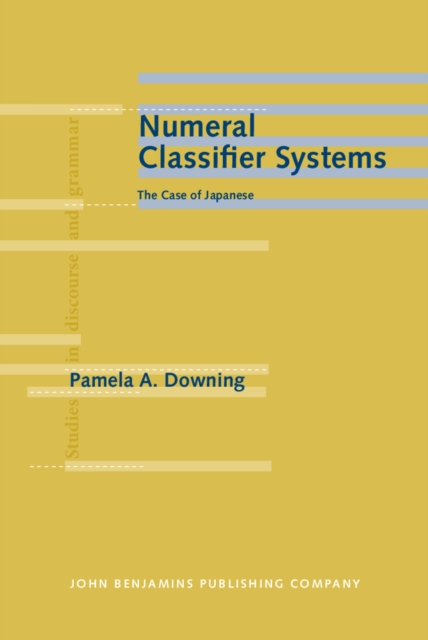
Numeral classifier systems : the case of Japanese
Numeral Classifier Systems considers the functional significance of the Japanese numeral system, its conclusions based on a corpus of 500 uses of classifier constructions drawn from oral and written Japanese texts.Interestingly, although the Japanese system appears to conform at least superficially to universalistic predictions about its semantic structure, this study reports that in actual usage, the semantic role of classifiers is slight - only very rarely do they carry any lexical information unavailable from the context or the noun with which the classifier occurs. It does appear, however, that the system has an important role to play in providing pronoun-like anaphoric elements and in marking pragmatic distinctions such as the individuatedness of referents and the newness of numerical information. For these reasons, the classifier system is deeply involved in a number of subsystems of Japanese grammar, and the demise of the system (sometimes rumored to be impending) would have substantial implications for the structure of the language as a whole.
eBook
Advances in the syntax of DPs : structure, agreement, and case
This chapter argues for the view that Standard Free Relatives and Transparent Free Relatives have exactly the same bi-dimensional configurational structures, and against the view that they have distinct multi-dimensional structures, the transparent variety being externally headed by a token of a CP-internal post-copular phrase. It is argued that the proposed view yields superior analyses of the following facts: [i] Transparent Free Relatives are typically construed as existentially quantified, regardless of the quantificational force of the pivot, and [ii] certain case mismatch effects, predicted by the competing approach, fail to materialize in most idiolects, and are only weakly manifested in a small number of idiolects, in which they affect both Standard and Transparent Free Relatives, contrary to predictions.
eBook
Determiners : universals and variation
This article explores definiteness as expressed by the determiner system of Malagasy. In particular, noun phrases with and without an overt determiner are compared in terms of familiarity, uniqueness, and other semantic notions commonly associated with definiteness. It is shown that the determiner does not uniformly signal definiteness (as typically understood) and that bare noun phrases can be interpreted as either definite or indefinite. The determiner instead signals the familiarity of the discourse referent of the DP and the absence of a determiner signals a non-familiar DP. In certain syntactic positions, however, where the determiner is either required or banned, the interpretation of DPs is underdetermined.
eBook