
Catalogue Search | MBRL


Are you sure you want to remove the book from the shelf?

{{itemTitle}}
2,257,304
result(s) for
"Climate changes"
Sort by:

How to save our planet : the facts
How can we save our planet and survive the 21st century? How can you argue with deniers? How can we create positive change in the midst of the climate crisis? Professor Mark Maslin has the key facts that we need to protect our future. Global awareness of climate change is growing rapidly. Science has proven that our planet and species are facing a massive environmental crisis. How to Save Our Planet is a call to action, guaranteed to equip everyone with the knowledge needed to make change. Be under no illusion the challenges of the twenty-first century are immense. We need to deal with: climate change, environmental destruction, global poverty and ensure everyone's security. -- Provided by publisher.
Book

Robustness and uncertainties in global multivariate wind-wave climate projections
Understanding climate-driven impacts on the multivariate global wind-wave climate is paramount to effective offshore/coastal climate adaptation planning. However, the use of single-method ensembles and variations arising from different methodologies has resulted in unquantified uncertainty amongst existing global wave climate projections. Here, assessing the first coherent, community-driven, multi-method ensemble of global wave climate projections, we demonstrate widespread ocean regions with robust changes in annual mean significant wave height and mean wave period of 5–15% and shifts in mean wave direction of 5–15°, under a high-emission scenario. Approximately 50% of the world’s coastline is at risk from wave climate change, with ~40% revealing robust changes in at least two variables. Furthermore, we find that uncertainty in current projections is dominated by climate model-driven uncertainty, and that single-method modelling studies are unable to capture up to ~50% of the total associated uncertainty.
Journal Article

collapse of the Kyoto Protocol and the struggle to slow global warming
Even as the evidence of global warming mounts, the international response to this serious threat is coming unraveled. The United States has formally withdrawn from the 1997 Kyoto Protocol; other key nations are facing difficulty in meeting their Kyoto commitments; and developing countries face no limit on their emissions of the gases that cause global warming. In this clear and cogent book-reissued in paperback with an afterword that comments on recent events--David Victor explains why the Kyoto Protocol was never likely to become an effective legal instrument. He explores how its collapse offers opportunities to establish a more realistic alternative.
Global warming continues to dominate environmental news as legislatures worldwide grapple with the process of ratification of the December 1997 Kyoto Protocol. The collapse of the November 2000 conference at the Hague showed clearly how difficult it will be to bring the Kyoto treaty into force. Yet most politicians, policymakers, and analysts hailed it as a vital first step in slowing greenhouse warming. David Victor was not among them.
Kyoto's fatal flaw, Victor argues, is that it can work only if emissions trading works. The Protocol requires industrialized nations to reduce their emissions of greenhouse gases to specific targets. Crucially, the Protocol also provides for so-called \"emissions trading,\" whereby nations could offset the need for rapid cuts in their own emissions by buying emissions credits from other countries. But starting this trading system would require creating emission permits worth two trillion dollars--the largest single invention of assets by voluntary international treaty in world history. Even if it were politically possible to distribute such astronomical sums, the Protocol does not provide for adequate monitoring and enforcement of these new property rights. Nor does it offer an achievable plan for allocating new permits, which would be essential if the system were expanded to include developing countries.
The collapse of the Kyoto Protocol--which Victor views as inevitable--will provide the political space to rethink strategy. Better alternatives would focus on policies that control emissions, such as emission taxes. Though economically sensible, however, a pure tax approach is impossible to monitor in practice. Thus, the author proposes a hybrid in which governments set targets for both emission quantities and tax levels. This offers the important advantages of both emission trading and taxes without the debilitating drawbacks of each.
Individuals at all levels of environmental science, economics, public policy, and politics-from students to professionals--and anyone else hoping to participate in the debate over how to slow global warming will want to read this book.
eBook
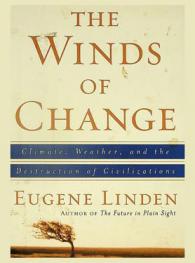
The winds of change : climate, weather, and the destruction of civilizations
Climate has been humanity's constant, if moody, companion. At times benefactor or tormentor, climate nurtured the first stirrings of civilization and then repeatedly visited ruin on empires and peoples. Environmental journalist Linden reveals a recurring pattern in which civilizations become prosperous and complacent during good weather, only to collapse when climate changes--either through its direct effects, such as floods or drought, or indirect consequences, such as disease, blight, and civil disorder. The science of climate change is still young, but the evidence mounts that climate loomed over the fate of societies from arctic Greenland to the Fertile Crescent and from the lost cities of the Mayans in Central America to the rain forests of Central Africa. The tragedy of New Orleans is but the latest instance in which a region prepared for weather disasters experienced in the past finds itself helpless when nature ups the ante--From publisher description.

Adapting to climate change in Eastern Europe and Central Asia
The climate is changing, and the Eastern Europe and Central Asia (ECA) region is vulnerable to the consequences. Many of the region's countries are facing warmer temperatures, a changing hydrology, and more extremes, droughts, floods, heat waves, windstorms, and forest fires. This book presents an overview of what adaptation to climate change might mean for Eastern Europe and Central Asia. It starts with a discussion of emerging best-practice adaptation planning around the world and a review of the latest climate projections. It then discusses possible actions to improve resilience organized around impacts on health, natural resources (water, biodiversity, and the coastal environment), the 'unbuilt' environment (agriculture and forestry), and the built environment (infrastructure and housing). The last chapter concludes with a discussion of two areas in great need of strengthening given the changing climate: disaster preparedness and hydro-meteorological services. This book has four key messages: a) contrary to popular perception, Eastern Europe and Central Asia face significant threats from climate change, with a number of the most serious risks already in evidence; b) vulnerability over the next 10 to 20 years is likely to be dominated by socioeconomic factors and legacy issues; c) even countries and sectors that stand to benefit from climate change are poorly positioned to do so; and d) the next decade offers a window of opportunity for ECA countries to make their development more resilient to climate change while reaping numerous co-benefits.
eBook

Our fragile moment : how lessons from Earth's past can help us survive the climate crisis
\"The conditions that allowed humans to live on Earth are incredibly fragile. Climate variability has at times created new niches that humans or their ancestors could potentially exploit, and challenges that at times have spurred innovation. But there's a relatively narrow envelope of climate variability within which human civilization remains viable, and our survival depends on conditions remaining within that range. In this book, renowned climate scientist Michael Mann provides readers with the knowledge necessary to appreciate the gravity of the unfolding climate crisis, while emboldening them to act before it is too late\"-- Provided by publisher.
Book

Twenty-five years of adaptation finance through a climate justice lens
How much finance should be provided to support climate change adaptation and by whom? How should it be allocated, and on what basis? Over the years, various actors have expressed different normative expectations on climate finance. Which of these expectations are being met and which are not; why, and with what consequences? Have new norms and rules emerged, which remain contested? This article takes stock of the first 25+ years of adaptation finance under the United Nations Framework Convention on Climate Change (UNFCCC) and seeks to understand whether adaptation finance has become more justly governed and delivered over the past quarter century. We distinguish among three “eras” of adaptation finance: (1) the early years under the UNFCCC (1992–2008); (2) the Copenhagen shift (2009–2015); and (3) the post-Paris era (2016–2018). For each era, we systematically review the justice issues raised by evolving expectations and rules over the provision, distribution, and governance of adaptation finance. We conclude by outlining future perspectives for adaptation finance and their implications for climate justice.
Journal Article

Anthropogenic climate change has slowed global agricultural productivity growth
Agricultural research has fostered productivity growth, but the historical influence of anthropogenic climate change (ACC) on that growth has not been quantified. We develop a robust econometric model of weather effects on global agricultural total factor productivity (TFP) and combine this model with counterfactual climate scenarios to evaluate impacts of past climate trends on TFP. Our baseline model indicates that ACC has reduced global agricultural TFP by about 21% since 1961, a slowdown that is equivalent to losing the last 7 years of productivity growth. The effect is substantially more severe (a reduction of ~26–34%) in warmer regions such as Africa and Latin America and the Caribbean. We also find that global agriculture has grown more vulnerable to ongoing climate change.Agricultural productivity has increased historically, but the impact of climate change on productivity growth is not clear. In the last 60 years, anthropogenic climate change has reduced agricultural total factor production globally by 21%, with stronger impacts in warmer regions.
Journal Article