
Catalogue Search | MBRL


Are you sure you want to remove the book from the shelf?

{{itemTitle}}
27,878
result(s) for
"Climate justice."
Sort by:
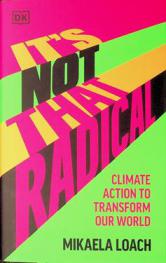
It's not that radical : climate action to transform our world
\"For too long, representations of climate action in the mainstream media have been white-washed, green-washed and diluted to be made compatible with capitalism. We are living in an economic system which pursues profit above all else; harmful, oppressive systems that heavily contribute to the climate crisis, and environmental consequences that have been toned down to the masses. Tackling the climate crisis requires us to visit the roots of poverty, capitalist exploitation, police brutality and legal injustice. Climate justice offers the real possibility of huge leaps towards racial equality and collective liberation as it aims to dismantle the very foundations of these issues. In this book, Mikaela Loach offers a fresh and radical perspective for real climate action that could drastically change the world as we know it for the benefit of us all. Written with candour and hope, It's Not That Radical will galvanise readers to take action, offering an accessible and transformative appraisal of our circumstances to help mobilise a majority for the future of our planet\"--Publisher's description.
Book

Feminist Climate Justice as a Framework for Inclusive Climate Governance
Women, particularly in lower-income countries and rural regions, experience a disproportionate impact from climate change as a result of the social, economic, and environmental disparities they encounter. The significant contribution of women to climate change mitigation and adaptation is acknowledged; however, they frequently remain overlooked in global climate change policies. This study employs an intersectional framework to elucidate how structural inequalities and patriarchal power dynamics intensify the effects of climate change on women and other marginalized populations. This study posits that attaining fair and effective climate justice necessitates the incorporation of feminist climate justice into climate change policies. This integration should encompass enhanced representation, a redistribution of power, and an acknowledgment of women’s contributions. This study highlights the significance of presenting climate change as a social justice concern encompassing diverse groups. It advocates for policy changes that prioritize inclusivity, sustainability, and the rectification of inequalities on both global and local scales. This study positions climate change within the context of social justice, advocating for developing policies that prioritize inclusivity, sustainability, and the rectification of existing inequalities on both global and local scales.
Journal Article

Just transformations : grassroots struggles for alternative futures
The climate crisis is the greatest existential threat humanity faces today. The need for a radical societal transformation in the interests of social justice and ecological sustainability has never been greater. But where can we turn to find systemic alternatives? From India, Turkey and Bolivia, to Venezuela, Canada and Lebanon, 'Just Transformations' looks to local environmental struggles for the answers. With each case study grounded in the social movements and specific politics of the region in question, this volume investigates the role that resistance movements play in bringing about sustainable transformations, the strategies and tools they utilise to overcome barriers, and how academics and grassroots activists can collaborate effectively.
BOOK

Degrowth, green growth, and climate justice for Africa
The concept of degrowth aligns with the principles of Climate and Environmental Justice (CEJ) in significant aspects. Both frameworks underline the need for new global structures and social movements that promote ecological conservation, local economic regeneration, and social well-being that goes beyond material accumulation. Therefore, degrowth can reinforce the pursuit of transformative global climate justice. However, I contend that significant contradictions remain between degrowth and North–South climate justice. I argue that on both conceptual and policy grounds, a ‘strong version’ of the green economy provides a better foundation for seeking international climate justice for Africa than degrowth. I also contend that green growth is a more pragmatic and realistic approach to global climate justice because it is more sensitive to the norms, structures, and dynamics of global politics.
Journal Article

The climate book
\"Greta Thunberg has gathered the wisdom of over one hundred experts--geophysicists, oceanographers and meteorologists; engineers, economists and mathematicians; historians, philosophers and indigenous leaders--to equip us all with the knowledge we need to combat climate disaster\"-- Provided by publisher.
Book

Carbon criminals, climate crimes
Carbon Criminals, Climate Crimes analyzes the looming threats posed by climate change from a criminological perspective. It advances the field of green criminology through a examination of the criminal nature of catastrophic environmental harms resulting from the release of greenhouse gases. The book describes and explains what corporations in the fossil fuel industry, the U.S. government, and the international political community did, or failed to do, in relation to global warming. Carbon Criminals, Climate Crimes integrates research and theory from a wide variety of disciplines, to analyze four specific state-corporate climate crimes: continued extraction of fossil fuels and rising carbon emissions; political omission (failure) related to the mitigation of these emissions; socially organized climate change denial; and climate crimes of empire, which include militaristic forms of adaptation to climate disruption. The final chapter reviews policies that could mitigate greenhouse gas emissions, adapt to a warming world, and achieve climate justice.
eBook


Nurturing Identity, Shaping Communities, and Forging New Pathways
This study explores the experiences of racially minoritized youth activists involved in the climate justice movement. From July to October of 2023, I conducted semi-structured narrative interviews with 15 Black, Indigenous, and youth of colour in Ontario, aged 18 to 29, who had been affiliated with a climate justice organization for at least six months. Through timeline mapping and semi-structured interviews, participants highlighted pivotal life events that shaped their justice-oriented values. Three overarching themes emerged: nurturing identity, shaping communities and schools, and forging new pathways for racially minoritized youth leaders. The findings underscore the empowerment youth experience through local action and community engagement. With a grounding in relational solidarity and ethical relationality, this study emphasizes the imperative for Canadian education systems to integrate robust climate justice pedagogies as well as interdisciplinary, action-oriented climate justice learning that fosters student efficacy and leadership. The study also aims to highlight the ways educators, policy makers, and stakeholders can engage with climate justice, informed by racially minoritized activists.
Cette étude explore les expériences de jeunes activistes racialisés impliqués dans le mouvement pour la justice climatique. De juillet à octobre 2023, j’ai mené des entrevues narratives semi-structurées avec 15 jeunes Noirs, Autochtones et non-Blancs en Ontario, âgés de 18 à 29 ans, affiliés à une organisation de justice climatique depuis au moins six mois. À travers la cartographie temporelle et les entrevues semi-structurées, les participants et participantes ont mis en lumière les événements marquants de leur vie ayant façonné leurs valeurs orientées vers la justice. Trois thèmes principaux ont émergé : le développement de l’identité, l’influence des communautés et des écoles, ainsi que la création de nouvelles voies pour le leadership des jeunes racialisés. Les résultats soulignent l’autonomisation que ressentent les jeunes grâce à l’action locale et à l’engagement communautaire. Ancrée dans la solidarité relationnelle et l’éthique relationnelle, cette étude met en avant la nécessité pour les systèmes d’éducation canadiens d’intégrer des pédagogies solides en matière de justice climatique, ainsi qu’un apprentissage interdisciplinaire et orienté vers l’action, afin de renforcer l’efficacité et le leadership des élèves. Elle vise à améliorer les façons dont les éducateurs, les décideurs politiques et les parties prenantes peuvent s’engager en faveur de la justice climatique, en s’inspirant des activistes racialisés.
Journal Article

Decolonizing the Atmosphere
A central concept raised by the climate justice movement is climate debt. Here, the claims and warrants of the movement support for climate debt is identified through an argumentation analysis of their central manifestos. It is found that the climate debt claim is understood as primarily restorative, in the sense that the environmental space of the developing countries must be returned, \"decolonized.\" The damage caused by climate change also gives rise to a compensatory adaptation debt. The result is compared with an earlier study on ecological debt. Both concepts are framed within an unjust power relation between North and South, but there are differences. Ecological debt is mainly analyzed in terms of an unjust economic exploitation, which is congenial with its use as an argument for cancellation of Southern external debts; climate debt is rather seen as a violation of communal rights and territories, an argument for climate justice.
Journal Article

\If not even the school listens to us…”: Echos of climate justice on the ground
Highlights:* Youth and other vulnerable groups have limited opportunities to participate in decision-making processes on climate politics.* Distributive and intergenerational dimensions of climate injustice are particularly present in youth discourses.* Recognitional and distributional climate injustice is mainly perceived by inland-rural young people.* More knowledge about climate change at the local level needs to be disseminated.* Climate justice concept needs further empirical and nuanced exploration with diverse social and political actors.Purpose:This article brings into debate young people’s meaning-making of climate justice in different geographic regions, and explores the roles of political, social, economic, and education actors in supporting youth’s climate agency in their communities.Design/methodology/approach:After selecting two schools located in Northern Portugal – in countryside/rural and in coastal/urban contexts – we conducted two focus group discussions with young students (aged between 16 and 18) and sixteen interviews with local stakeholders (policy-makers, economic agents, activists, and scientists). We performed content analysis, using climate justice’s dimensions as analytical axes.Findings: The data analysis reveals that young people do not feel heard in schools or in policy-making processes on climate. In contrast, adults unanimously recognize the importance of having more youth voices but fail to identify opportunities for youth participation in local climate policymaking. In addition to procedural and intergenerational dimensions, issues of recognitional and distributional climate injustice are identified by youngsters in their regions.
Journal Article