
Catalogue Search | MBRL


Are you sure you want to remove the book from the shelf?

{{itemTitle}}
49
result(s) for
"Climatic changes Asia History."
Sort by:


The Climate of Rebellion in the Early Modern Ottoman Empire
The Climate of Rebellion in the Early Modern Ottoman Empire explores the serious and far-reaching impacts of Little Ice Age climate fluctuations in Ottoman lands. This study demonstrates how imperial systems of provisioning and settlement that defined Ottoman power in the 1500s came unraveled in the face of ecological pressures and extreme cold and drought, leading to the outbreak of the destructive Celali Rebellion (1595–1610). This rebellion marked a turning point in Ottoman fortunes, as a combination of ongoing Little Ice Age climate events, nomad incursions and rural disorder postponed Ottoman recovery over the following century, with enduring impacts on the region's population, land use and economy.
eBook

Climate, science, and colonization : histories from Australia and New Zealand
\"Offering important new historical understandings of human responses to climate and climate change, this cutting-edge volume explores the dynamic relationship between settlement, climate, and colonization. The contributions gathered here consider a wide range of interrelated topics, among them the use of scientific evidence in historical research, the physical impact of climate on agriculture and land development, and changing understandings of climate, including the development of \"folk\" and government meteorologies. They reveal Australasia to be a remarkably varied and fertile area for analyzing cultural responses to climate as well as the wider social ramifications of historical climatic events\"-- Provided by publisher.
Book
Climate change and migration
Climate change is a major source of concern in the Middle East and North Africa (MENA) region, and migration is often understood as one of several strategies used by households to respond to changes in climate and environmental conditions, including extreme weather events. This study focuses on the link between climate change and migration. Most micro-level studies measure climate change either by the incidences of extreme weather events or by variation in temperature or rainfall. A few studies have found that formal and informal institutions as well as policies also affect migration. Institutions that make government more responsive to households (for example through public spending) discourage both international and domestic migration in the aftermath of extreme weather events. Migration is often an option of last resort after vulnerable rural populations attempting to cope with new and challenging circumstances have exhausted other options such as eating less, selling assets, or removing children from school. This study is based in large part on new data collected in 2011 in Algeria, Egypt, Morocco, Syria, and the Republic of Yemen. The surveys were administered by in-country partners to a randomly selected set of 800 households per country. It is also important to emphasize that neither the household survey results nor the findings from the qualitative focus groups are meant to be representative of the five countries in which the work was carried, since only a few areas were surveyed in each country. This report is organized as follows: section one gives synthesis. Section two discusses household perceptions about climate change and extreme weather events. Section three focuses on migration as a coping mechanisms and income diversification strategy. Section four examines other coping and adaptation strategies. Section five discusses perceptions about government and community programs.
eBook

The Collapse of the Eastern Mediterranean
As a 'Medieval Warm Period' prevailed in Western Europe during the tenth and eleventh centuries, the eastern Mediterranean region, from the Nile to the Oxus, was suffering from a series of climatic disasters which led to the decline of some of the most important civilizations and cultural centres of the time. This provocative study argues that many well-documented but apparently disparate events - such as recurrent drought and famine in Egypt, mass migrations in the steppes of central Asia, and the decline in population in urban centres such as Baghdad and Constantinople - are connected and should be understood within the broad context of climate change. Drawing on a wealth of textual and archaeological evidence, Ronnie Ellenblum explores the impact of climatic and ecological change across the eastern Mediterranean in this period, to offer a new perspective on why this was a turning point in the history of the Islamic world.
eBook

Nature, Environment\u2029and Culture in East Asia
Nature, Environment and Culture in East Asia. The Challenge of Climate Change explores East Asian cultural variations in approaching and solving environmental challenges in the past, present, and future--important perspectives from cultural studies to the current global environmental and climate crisis.
eBook
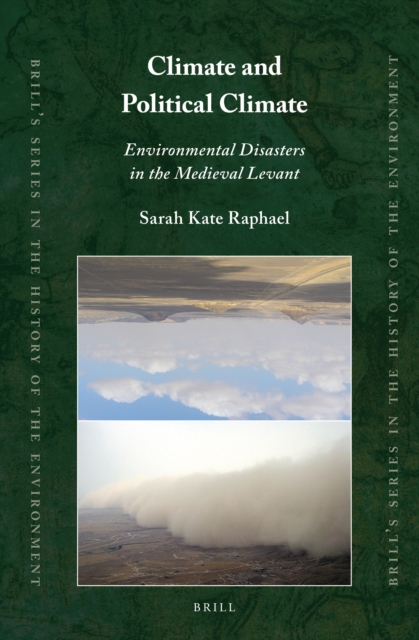
Climate and Political Climate
This study examines environmental disasters in the Levant. The data is drawn from contemporary sources. The main aim is to determine the long and short-term repercussions of environmental disasters on the regional affairs during the Crusader, Ayyubid and Mamluk periods.
eBook

Plows, plagues, and petroleum : how humans took control of climate
The impact on climate from 200 years of industrial development is an everyday fact of life, but did humankind's active involvement in climate change really begin with the industrial revolution, as commonly believed? Plows, Plagues, and Petroleum has sparked lively scientific debate since it was first published--arguing that humans have actually been changing the climate for some 8,000 years--as a result of the earlier discovery of agriculture.The \"Ruddiman Hypothesis\" will spark intense debate. We learn that the impact of farming on greenhouse-gas levels, thousands of years before the industrial revolution, kept our planet notably warmer than if natural climate cycles had prevailed--quite possibly forestalling a new ice age.Plows, Plagues, and Petroleum is the first book to trace the full historical sweep of human interaction with Earth's climate. Ruddiman takes us through three broad stages of human history: when nature was in control; when humans began to take control, discovering agriculture and affecting climate through carbon dioxide and methane emissions; and, finally, the more recent human impact on climate change. Along the way he raises the fascinating possibility that plagues, by depleting human populations, also affected reforestation and thus climate--as suggested by dips in greenhouse gases when major pandemics have occurred. While our massive usage of fossil fuels has certainly contributed to modern climate change, Ruddiman shows that industrial growth is only part of the picture. The book concludes by looking to the future and critiquing the impact of special interest money on the global warming debate. In the afterword, Ruddiman explores the main challenges posed to his hypothesis, and shows how recent investigations and findings ultimately strengthen the book's original claims.
eBook

Importance of Land-Cover Change in Simulating Future Climates
Adding the effects of changes in land cover to the A2 and B1 transient climate simulations described in the Special Report on Emissions Scenarios (SRES) by the Intergovernmental Panel on Climate Change leads to significantly different regional climates in 2100 as compared with climates resulting from atmospheric SRES forcings alone. Agricultural expansion in the A2 scenario results in significant additional warming over the Amazon and cooling of the upper air column and nearby oceans. These and other influences on the Hadley and monsoon circulations affect extratropical climates. Agricultural expansion in the mid-latitudes produces cooling and decreases in the mean daily temperature range over many areas. The A2 scenario results in more significant change, often of opposite sign, than does the B1 scenario.
Journal Article

Environment and society in the Japanese islands : from prehistory to the present
Over the long course of Japan's history, its people profited from their rich natural environment while simultaneously facing significant environmental challenges.Over time, they have altered their natural environment in numerous ways, from landscape modification to industrial pollution.
eBook