
Catalogue Search | MBRL


Are you sure you want to remove the book from the shelf?

{{itemTitle}}
7,142
result(s) for
"Climatic changes Economic aspects"
Sort by:

Climate change and migration
Climate change is a major source of concern in the Middle East and North Africa (MENA) region, and migration is often understood as one of several strategies used by households to respond to changes in climate and environmental conditions, including extreme weather events. This study focuses on the link between climate change and migration. Most micro-level studies measure climate change either by the incidences of extreme weather events or by variation in temperature or rainfall. A few studies have found that formal and informal institutions as well as policies also affect migration. Institutions that make government more responsive to households (for example through public spending) discourage both international and domestic migration in the aftermath of extreme weather events. Migration is often an option of last resort after vulnerable rural populations attempting to cope with new and challenging circumstances have exhausted other options such as eating less, selling assets, or removing children from school. This study is based in large part on new data collected in 2011 in Algeria, Egypt, Morocco, Syria, and the Republic of Yemen. The surveys were administered by in-country partners to a randomly selected set of 800 households per country. It is also important to emphasize that neither the household survey results nor the findings from the qualitative focus groups are meant to be representative of the five countries in which the work was carried, since only a few areas were surveyed in each country. This report is organized as follows: section one gives synthesis. Section two discusses household perceptions about climate change and extreme weather events. Section three focuses on migration as a coping mechanisms and income diversification strategy. Section four examines other coping and adaptation strategies. Section five discusses perceptions about government and community programs.
eBook

Threatening dystopias : the global politics of climate change adaptation in Bangladesh
\"The political ecology of climate change adaptation is shaped by longer histories of development and agrarian change. In coastal Bangladesh, competing visions of this history and of desirable development trajectories under climate change among practitioners, scientists, and local residents shape different possibilities for the future\"-- Provided by publisher.
Book

A Question of Balance
As scientific and observational evidence on global warming piles up every day, questions of economic policy in this central environmental topic have taken center stage. But as author and prominent Yale economist William Nordhaus observes, the issues involved in understanding global warming and slowing its harmful effects are complex and cross disciplinary boundaries. For example, ecologists see global warming as a threat to ecosystems, utilities as a debit to their balance sheets, and farmers as a hazard to their livelihoods.
In this important work, William Nordhaus integrates the entire spectrum of economic and scientific research to weigh the costs of reducing emissions against the benefits of reducing the long-run damages from global warming. The book offers one of the most extensive analyses of the economic and environmental dynamics of greenhouse-gas emissions and climate change and provides the tools to evaluate alternative approaches to slowing global warming. The author emphasizes the need to establish effective mechanisms, such as carbon taxes, to harness markets and harmonize the efforts of different countries. This book not only will shape discussion of one the world's most pressing problems but will provide the rationales and methods for achieving widespread agreement on our next best move in alleviating global warming.
eBook

Fire and flood : a people's history of climate change, from 1979 to the present
\"From a writer and climate-change expert who has been at the center of the fight for more than thirty years, a brilliant big-picture reckoning with the reasons for our shocking failure to this point, focusing on the malign power of key business interests, and arguing that those same interests could flip this story very quickly, if a looming economic catastrophe doesn't happen first. Eugene Linden wrote his first big cover story on climate change, for Time magazine, in 1988. In the years since, he has written many more investigative pieces, for many outlets, as well as served as an advisor for nonprofits, insurance companies, and other businesses in the cross-hairs of the disastrous impact of global warming. Fire and Flood represents his definitive case for the prosecution as to how and why we have arrived at our current dire pass, closing with his argument that the same forces that have so confused the public's mind and slowed the policy response are poised to pivot with astonishing speed, as long-term risks have become present-day realities and the cliff's edge is now within view. Starting with the 1980's, Linden tells the story decade by decade by looking at four clocks within each span that move at different speeds: the reality of climate change itself; the scientific consensus about it, which always lags reality; public opinion and political will, which lag farther still; and finally, what he argues is the most important clock, business and finance. Reality marches on at its own pace, but the public will and even the science are downstream from the money, and Fire and Flood shows vividly how devilishly effective the monied climate-change deniers have been at slowing and even reversing the progress of our collective awakening. When a threat means certain disaster at an unknown future point, but addressing it means certain lost profit in the present, capitalism's response is sadly predictable. Now, however, the seasons of fire and flood have crossed the threshold into plain view. Linden focuses in on the insurance industry as one loud canary in the coal mine: fire and flood zones in Florida and California, among other regions, are seeing insurers flee the market, and others demand government back-stops-\"climate redlining\" as many call it. The whole system is teetering on the brink, and the odds that in the next few years we have another housing collapse, for starters, are much higher than most people understand. There is a path back from the cliff, but we must pick up the pace. Fire and Flood shows us why, and how\"-- Provided by publisher.
Book

Endangered economies
In the decades since Geoffrey Heal began his field-defining work in environmental economics, one central question has animated his research: \"Can we save our environment and grow our economy?\" This issue has become only more urgent in recent years with the threat of climate change, the accelerating loss of ecosystems, and the rapid industrialization of the developing world. Reflecting on a lifetime of experience not only as a leading voice in the field, but as a green entrepreneur, activist, and advisor to governments and global organizations, Heal clearly and passionately demonstrates that the only way to achieve long-term economic growth is to protect our environment. Writing both to those conversant in economics and to those encountering these ideas for the first time, Heal begins with familiar concepts, like the tragedy of the commons and unregulated pollution, to demonstrate the underlying tensions that have compromised our planet, damaging and in many cases devastating our natural world. Such destruction has dire consequences not only for us and the environment but also for businesses, which often vastly underestimate their reliance on unpriced natural benefits like pollination, the water cycle, marine and forest ecosystems, and more. After painting a stark and unsettling picture of our current quandary, Heal outlines simple solutions that have already proven effective in conserving nature and boosting economic growth. In order to ensure a prosperous future for humanity, we must understand how environment and economy interact and how they can work in harmony-lest we permanently harm both. -- Provided by publisher.
eBook


Economics of climate change in the Arab world
This book takes both a global as well as a local perspective in assessing the impacts of climate change on the economy, agricultural sector, and households in three of the MENA countries; Syria, Tunisia and Yemen. The major channels of impact for global climate change are through changing world food (and energy) prices, especially since all the countries under analysis are or have become net importers of oil and petroleum products and many food commodities in recent years. The impacts of local climate change decrease crop yields in the longer run and through them, productivity in the agricultural sector and all the implications this may have on both, the livelihoods of those dependent on the sector as well as the rest of the economy. The analysis also covered what happens when both global and local climate changes work simultaneously for each country. Findings show that in all three countries the effects of climate change are negative for people and the economy-GDP falls and livelihoods suffer. Furthermore, the prevalence of extreme variations in climate-such as the droughts affecting Syria and the floods impacting Yemen-draws attention to the potentially significant drawbacks that are likely to not only affect any strides towards economic growth and development, but may also reverse such strides if appropriate policies are not in place to weather this storm. The analyses in this book apply CGE models.
eBook

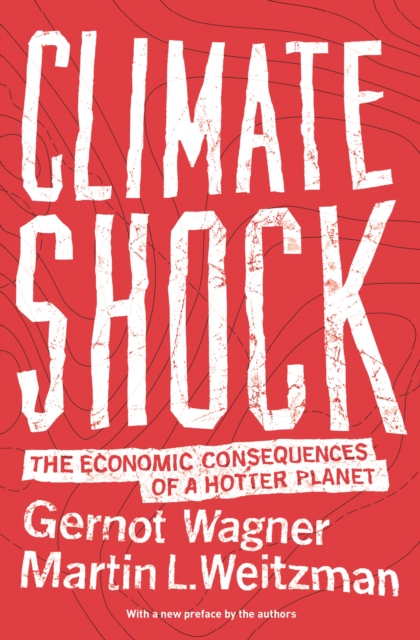
Climate shock : the economic consequences of a hotter planet
If you had a 10 percent chance of having a fatal car accident, you'd take necessary precautions. If your finances had a 10 percent chance of suffering a severe loss, you'd reevaluate your assets. So if we know the world is warming and there's a 10 percent chance this might eventually lead to a catastrophe beyond anything we could imagine, why aren't we doing more about climate change right now? We insure our lives against an uncertain future--why not our planet?In Climate Shock, Gernot Wagner and Martin Weitzman explore in lively, clear terms the likely repercussions of a hotter planet, drawing on and expanding from work previously unavailable to general audiences. They show that the longer we wait to act, the more likely an extreme event will happen. A city might go underwater. A rogue nation might shoot particles into the Earth's atmosphere, geoengineering cooler temperatures. Zeroing in on the unknown extreme risks that may yet dwarf all else, the authors look at how economic forces that make sensible climate policies difficult to enact, make radical would-be fixes like geoengineering all the more probable. What we know about climate change is alarming enough. What we don't know about the extreme risks could be far more dangerous. Wagner and Weitzman help readers understand that we need to think about climate change in the same way that we think about insurance--as a risk management problem, only here on a global scale.Demonstrating that climate change can and should be dealt with--and what could happen if we don't do so--Climate Shock tackles the defining environmental and public policy issue of our time.Gernot Wagner is lead senior economist at the Environmental Defense Fund. He is the author of But Will the Planet Notice? (Hill & Wang). Martin L. Weitzman is professor of economics at Harvard University. His books include Income, Wealth, and the Maximum Principle. For more, see www.gwagner.com and scholar.harvard.edu/weitzman.
eBook