
Catalogue Search | MBRL


Are you sure you want to remove the book from the shelf?

{{itemTitle}}
54
result(s) for
"Climatic changes Government policy Europe."
Sort by:

European climate vulnerabilities and adaptation : a spatial planning perspective
\"Provides a comprehensive analysis of the impacts climate change might have on European regions and their local economies\"-- Provided by publisher.
Book

Adapting to climate change in Eastern Europe and Central Asia
The climate is changing, and the Eastern Europe and Central Asia (ECA) region is vulnerable to the consequences. Many of the region's countries are facing warmer temperatures, a changing hydrology, and more extremes, droughts, floods, heat waves, windstorms, and forest fires. This book presents an overview of what adaptation to climate change might mean for Eastern Europe and Central Asia. It starts with a discussion of emerging best-practice adaptation planning around the world and a review of the latest climate projections. It then discusses possible actions to improve resilience organized around impacts on health, natural resources (water, biodiversity, and the coastal environment), the 'unbuilt' environment (agriculture and forestry), and the built environment (infrastructure and housing). The last chapter concludes with a discussion of two areas in great need of strengthening given the changing climate: disaster preparedness and hydro-meteorological services. This book has four key messages: a) contrary to popular perception, Eastern Europe and Central Asia face significant threats from climate change, with a number of the most serious risks already in evidence; b) vulnerability over the next 10 to 20 years is likely to be dominated by socioeconomic factors and legacy issues; c) even countries and sectors that stand to benefit from climate change are poorly positioned to do so; and d) the next decade offers a window of opportunity for ECA countries to make their development more resilient to climate change while reaping numerous co-benefits.
eBook


The Failures of American and European Climate Policy
In this timely work, Loren R. Cass argues that international norms and normative debates provide the keys to understanding the evolution of both domestic and international responses to the threat of global climate change. Ranging from the early identification and framing of this problem in the mid 1980s through the Kyoto Protocol's entry into force in 2005, Cass focuses on two normative debates that were critical to the development of climate policy—who should bear primary responsibility for reducing global greenhouse gas emissions and what principles would guide these reductions. He examines why some nations, but not others, have met their commitments, and concludes that while many states affirmed the international norms, most did not fully translate them into domestic policy. Cass offers an index to measure the domestic salience of international norms and compare the level of salience across states and within states over time, and uses it to assess the European Union, Germany, the United Kingdom, and the United States.
eBook


Climate change adaptation in practice
Climate change adaptation is increasingly recognized as complementary part to climate change mitigation. Climate change affects sea level, the extent of flood prone areas and precipitation patterns among many others. To adapt to these changes, the tasks of municipalities and cities are to implement policies and strategies for changes in land use and coastal management as part of their future development. It is of vital importance to address the uncertainties of climate change scenarios when proposing adaptation measures that are socially viable and economically reasonable. The decision making process, promoted here, is based on scientific excellence as well on an integrated communication process.
This book provides a comprehensive overview of key elements required for effective analysis and assessment of climate change impacts, economic cost-benefit analysis, communication processes and creation and transfer of knowledge, governance issues and implementation of related policies. It describes the results achieved by the BaltCICA (www.baltcica.org [http://www.baltcica.org/]) project whose contributors come from the scientific and public administration communities. The regional cooperation has led to the implementation of climate change adaptation in several case studies. The BaltCICA project developed concepts, methodologies and tools for climate change adaptation that can be translated across other global regions.
Scientists and students working on the development of climate change and adaptation strategies; public administrators in the related fields on local, regional and state level including environment, water management, civil defense; as well as professionals working with adaptation technologies, including engineering, technological solutions, urban planning agencies and construction, will value this innovative book.
eBook

Market based instruments : national experiences in environmental sustainability
\"In the field of environmental policy, there is a widespread tendency to move from command-and-control towards market based instruments that are more efficient and less costly. This book provides a fresh contribution to the literature enlightening the most relevant characteristics of economic tools, with a comprehensive review of experiences in the EU, the Asia-Pacific region and North America. Even if this is a technical book, the language is plain and the comprehension easy. There is much to learn in reading it.\"--Alberto Majocchi, University of Pavia, Italy. 'This book contains an impressive collection of papers discussing various aspects of the application of different market based instruments for environmental and climate policy. It covers questions related to the conceptualisation of environmental taxation and national experiences as well as results of modelling exercises from different countries. I highly recommend this book as it discusses the current developments in the application and assessments of market based instruments written by scholars from diverse backgrounds.' - Stefan Speck, European Environment Agency, Denmark. This detailed book explores how market based environmental strategies are used in various countries around the world. It investigates how successful sustainability strategies used by one country can be transferred and used successfully in other countries, with a minimum of new research and experimentation. Leading environmental taxation scholars discuss this question and analyse a set of key case studies. This enriching and detailed book will appeal to policy makers in government, as well as to professors in environmental law, environmental economics and environmental sustainability programmes. Students in these fields will also find much to benefit them in this book.
Book
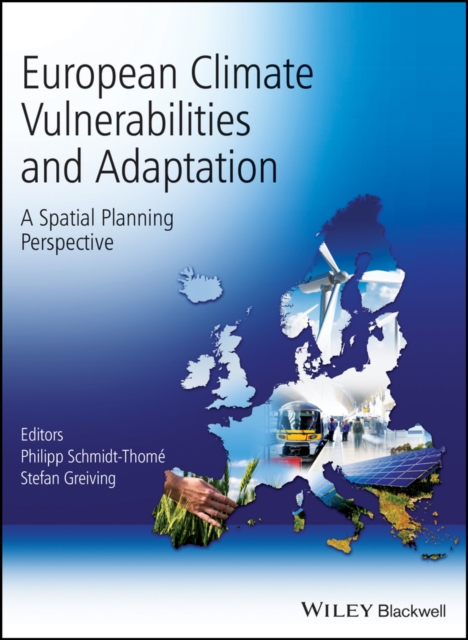
European climate vulnerabilities and adaptation
European Climate Vulnerabilities and Adaptation: A Spatial Planning Perspective analyses the impacts climate change might have on regions and their local economies. Regions clearly differ in view of the complex patterns of climate change impact, but also regarding the given vulnerability and coping capacity.
Impacts of climate change can have a marked effect on the functioning of regions and sectors of the society, if not properly addressed. Readiness to adapt to the impacts and lasting changes counts towards vulnerability of the regions.
The book builds upon the findings of a project conducted under the European observation network for territorial development and cohesion (ESPON), The ESPON Climate project. Following the stipulations of the ESPON programme and the tender for this project the territorial focus is the raison d'être and methodological core of the project as a whole and its various research actions: The outcomes of each action will be focused on what impacts global climate change will have for the different European regions and how the regions can cope with the projected impacts in order to become less vulnerable to climate change.
This book:
* Provides a comprehensive analysis of climate change impacts on 29 European regions and their local economies
* Takes an interdisciplinary approach dealing with the physical, social, economic, environmental, cultural and institutional aspects of climate change vulnerability and the consequences for spatial planning
* Builds on the findings of the ESPON Climate project with a policy focused approach
* Is in full colour throughout with a broad range of case studies
eBook

The triple challenge for Europe : economic development, climate change, and governance
\"Europe is confronted by an intimidating triple challenge--economic stagnation, climate change, and a governance crisis. This book demonstrates how these three challenges are closely inter-related. A return to economic growth cannot come at the expense of greater risk of irreversible climate change. Instead, what is required is a reconceptualization of what is intended by 'economic development' and a fundamental transformation of the economy to a new 'green' trajectory, based on rapidly diminishing emission of greenhouse gases. This entails a much greater emphasis on innovation in all its forms--not just technological. Innovation policy must be placed at the very heart of industrial policy and indeed of economic policy more broadly. Other parts of the world are also facing varying forms of the triple challenge, and while the governance challenge may not be exactly the same as for Europe and the EU, Europe is uniquely placed to take the lead in addressing the triple challenge. While this may well entail certain costs in the short term, it will undoubtedly bring considerable benefits in the longer term.\"-- Provided by publisher.
Book

Adapting to climate change in Eastern Europe and Central Asia / Marianne Fay, Rachel I. Block, Jane Ebinger, editors
The climate is changing, and the Eastern Europe and Central Asia (ECA) region is vulnerable to the consequences. Many of the region's countries are facing warmer temperatures, a changing hydrology, and more extremes, droughts, floods, heat waves, windstorms, and forest fires. This book presents an overview of what adaptation to climate change might mean for Eastern Europe and Central Asia. It starts with a discussion of emerging best-practice adaptation planning around the world and a review of the latest climate projections. It then discusses possible actions to improve resilience organized around impacts on health, natural resources (water, biodiversity, and the coastal environment), the 'unbuilt' environment (agriculture and forestry), and the built environment (infrastructure and housing). The last chapter concludes with a discussion of two areas in great need of strengthening given the changing climate: disaster preparedness and hydro-meteorological services. This book has four key messages: a) contrary to popular perception, Eastern Europe and Central Asia face significant threats from climate change, with a number of the most serious risks already in evidence; b) vulnerability over the next 10 to 20 years is likely to be dominated by socioeconomic factors and legacy issues; c) even countries and sectors that stand to benefit from climate change are poorly positioned to do so; and d) the next decade offers a window of opportunity for ECA countries to make their development more resilient to climate change while reaping numerous co-benefits.
eBook