
Catalogue Search | MBRL


Are you sure you want to remove the book from the shelf?

{{itemTitle}}
7,348
result(s) for
"Climatic changes Political aspects."
Sort by:


Power in a Warming World
After nearly a quarter century of international negotiations on climate change, we stand at a crossroads. A new set of agreements is likely to fail to prevent the global climate's destabilization. Islands and coastlines face inundation, and widespread drought, flooding, and famine are expected to worsen in the poorest and most vulnerable countries. How did we arrive at an entirely inequitable and scientifically inadequate international response to climate change? InPower in a Warming World, David Ciplet, J. Timmons Roberts, and Mizan Khan, bring decades of combined experience as negotiators, researchers, and activists to bear on this urgent question. Combining rich empirical description with a political economic view of power relations, they document the struggles of states and social groups most vulnerable to a changing climate and describe the emergence of new political coalitions that take climate politics beyond a simple North-South divide. They offer six future scenarios in which power relations continue to shift as the world warms. A focus on incremental market-based reform, they argue, has proven insufficient for challenging the enduring power of fossil fuel interests, and will continue to be inadequate without a bolder, more inclusive and aggressive response.
eBook

Hot air : the inside story of the battle against climate change denial / Peter Stott
\" The shocking inside story of the fight to halt climate change over the past twenty-five years by a world-renowned scientist. Ours is the age of global warming. Rising sea levels, extreme weather, forest fires. Dire warnings are everywhere, so why has it taken so long for the crisis to be recognised? Here, for the first time, climate scientist Peter Stott reveals the bitter fight to get international recognition for what, among scientists, has been known for decades: human activity causes climate change. Across continents and against the efforts of sceptical governments, prominent climate change deniers and shadowy lobbyists, Hot Air is the urgent story of how the science was developed, how it has been repeatedly sabotaged and why humanity hasn't a second to spare in the fight to halt climate change\"--Publisher's description.
Book

Eco-republic : what the ancients can teach us about ethics, virtue, and sustainable living
Ancient lessons for sustainable citizenship
An ecologically sustainable society cannot be achieved without citizens who possess the virtues and values that will foster it, and who believe that individual actions can indeed make a difference. Eco-Republic draws on ancient Greek thought—and Plato's Republic in particular—to put forward a new vision of citizenship that can make such a society a reality. Melissa Lane develops a model of a society whose health and sustainability depend on all its citizens recognizing a shared standard of value and shaping their personal goals and habits accordingly. Bringing together the moral and political ideas of the ancients with the latest social and psychological theory, Lane illuminates the individual's vital role in social change, and articulates new ways of understanding what is harmful and what is valuable, what is a benefit and what is a cost, and what the relationship between public and private well-being ought to be.
Eco-Republic reveals why we must rethink our political imagination if we are to meet the challenges of climate change and other urgent environmental concerns. Offering a unique reflection on the ethics and politics of sustainability, the book goes beyond standard approaches to virtue ethics in philosophy and current debates about happiness in economics and psychology. Eco-Republic explains why health is a better standard than happiness for capturing the important links between individual action and social good, and diagnoses the reasons why the ancient concept of virtue has been sorely neglected yet is more relevant today than ever.
eBook

Threatening dystopias : the global politics of climate change adaptation in Bangladesh
\"The political ecology of climate change adaptation is shaped by longer histories of development and agrarian change. In coastal Bangladesh, competing visions of this history and of desirable development trajectories under climate change among practitioners, scientists, and local residents shape different possibilities for the future\"-- Provided by publisher.
Book

Threatened Island Nations
Rising seas are endangering the habitability and very existence of several small island nations, mostly in the Pacific and Indian oceans. This is the first book to focus on the myriad legal issues posed by this tragic situation: if a nation is under water, is it still a state? Does it still have a seat at the United Nations? What becomes of its exclusive economic zone, the basis for its fishing rights? What obligations do other nations have to take in the displaced populations, and what are these peoples' rights and legal status once they arrive? Should there be a new international agreement on climate-displaced populations? Do these nations and their citizens have any legal recourse for compensation? Are there any courts that will hear their claims, and based on what theories? Leading legal scholars from around the world address these novel questions and propose answers.
eBook


Atmospheric justice : a political theory of climate change
When the policies and activities of one country or generation harm both other nations and later generations, they constitute serious injustices. Recognizing the broad threat posed by anthropogenic climate change, advocates for an international climate policy development process have expressly aimed to mitigate this pressing contemporary environmental threat in a manner that promotes justice. Yet, while making justice a primary objective of global climate policy has been the movement's noblest aspiration, it remains an onerous challenge for policymakers. Atmospheric Justice is the first single-authored work of political theory that addresses this pressing challenge via the conceptual frameworks of justice, equality, and responsibility. Throughout this incisive study, Steve Vanderheiden points toward ways to achieve environmental justice by exploring how climate change raises issues of both international and intergenerational justice. In addition, he considers how the design of a global climate regime might take these aims into account. Engaging with the principles of renowned political philosopher John Rawls, he expands on them by factoring in the needs of future generations. Vanderheiden also demonstrates how political theory can contribute to reaching a better understanding of the proper human response to climate change. By showing how climate policy offers insights into resolving contemporary controversies within political theory, he illustrates the ways in which applying normative theory to policy allows us to better understand both. Thoroughly researched and persuasively argued, Atmospheric Justice makes an important step toward providing us with a set of carefully elaborated first principles for achieving environmental justice.
eBook

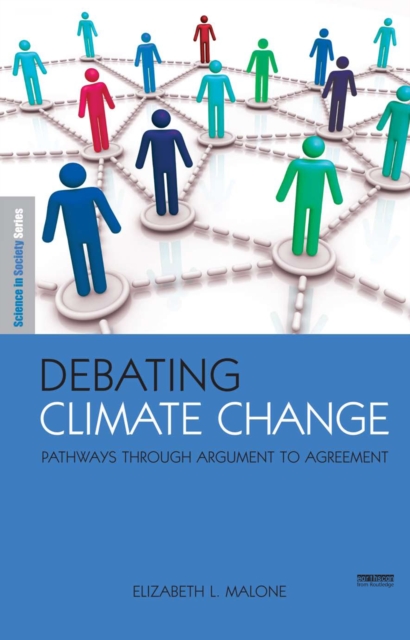
Debating climate change
As greenhouse gas emissions continue unabated and contentious voices fill the air, the question gains urgency: How can people with widely varying viewpoints agree to address climate change? Each participant in the debate seems to have a different agenda, from protecting economic growth in developing countries to protecting the energy industry in industrialized countries, from those aghast at the damage done to the Earth to optimists who think we just need to adjust our technological approach.
Debating Climate Change sorts through the tangle of arguments surrounding climate change to find paths to unexpected sites of agreement. Using an innovative sociological approach - combined discourse and social network analyses - Elizabeth L. Malone analyzes 100 documents representing a range of players in this high-stakes debate. Through this she shows how even the most implacable adversaries can find common ground - and how this common ground can be used to build agreement.
Written in a clear, accessible style, this original research and insightful use of communication analysis will help advance understanding and negotiation on climate change throughout the pivotal times to come.
Published with Science in Society
eBook