
Catalogue Search | MBRL


Are you sure you want to remove the book from the shelf?

{{itemTitle}}
1,881
result(s) for
"Climatic changes Prevention"
Sort by:

The 100% solution : a plan for solving climate change
Most experts agree that we need to get to negative greenhouse gas emissions worldwide by the year 2050 in order to stave off the most catastrophic effects of climate change. It's a colossal challenge, but despite a lot of outright cynicism, it is possible. This is not a problem that can be solved halfway, however, or even 95% of the way. Yet no proposal is currently on the table that specifically addresses the full scope of solutions. This is why we need Solomon Goldstein-Rose's book, The 100% Solution.
Book


The clean energy age
It’s time for a new approach to environmentalism that focusses on practical solutions rather than problems and speaks to ordinary citizens in simple terms. This clear, positive, and non-partisan guidebook offers Top 10 lists that will help individuals and organizations save money while taking aim at the source of most of our carbon emissions. Reviewing proven and unproven technologies and government programs, it explores opportunities for homeowners, governments, corporations, media, and others. While BF Nagy evaluates clean technology progress to date, he does not dwell on doom and gloom, seek to shame or scold, or propose unlikely overnight lifestyle upheavals. Instead he prioritizes everyday actions and reviews the paybacks and effectiveness of clean building technologies and vehicles, government/utility incentives, and finance structures. Organized for both quick reference and deep dives into the nuts and bolts of saving the plant from environmental ruin, The Clean Energy Age contains specific sections for individuals and organizations using appropriate language and exploring current trends and issues for homeowners, regional and local governments, small businesses, large corporations, investors, politicians, civil servants, urban planners, media people, entertainers, teachers, transportation people, medical professionals, manufacturers, farmers, and others. In addition to technology and government programs it reviews current clean tech business and economic realities and insights into what we can expect in the future. It explores electric vehicles, net-zero smart homes, the Internet of things, smart grids, solar, wind, and geothermal. Each Top 10 list offers detailed explanations as well as a simple, summary format. Other chapters on buildings, electricity, transportation, investment, business, politics & economics, government, and unproven technologies, provide support for the information found in the Top 10 lists and success stories accumulated during consultations with clean technology, government and business specialists. Organized for easy-access by people in different segments, there is something for everyone looking to combat climate change in these pages.
eBook

Environmentalism from below : how global people's movements are leading the fight for our planet
\"Environmentalism from Below takes readers inside the popular struggles for environmental liberation in the Global South. These communities--among the most vulnerable to but also least responsible for the climate crisis--have long been at the forefront of the fight to protect imperiled worlds. Today, as the world's forests burn and our oceans acidify, grassroots movements are tenaciously defending the environmental commons and forging just and sustainable ways of living on Earth. Scholar and activist Ashley Dawson constructs a gripping narrative of these movements of climate insurgents, from international solidarity organizations like La Via Campesina and Shack Dwellers International to local struggles in South Africa, Colombia, India, Nigeria, and beyond. Taking up the four critical challenges we face in a warming world--food, urban sustainability, energy transition, and conservation--Dawson shows how the unruly power of environmentalism from below is charting an alternative path forward, from challenging industrial agriculture through fights for food sovereignty and agroecology to resisting extractivism using mass nonviolent protest and sabotage\"-- Amazon.
Book

Solutions to climate change challenges in the built environment
\"The multi-disciplinary perspective provided here offers a strategic view on built environment issues and improve understanding of how built environment activities potentially induce global warming and climate change. It also highlights solutions to these challenges. Solutions to Climate change Challenges in the Built Environment helps develop an appreciation of the diverse themes of the climate change debate across the built environment continuum. A wide perspective is provided through contributions from physical, environmental, social, economic and political scientists. This strategic view on built environment issues will be useful to researchers as well as policy experts and construction practitioners wanting a holistic view. This book clarifies complex issues around climate change and follows five main themes: climate change experiences; urban landscape development; urban management issues; measurement of impact; and the future. Chapters are written by eminent specialists from both academic and professional backgrounds. The main context for chapters is the developed world but the discussion is widened to incorporate regional issues. The book will be valuable to researchers and students in all the built environment disciplines, as well as to practitioners involved with the design, construction and maintenance of buildings, and government organisations developing and implementing climate change policy\"--
eBook


Energy and the New Reality 1: Energy Efficiency and the Demand for Energy Services
Reducing and managing humanity's demand for energy is a fundamental part of the effort to mitigate climate change. In this, the most comprehensive textbook ever written on the subject, L.D. Danny Harvey lays out the theory and practice of how things must change if we are to meet our energy needs sustainably. The book begins with a succinct summary of the scientific basis for concern over global warming, then outlines energy basics and current patterns and trends in energy use. This is followed by a discussion of current and advanced technologies for the generation of electricity from fossil fuels. The book then considers in detail how energy is used, and how this use can be dramatically reduced, in the following end-use sectors:
buildings
transportation
industry
food and agriculture
municipal services
The findings from these sector-by-sector assessments are then applied to generate scenarios of how global energy demand could evolve over the coming decades with full implementation of the identified and economically-feasible energy-saving potential. The book ends with a brief discussion of policies that can be used to reduce energy demand, but also addresses the limits of technologically-based improvements in efficiency in moderating demand and of the need to re-think some of our underlying assumptions concern ends with a brief discusing what we really need. Along with its companion volume on C-free energy supply, and accompanied by extensive supplementary online material, this is an essential resource for students and practitioners in engineering, architecture, environment and energy related fields.
Online material includes: Excel-based computational exercises, teaching slides for each chapter, links to free software tools.
eBook
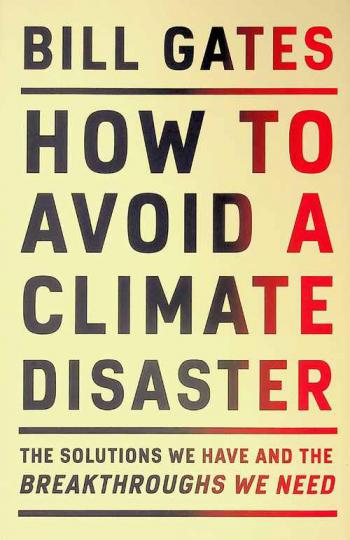
How to avoid a climate disaster : the solutions we have and the breakthroughs we need
In this urgent, authoritative book, Bill Gates sets out a wide-ranging, practical - and accessible - plan for how the world can get to zero greenhouse gas emissions in time to avoid a climate catastrophe. Bill Gates has spent a decade investigating the causes and effects of climate change. With the help of experts in the fields of physics, chemistry, biology, engineering, political science, and finance, he has focused on what must be done in order to stop the planet's slide to certain environmental disaster. In this book, he not only explains why we need to work toward net-zero emissions of greenhouse gases, but also details what we need to do to achieve this profoundly important goal. He gives us a clear-eyed description of the challenges we face. Drawing on his understanding of innovation and what it takes to get new ideas into the market, he describes the areas in which technology is already helping to reduce emissions, where and how the current technology can be made to function more effectively, where breakthrough technologies are needed, and who is working on these essential innovations. Finally, he lays out a concrete, practical plan for achieving the goal of zero emissions - suggesting not only policies that governments should adopt, but what we as individuals can do to keep our government, our employers, and ourselves accountable in this crucial enterprise. As Bill Gates makes clear, achieving zero emissions will not be simple or easy to do, but if we follow the plan he sets out here, it is a goal firmly within our reach. -- From dust jacket.
Book

Limiting the Magnitude of Future Climate Change
Climate change, driven by the increasing concentration of greenhouse gases in the atmosphere, poses serious, wide-ranging threats to human societies and natural ecosystems around the world. The largest overall source of greenhouse gas emissions is the burning of fossil fuels. The global atmospheric concentration of carbon dioxide, the dominant greenhouse gas of concern, is increasing by roughly two parts per million per year, and the United States is currently the second-largest contributor to global emissions behind China.
Limiting the Magnitude of Future Climate Change , part of the congressionally requested America's Climate Choices suite of studies, focuses on the role of the United States in the global effort to reduce greenhouse gas emissions. The book concludes that in order to ensure that all levels of government, the private sector, and millions of households and individuals are contributing to shared national goals, the United States should establish a \"budget\" that sets a limit on total domestic greenhouse emissions from 2010-2050. Meeting such a budget would require a major departure from business as usual in the way the nation produces and uses energy-and that the nation act now to aggressively deploy all available energy efficiencies and less carbon-intensive technologies and to develop new ones.
With no financial incentives or regulatory pressure, the nation will continue to rely upon and \"lock in\" carbon-intensive technologies and systems unless a carbon pricing system is established-either cap-and-trade, a system of taxing emissions, or a combination of the two. Complementary policies are also needed to accelerate progress in key areas: developing more efficient, less carbon-intense energy sources in electricity and transportation; advancing full-scale development of new-generation nuclear power, carbon capture, and storage systems; and amending emissions-intensive energy infrastructure. Research and development of new technologies that could help reduce emissions more cost effectively than current options is also strongly recommended.
eBook