
Catalogue Search | MBRL


Are you sure you want to remove the book from the shelf?

{{itemTitle}}
9
result(s) for
"Clothing and dress Social aspects Asia."
Sort by:


Appearance Politics
Lex Lu argues in Appearance
Politics that crafting an appealing and
powerful outward image has long been an essential political
instrument in China. Its traces may be found in historical
records, imperial portraits, physiognomic prognostications,
photographs, posters, statues, and digital images. Employing rare
archival materials from Beijing, Shanghai, and Nanjing, Lu tells
the story of these political maneuverings. We learn the ways in
which political actors and their agents designed their images, and
we observe the shifting standards of male beauty that guided their
decisions.
Appearance Politics examines five case studies: the
usurpation of Ming Prince Zhu Di; the rise of Manchu masculinity
and its mixed standards of Han Chinese and Manchu beauty at the
Yongzheng court; the use of modern photography and Western male
beauty standards at the turn of the twentieth century; the making
of the Republican founding father Sun Yat-sen; and the creation of
visual templates of Mao Zedong. Lu's rich empirical study counters
systematic stereotypical descriptions of Chinese male leadership
embedded in Western media and scholarship.
eBook

Fashion, identity, and power in modern Asia
This edited volume on radical dress reforms in East Asia takes a fresh look at the symbols and languages of modernity in dress and body. Dress reform movements around the turn of the twentieth century in the region have received little critical attention as a multicultural discourse of labor, body, gender identity, colonialism, and government authority. With contributions by leading experts of costume/textile history of China, Korea, and Japan, this book presents up-to-date scholarship using diverse methodologies in costume history, history of consumption, and international trade. 0Thematically organized into sections exploring the garments and uniforms, accessories, fabrics, and fashion styles of Asia, this edited volume offers case studies for students and scholars in an ever-expanding field of material culture including, but not limited to, economic history, visual culture, art history, history of journalism, and popular culture. Fashion, Identity, and Power in Modern Asia stimulates further research on the impact of modernity and imperialism in neglected areas such as military uniform, school uniform, women?s accessories, shoe manufacturing, and textile trade.
Book

The Social Life of Kimono
The kimono is an iconic garment with a history as rich and colourful as the textiles from which it is crafted. Deeply associated with Japanese culture both past and present, it has often been thought of as a highly gendered, rigidly traditional, and unchanging national costume. This book challenges that perception, revealing the nuanced meanings and messages behind the kimono from the point of view of its wearers and producers, many of whom – both men and women – see the garment as a vehicle for self-expression. Taking a material culture approach, The Social Life of Kimono is the first study to combine the history of the kimono as a fashionable garment with an in-depth exploration of its multifaceted role today on both the street and the catwalk. Through case studies covering historical advertising campaigns, fashion magazines, interviews with contemporary kimono designers, large scale and small craft producers, and consumers who choose to wear them, The Social Life of Kimono gives a unique insight into making and meaning of this complex garment.
eBook

The social life of kimono : Japanese fashion past and present
\"The kimono is an iconic garment with a history as rich and colourful as the textiles from which it is crafted. Deeply associated with Japanese culture both past and present, it has often been thought of as a highly gendered, rigidly traditional and unchanging national costume. This book challenges that perception, revealing the nuanced meanings and messages behind the kimono from the point of view of its wearers and producers, many of whom - both men and women - see the garment as a vehicle for self-expression. Taking a material culture approach, The Social Life of Kimono is the first study to combine the history of the kimono as a fashionable garment with an in-depth exploration of its multifaceted role today on both the street and the catwalk. Through case studies covering historical advertising campaigns, fashion magazines, interviews with contemporary kimono designers, large scale and small craft producers, and consumers who choose to wear them, The Social Life of Kimono gives a unique insight into making and meaning of this complex garment\"-- Provided by publisher.
Book
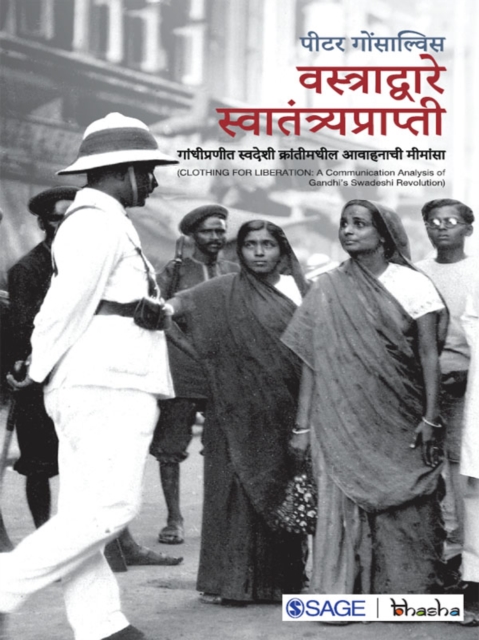
Vastradware Swatantrayaprapti: Gandhipraneet Swadeshi Krantimadheel Aavahanachi Meemansa
This is the first analysis of Gandhi's dressing style in terms of communication theory and an exploration of the subliminal messages that were subtly communicated to a large audience. Peter Gonsalves chooses three famous theorists from the field of communication studies and looks at Gandhi through the lens of each one, to give us a fascinating and new insight into one of the most famous men from South Asia. The author first prepares the ground for the theoretical investigation by exploring the breadth of Gandhi's communication skills. He provides essential information on a wide range of Gandhi's communication skills, with a view to proposing interesting areas of research for communication scholars. The book deals with the qualitative and quantitative aspects of Gandhi's verbal output, his linguistic capacity, his journalistic and letter-writing style, his peace communication in an atmosphere of conflict, his organizational ability and the international repercussions of his mass mediated messages. It also elaborates the different types of non-verbal communication he used, such as silence, fasting, clothing, personal presence and charisma. The book closes with, perhaps for the first time, a Gandhian approach to symbolisation for socio-political change.Photographs of Gandhi in different phases of his life have been used to provide a visual chronology of sartorial change and emphasise the arguments in the book.
eBook

Couture Korea
\"Couture Korea highlights traditional ways of dressing and shows how contemporary haute couture is rooted in Korean tradition. Through garments including baeja (woman's vest), po (man's outerwear), and baegilbok (child's costume for the 100th-day celebration), this Korean fashion book explores how each gender dressed during different seasons, on special occasions, and according to social status. Interviews with contemporary fashion designers Jin Teok and Karl Lagerfeld and historians Minjee Kim and Cho Hyo Sook examine how historic and contemporary clothing design reinvigorates Korean cultural identity\"-- Provided by publisher.
Book

Cinderella's Sisters
The history of footbinding is full of contradictions and unexpected turns. The practice originated in the dance culture of China's medieval court and spread to gentry families, brothels, maid's quarters, and peasant households. Conventional views of footbinding as patriarchal oppression often neglect its complex history and the incentives of the women involved. This revisionist history, elegantly written and meticulously researched, presents a fascinating new picture of the practice from its beginnings in the tenth century to its demise in the twentieth century. Neither condemning nor defending foot-binding, Dorothy Ko debunks many myths and misconceptions about its origins, development, and eventual end, exploring in the process the entanglements of male power and female desires during the practice's thousand-year history.Cinderella's Sistersargues that rather than stemming from sexual perversion, men's desire for bound feet was connected to larger concerns such as cultural nostalgia, regional rivalries, and claims of male privilege. Nor were women hapless victims, the author contends. Ko describes how women-those who could afford it-bound their own and their daughters' feet to signal their high status and self-respect. Femininity, like the binding of feet, was associated with bodily labor and domestic work, and properly bound feet and beautifully made shoes both required exquisite skills and technical knowledge passed from generation to generation. Throughout her narrative, Ko deftly wields methods of social history, literary criticism, material culture studies, and the history of the body and fashion to illustrate how a practice that began as embodied lyricism-as a way to live as the poets imagined-ended up being an exercise in excess and folly.
eBook

Kimono and the Construction of Gendered and Cultural Identities
This article argues that the distinction between Japanese and Western attire is a part of the process of the construction of gendered and cultural identities in modern Japan. Kimono in modern Japan has been invented as national attire and as a marked feminine costume. Women have become models of Japanese femininity, as contrasted with men, who have been given the role of models for rational action and achievement. The article follows this dynamic process in modern Japan, and more particularly analyzes the process of producing young women for their coming-of-age ceremony.
Journal Article