
Catalogue Search | MBRL


Are you sure you want to remove the book from the shelf?

{{itemTitle}}
808,447
result(s) for
"Codes"
Sort by:
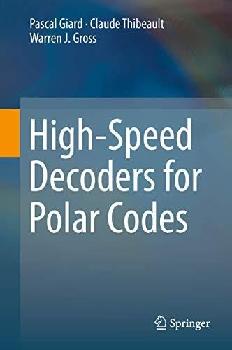
High-speed decoders for polar codes
A new class of provably capacity achieving error-correction codes, polar codes are suitable for many problems, such as lossless and lossy source coding, problems with side information, multiple access channel, etc. The first comprehensive book on the implementation of decoders for polar codes, the authors take a tutorial approach to explain the practical decoder implementation challenges and trade-offs in either software or hardware. They also demonstrate new trade-offs in latency, throughput, and complexity in software implementations for high-performance computing and GPGPUs, and hardware implementations using custom processing elements, full-custom application-specific integrated circuits (ASICs), and field-programmable-gate arrays (FPGAs). Presenting a good overview of this research area and future directions, High-Speed Decoders for Polar Codes is perfect for any researcher or SDR practitioner looking into implementing efficient decoders for polar codes, as well as students and professors in a modern error correction class. As polar codes have been accepted to protect the control channel in the next-generation mobile communication standard (5G) developed by the 3GPP, the audience includes engineers who will have to implement decoders for such codes and hardware engineers designing the backbone of communication networks.
Book

Three-word codes a,aba,u and a,ab,v having finite completions
Does every three-word code have a finite completion? Up to now, this famous question in the theory of codes remains open. Motivated by this problem, we construct several types of three-word codes with the form a,aba,u and a,ab,v which have finite completions.
Journal Article

The leggings revolt
\"Eric and his buddies have left behind their all boys school to attend high school with girls. Eager to find his place in this exciting new world, Eric joins the student life committee, unaware that he is expected to enforce the school's strict dress code. The dress code is particularly harsh on the girls he is keen to get to know. Eric finds this awkward, but it's nothing compared to the position he finds himself in when the whole school revolts.\"--Provided by publisher.
Book

The minimum locality of linear codes
Locally recoverable codes (LRCs) were proposed for the recovery of data in distributed and cloud storage systems about nine years ago. A lot of progress on the study of LRCs has been made by now. However, there is a lack of general theory on the minimum locality of linear codes. In addition, the minimum locality of many known families of linear codes has not been studied in the literature. Motivated by these two facts, this paper develops some general theory about the minimum locality of linear codes, and investigates the minimum locality of a number of families of linear codes, such as
q
-ary Hamming codes,
q
-ary Simplex codes, generalized Reed-Muller codes, ovoid codes, maximum arc codes, the extended hyperoval codes, and near MDS codes. Many classes of both distance-optimal and dimension-optimal LRCs are presented in this paper. To this end, the concepts of linear locality and minimum linear locality are specified. The minimum linear locality of many families of linear codes are settled with the general theory developed in this paper.
Journal Article

Euclidean and Hermitian LCD MDS codes
Linear codes with complementary duals (abbreviated LCD) are linear codes whose intersection with their dual is trivial. When they are binary, they play an important role in armoring implementations against side-channel attacks and fault injection attacks. Non-binary LCD codes in characteristic 2 can be transformed into binary LCD codes by expansion. On the other hand, being optimal codes, maximum distance separable codes (abbreviated MDS) are of much interest from many viewpoints due to their theoretical and practical properties. However, little work has been done on LCD MDS codes. In particular, determining the existence of q-ary [n, k] LCD MDS codes for various lengths n and dimensions k is a basic and interesting problem. In this paper, we firstly study the problem of the existence of q-ary [n, k] LCD MDS codes and solve it for the Euclidean case. More specifically, we show that for q>3 there exists a q-ary [n, k] Euclidean LCD MDS code, where 0≤k≤n≤q+1 , or, q=2m , n=q+2 and k=3orq-1 . Secondly, we investigate several constructions of new Euclidean and Hermitian LCD MDS codes. Our main techniques in constructing Euclidean and Hermitian LCD MDS codes use some linear codes with small dimension or codimension, self-orthogonal codes and generalized Reed-Solomon codes.
Journal Article


Algebra and coding theory : virtual conference in honor of Tariq Rizvi, Noncommutative rings and their Applications VII, July 5-7, 2021, Université d'Artois, Lens, France ; virtual conference on Quadratic forms, rings and codes, July 8, 2021, Université d'Artois, Lens, France
This volume contains the proceedings of the Virtual Conference on Noncommutative Rings and their Applications VII, in honor of Tariq Rizvi, held from July 5-7, 2021, and the Virtual Conference on Quadratic Forms, Rings and Codes, held on July 8, 2021, both of which were hosted by the Universite d'Artois, Lens, France.The articles cover topics in commutative and noncommutative algebra and applications to coding theory. In some papers, applications of Frobenius rings, the skew group rings, and iterated Ore extensions to coding theory are discussed. Other papers discuss classical topics, such as Utumi rings, Baer rings, nil and nilpotent algebras, and Brauer groups. Still other articles are devoted to various aspects of the elementwise study for rings and modules. Lastly, this volume includes papers dealing with questions in homological algebra and lattice theory. The articles in this volume show the vivacity of the research of noncommutative rings and its influence on other subjects.
eBook

Constructions of good entanglement-assisted quantum error correcting codes
Entanglement-assisted quantum error correcting codes (EAQECCs) are a simple and fundamental class of codes. They allow for the construction of quantum codes from classical codes by relaxing the duality condition and using pre-shared entanglement between the sender and receiver. However, in general it is not easy to determine the number of shared pairs required to construct an EAQECC. In this paper, we show that this number is related to the hull of the classical code. Using this fact, we give methods to construct EAQECCs requiring desirable amounts of entanglement. This allows for designing families of EAQECCs with good error performance. Moreover, we construct maximal entanglement EAQECCs from LCD codes. Finally, we prove the existence of asymptotically good EAQECCs in the odd characteristic case.
Journal Article