
Catalogue Search | MBRL


Are you sure you want to remove the book from the shelf?

{{itemTitle}}
8
result(s) for
"Coffeehouses -- Austria -- Vienna"
Sort by:

The viennese café and fin-de-siècle culture
The Viennese café was a key site of urban modernity around 1900. In the rapidly growing city it functioned simultaneously as home and workplace, affording opportunities for both leisure and intellectual exchange. This volume explores the nature and function of the coffeehouse in the social, cultural, and political world of fin-de-siècle Vienna. Just as the café served as a creative meeting place within the city, so this volume initiates conversations between different disciplines focusing on Vienna at the beginning of the twentieth century. Contributions are drawn from the fields of social and cultural history, literary studies, Jewish studies and art, and architectural and design history. A fresh perspective is also provided by a selection of comparative articles exploring coffeehouse culture elsewhere in Eastern Europe.
eBook
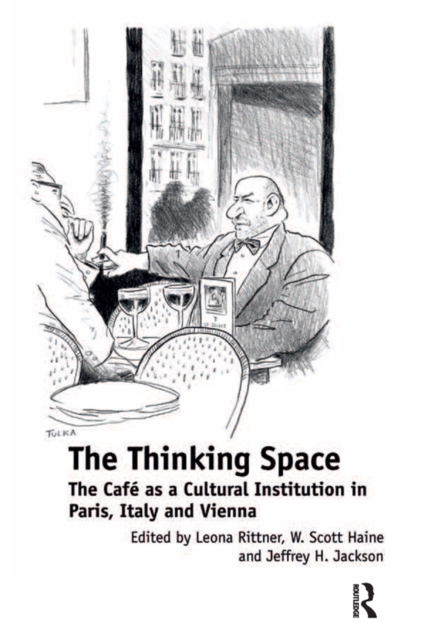
The Thinking Space
The cafe is not only a place to enjoy a cup of coffee, it is also a space - distinct from its urban environment - in which to reflect and take part in intellectual debate. Since the eighteenth century in Europe, intellectuals and artists have gathered in cafes to exchange ideas, inspirations and information that has driven the cultural agenda for Europe and the world. Without the café, would there have been a Karl Marx or a Jean-Paul Sartre? The café as an institutional site has been the subject of renewed interest amongst scholars in the past decade, and its role in the development of art, ideas and culture has been explored in some detail. However, few have investigated the ways in which cafés create a cultural and intellectual space which brings together multiple influences and intellectual practices and shapes the urban settings of which they are a part. This volume presents an international group of scholars who consider cafés as sites of intellectual discourse from across Europe during the long modern period. Drawing on literary theory, history, cultural studies and urban studies, the contributors explore the ways in which cafes have functioned and evolved at crucial moments in the histories of important cities and countries - notably Paris, Vienna and Italy. Choosing these sites allows readers to understand both the local particularities of each café while also seeing the larger cultural connections between these places. By revealing how the café operated as a unique cultural context within the urban setting, this volume demonstrates how space and ideas are connected. As our global society becomes more focused on creativity and mobility the intellectual cafés of past generations can also serve as inspiration for contemporary and future knowledge workers who will expand and develop this tradition of using and thinking in space.
eBook

Jewish Modernism and Viennese Cafés, 1900–1930
The Cafés of Vienna during the first three decades of the twentieth century highlight many of the elements of the Café as a third space, as well as the tangled relationship between Café culture, modernism, and Jewishness. At the turn of the century, Vienna became one of the most important centers of modernism in literature, philosophy, art, and architecture. And at the same time that the Viennese Café was in its heyday as a commercial and cultural institution. The world of the Viennese Café has usually been described in writings of acculturated Jews such as Schnitzler, Roth, Torberg, Polgar, and Zweig, who are well-known in Austrian and international modernism. The Viennese Kaffeehaus proved to be the place that brought these immigrant writers, artists, and intellectuals together and opened new paths for them. Indeed, Vienna fostered close collaboration between Hebrew and Yiddish writers at a time when these two literatures were gradually separating from each other for ideological and political reasons.
The caf was transformed from an urban curiosity at its inception in 1686 to an institution of everyday life, with the existence of several hundred in Paris by the 1740's. It was a part of the theater of everyday life, which held a unique dangerno one could fully anticipate the direction of the next performance. Despite the presence of aristocrats and clerics, the caf was a forward-looking institution exempt from courtly protocols. The caf evolved in tandem with the state's regulatory and disciplinary functions, both in licensing different types of public drinking establishments and in the surveillance of writing and speech. The Enlightenment caf draws scholarly attention precisely because its representation in literary sources of the period point to later-century forms of sociability and democratic expression to which the caf space was central. The caf's recurrence, rhetorically, in tales of sedition and Enlightenment indicates the important place that it held in the collective imaginary about speaking and subjectivity.
Book Chapter

SPECIAL EUROPE SECTION: delicious moments: Coffeehouses of Vienna, Prague and Budapest are brimming with culture and reasons to linger
Photo Gerbeaud slices --- layers of firm pastry, nuts and apricot jam topped with chocolate --- are guaranteed to be diet-breakers. / KELLY BUGDEN / \"Kaffeehaus\" (Clarkson Potter) Graphic IF YOU GO Getting there > Air France, Delta, Lufthansa and United airlines offer flights to Vienna for around $600. Train service between Vienna, Prague and Budapest is frequent and inexpensive. Hydrofoil service on the Danube also connects Budapest and Vienna. > Visas: If you are a United States citizen, you don't need visas for Austria, Hungary or the Czech Republic. If you are a Canadian citizen, you must have a visa to enter the Czech Republic. We weren't aware of this little factoid and found ourselves getting thrown off a train at the Czech-Austrian border (my wife is Canadian), only to catch a local back to Vienna. The reason? Canada imposed a visa requirement on Czech nationals to abate the flow of Romany (Gypsy) refugees, and the Czechs responded in turn. Where to stay > In Vienna: Hotel-Pension Continental, Mariahilferstrasse 50; phone: 43 1 523 24 18; www.hotel-continental.at. It's buyer beware at Vienna's overpriced hotels, but this little charmer is a bargain. Located on the upper floors of an apartment/office building just off a major shopping artery, it's right on a useful U-Bahn stop, and is only 10 minutes by foot from the Hofburg and the Museum of Fine Arts. We rented a spacious two-room suite with a large living room and bath for about $150 per night (continental breakfast included) that comfortably accommodated our family of five. We discovered it after doing a walking survey of the area pensions and promptly canceled our reservation elsewhere. > In Prague: Flathotel ORION, Americka 9, Vinohrady; phone: 420 02 22521700; www.abaka.com/Czech/Orion. An excellent choice for families travelling on a budget. For about $90 a night, you get the kind of apartment you could move into --- two spacious bedrooms, a living room with a groovy vinyl sectional sofa and a full kitchen with a dining table. There are many nice food shops and non- touristy restaurants in this quiet, residential area, and the front desk stocks a few kitchen essentials (and non-essentials, like iced champagne). The Old City is 10 minutes away by tram or subway. > In Budapest: Hotel Fiesta, Kiraly Utca 20; phone: 36 1 266 6021; www.hotelfiesta.hu. This exceedingly peculiar but not uncomfortable hotel is about a 10-minute walk from the pedestrian malls of Pest. It apparently set out to be an edgy, modernist renovation of an old block apartment building, but construction took a funny turn. Look for stark rooms with bunches of wiring jutting from cutouts in the walls, paper room numbers taped to the doors, electric keys that will choose to confound you every time you're rushing to the bathroom and an elevator through the atrium that shudders and lurches like a communist-era statue come to life. But the friendly young staff and ample air conditioning make up for its deficits. There comes a point in Hungary when you can't bear the sight of another whirring fan. About $100 a night for a large suite. Photo The Staubs, proprietors of Cafe Sperl in Vienna, offer the ultimate Kaffeehaus experience in a classic that dates to 1880.
Newspaper Article
Lingering in a cafe is a treasured tradition for Viennese
Within Vienna, you'll find a colorful pub on nearly every street corner, filled with poetry teachers and their students, couples loving without touching, housewives on their way home from cello lessons and waiters who enjoy serving hearty, affordable food and drinks.
Newspaper Article
Vienna Opens Cat Cafe
\"Vienna is one of the world's greatest cities. It is well known for its charming cafés. In Vienna, people spend lots of time relaxing at cafes. There, they drink coffee, eat pastries, read, and chat with their friends. But customers at the new Cafe Neko get to do more than that--they can interact with the cafe's five feline residents. Sonja, Thomas, Moritz, Luca, and Momo are cats that were rescued from a local animal shelter. They spend their days roaming around the Cafe Neko, and enjoying the attention of its customers.\" (NewsCurrents Read to Know) Learn more about this cat cafe in Vienna. The role of cats in human histrory is detailed.
Magazine Article

Off the Beaten Track / Vienna, Austria
The Classic: Aida is a much-loved local chain where many of the interiors resemble 1950s diners, with mirrored walls and counter seating (Stock-im-Eisen-Platz 2 and elsewhere, Tel. 512-2977, www.aida.at). The coffee-and-cake shop Demel claims to be one of only two establishments possessing the true recipe for sachertorte, the chocolate-on-chocolate treat that is Vienna's most famous desert. (Kohlmarkt 14, Tel. 535-1717, www.demel.at).
Newspaper Article