
Catalogue Search | MBRL


Are you sure you want to remove the book from the shelf?

{{itemTitle}}
2
result(s) for
"Coffeehouses France Paris History 20th century."
Sort by:

Europeanising spaces in Paris, c. 1947-1962
\"In the wake of the Second World War, ideas of Europe abounded. What did Europe mean as a concept, and what did it mean to be European? Europeanising Spaces in Paris, c. 1947-1962 makes the case that Paris was both a leading and distinctive forum for the expression of these ideas in the post-war period. It examines spaces in the French capital in which ideas about Europe were formulated, articulated, exchanged, circulated, and contested during this post-war period, roughly between the escalation of the Cold War and the end of France's war of decolonisation in Algeria. Such processes of making sense of Europe are elucidated in urban, political and cultural spaces in the French capital. Specifically, the Parisian cafâe, home and street are each examined in terms of how they were implicated in ideas about Europe. Then, the Paris-based Mouvement socialiste des âetats unis d'Europe (The Socialist Movement for the United States of Europe) and the far-right wing Fâedâeration des âetudiants nationalistes (The Federation of Nationalist Students) are examined as examples of political movements that mobilised around--very different--concepts of Europe. The final section on cultural Europeanising spaces draws attention to the specificities of the Europeanism of exiles from Franco's Spain in Paris; the work of the great scholar of the Arab world, Jacques Berque, in the context of his understanding of the Mediterranean world and his understanding of faith; and finally, the work of the legendary photographer, Henri Cartier-Bresson, by looking at the capacities and limitations of the photographic medium for the representation of Europe, and how these corresponded with Cartier-Bresson's political, social, and aesthetic commitments\"--Publisher description.
Book
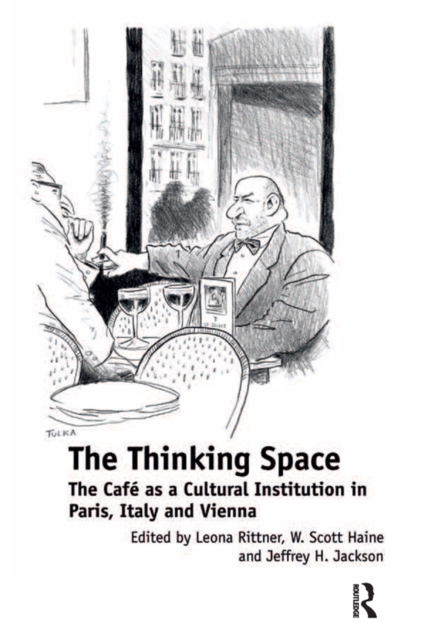
The Thinking Space
The cafe is not only a place to enjoy a cup of coffee, it is also a space - distinct from its urban environment - in which to reflect and take part in intellectual debate. Since the eighteenth century in Europe, intellectuals and artists have gathered in cafes to exchange ideas, inspirations and information that has driven the cultural agenda for Europe and the world. Without the café, would there have been a Karl Marx or a Jean-Paul Sartre? The café as an institutional site has been the subject of renewed interest amongst scholars in the past decade, and its role in the development of art, ideas and culture has been explored in some detail. However, few have investigated the ways in which cafés create a cultural and intellectual space which brings together multiple influences and intellectual practices and shapes the urban settings of which they are a part. This volume presents an international group of scholars who consider cafés as sites of intellectual discourse from across Europe during the long modern period. Drawing on literary theory, history, cultural studies and urban studies, the contributors explore the ways in which cafes have functioned and evolved at crucial moments in the histories of important cities and countries - notably Paris, Vienna and Italy. Choosing these sites allows readers to understand both the local particularities of each café while also seeing the larger cultural connections between these places. By revealing how the café operated as a unique cultural context within the urban setting, this volume demonstrates how space and ideas are connected. As our global society becomes more focused on creativity and mobility the intellectual cafés of past generations can also serve as inspiration for contemporary and future knowledge workers who will expand and develop this tradition of using and thinking in space.
eBook