
Catalogue Search | MBRL


Are you sure you want to remove the book from the shelf?

{{itemTitle}}
555
result(s) for
"Cognition and culture History."
Sort by:


How ancient Europeans saw the world
The peoples who inhabited Europe during the two millennia before the Roman conquests had established urban centers, large-scale production of goods such as pottery and iron tools, a money economy, and elaborate rituals and ceremonies. Yet as Peter Wells argues here, the visual world of these late prehistoric communities was profoundly different from those of ancient Rome's literate civilization and today's industrialized societies. Drawing on startling new research in neuroscience and cognitive psychology, Wells reconstructs how the peoples of pre-Roman Europe saw the world and their place in it. He sheds new light on how they communicated their thoughts, feelings, and visual perceptions through the everyday tools they shaped, the pottery and metal ornaments they decorated, and the arrangements of objects they made in their ritual places--and how these forms and patterns in turn shaped their experience.
How Ancient Europeans Saw the Worldoffers a completely new approach to the study of Bronze Age and Iron Age Europe, and represents a major challenge to existing views about prehistoric cultures. The book demonstrates why we cannot interpret the structures that Europe's pre-Roman inhabitants built in the landscape, the ways they arranged their settlements and burial sites, or the complex patterning of their art on the basis of what these things look like to us. Rather, we must view these objects and visual patterns as they were meant to be seen by the ancient peoples who fashioned them.
eBook
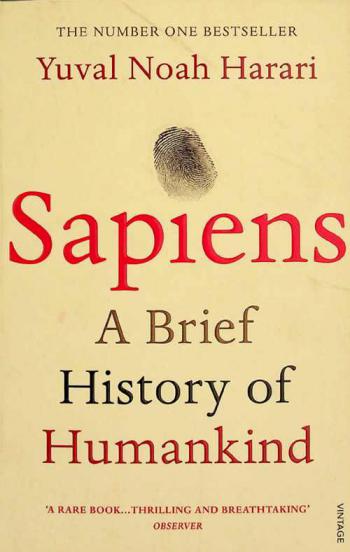
Sapiens : a brief history of humankind
100,000 years ago, at least six species of human inhabited the earth. Today there is just one. Us. Homo Sapiens. How did our species succeed in the battle for dominance ? Why did our foraging ancestors come together to create cities and kingdoms ? How did we come to believe in gods, nations, and human rights; to trust money, books, and laws; and to be enslaved by bureaucracy, timetables, and consumerism? And what will our world be like in the millennia to come ? In Sapiens, Dr. Yuval Noah Harari spans the whole of human history, from the very first humans to walk the earth to the radical -- and sometimes devastating -- breakthroughs of the Cognitive, Agricultural, and Scientific Revolutions. Drawing on insights from biology, anthropology, palaeontology, and economics, he explores how the currents of history have shaped our human societies, the animals and plants around us, and even our personalities. Have we become happier as history has unfolded ? Can we ever free our behaviour from the heritage of our ancestors ? And what, if anything, can we do to influence the course of the centuries to come ? Bold, wide-ranging and provocative, Sapiens challenges everything we thought we knew about being human: our thoughts, our actions, our power ... and our future.
Book

Minds make societies : how cognition explains the world humans create
A scientist integrates evolutionary biology, genetics, psychology, economics, and more to explore the development and workings of human societies.
\"There is no good reason why human societies should not be described and explained with the same precision and success as the rest of nature.\" Thus argues evolutionary psychologist Pascal Boyer in this uniquely innovative book.
Integrating recent insights from evolutionary biology, genetics, psychology, economics, and other fields, Boyer offers precise models of why humans engage in social behaviors such as forming families, tribes, and nations, or creating gender roles. In fascinating, thought-provoking passages, he explores questions such as: Why is there conflict between groups? Why do people believe low-value information such as rumors? Why are there religions? What is social justice? What explains morality? Boyer provides a new picture of cultural transmission that draws on the pragmatics of human communication, the constructive nature of memory in human brains, and human motivation for group formation and cooperation.
\"Cool and captivating…It will change forever your understanding of society and culture.\"—Dan Sperber, co-author of The Enigma of Reason
\"It is highly recommended…to researchers firmly settled within one of the many single disciplines in question. Not only will they encounter a wealth of information from the humanities, the social sciences and the natural sciences, but the book will also serve as an invitation to look beyond the horizons of their own fields.\"—Eveline Seghers, Evolutionary Studies in Imaginative Culture
eBook


Rational ritual
Why do Internet, financial service, and beer commercials dominate Super Bowl advertising? How do political ceremonies establish authority? Why does repetition characterize anthems and ritual speech? Why were circular forms favored for public festivals during the French Revolution? This book answers these questions using a single concept: common knowledge.
Game theory shows that in order to coordinate its actions, a group of people must form \"common knowledge.\" Each person wants to participate only if others also participate. Members must have knowledge of each other, knowledge of that knowledge, knowledge of the knowledge of that knowledge, and so on. Michael Chwe applies this insight, with striking erudition, to analyze a range of rituals across history and cultures. He shows that public ceremonies are powerful not simply because they transmit meaning from a central source to each audience member but because they let audience members know what other members know. For instance, people watching the Super Bowl know that many others are seeing precisely what they see and that those people know in turn that many others are also watching. This creates common knowledge, and advertisers selling products that depend on consensus are willing to pay large sums to gain access to it. Remarkably, a great variety of rituals and ceremonies, such as formal inaugurations, work in much the same way.
By using a rational-choice argument to explain diverse cultural practices, Chwe argues for a close reciprocal relationship between the perspectives of rationality and culture. He illustrates how game theory can be applied to an unexpectedly broad spectrum of problems, while showing in an admirably clear way what game theory might hold for scholars in the social sciences and humanities who are not yet acquainted with it.
In a new afterword, Chwe delves into new applications of common knowledge, both in the real world and in experiments, and considers how generating common knowledge has become easier in the digital age.
eBook


Changes in cognitive flexibility and hypothesis search across human life history from childhood to adolescence to adulthood
How was the evolution of our unique biological life history related to distinctive human developments in cognition and culture? We suggest that the extended human childhood and adolescence allows a balance between exploration and exploitation, between wider and narrower hypothesis search, and between innovation and imitation in cultural learning. In particular, different developmental periods may be associated with different learning strategies. This relation between biology and culture was probably coevolutionary and bidirectional: life-history changes allowed changes in learning, which in turn both allowed and rewarded extended life histories. In two studies, we test how easily people learn an unusual physical or social causal relation from a pattern of evidence. We track the development of this ability from early childhood through adolescence and adulthood. In the physical domain, preschoolers, counterintuitively, perform better than school-aged children, who in turn perform better than adolescents and adults. As they grow older learners are less flexible: they are less likely to adopt an initially unfamiliar hypothesis that is consistent with new evidence. Instead, learners prefer a familiar hypothesis that is less consistent with the evidence. In the social domain, both preschoolers and adolescents are actually the most flexible learners, adopting an unusual hypothesis more easily than either 6-y-olds or adults. There may be important developmental transitions in flexibility at the entry into middle childhood and in adolescence, which differ across domains.
Journal Article

The boundaries of art and social space in Rome : the caged bird and other art forms
\"This volume focuses on four cultural phenomena in the Roman world of the late Republic - the garden, a garden painting, tapestry, and the domestic caged bird. They accept or reject a categorisation as art in varying degrees, but they show considerable overlaps in the ways in which they impinge on social space. The study looks, therefore, at the borderlines between things that variously might or might not seem to be art forms. It looks at boundaries in another sense too. Boundaries between different social modes and contexts are embodied and represented in the garden and paintings of gardens, reinforced by the domestic use of decorative textile work, and replicated in the bird cage. The boundaries thus thematised map on to broader boundaries in the Roman house, city, and wider world, becoming part of the framework of the citizen's cognitive development and individual and civic identities. Frederick Jones presents a novel analysis that uses the perspective of cognitive development in relation to how elements of domestic and urban visual culture and the broader world map on to each other. His study for the first time understands the domestic caged bird as a cultural object and uniquely brings together four disparate cases under the umbrella of 'art'\"-- Provided by publisher.
Book

How Things Shape the Mind
An account of the different ways in which things have become cognitive extensions of the human body, from prehistory to the present.
An increasingly influential school of thought in cognitive science views the mind as embodied, extended, and distributed rather than brain-bound or “all in the head.” This shift in perspective raises important questions about the relationship between cognition and material culture, posing major challenges for philosophy, cognitive science, archaeology, and anthropology. In How Things Shape the Mind, Lambros Malafouris proposes a cross-disciplinary analytical framework for investigating the ways in which things have become cognitive extensions of the human body. Using a variety of examples and case studies, he considers how those ways might have changed from earliest prehistory to the present. Malafouris's Material Engagement Theory definitively adds materiality—the world of things, artifacts, and material signs—into the cognitive equation. His account not only questions conventional intuitions about the boundaries and location of the human mind but also suggests that we rethink classical archaeological assumptions about human cognitive evolution.
eBook