
Catalogue Search | MBRL


Are you sure you want to remove the book from the shelf?

{{itemTitle}}
772
result(s) for
"Cognitive science Textbooks"
Sort by:


Can Generative AI and ChatGPT Outperform Humans on Cognitive-Demanding Problem-Solving Tasks in Science?
This study aimed to examine an assumption regarding whether generative artificial intelligence (GAI) tools can overcome the cognitive intensity that humans suffer when solving problems. We examine the performance of ChatGPT and GPT-4 on NAEP science assessments and compare their performance to students by cognitive demands of the items. Fifty-four 2019 NAEP science assessment tasks were coded by content experts using a two-dimensional cognitive load framework, including task cognitive complexity and dimensionality. ChatGPT and GPT-4 answered the questions individually and were scored using the scoring keys provided by NAEP. The analysis of the available data for this study was based on the average student ability scores for students who answered each item correctly and the percentage of students who responded to individual items. The results showed that both ChatGPT and GPT-4 consistently outperformed most students who answered each individual item in the NAEP science assessments. As the cognitive demand for NAEP science assessments increases, statistically higher average student ability scores are required to correctly address the questions. This pattern was observed for Grades 4, 8, and 12 students respectively. However, ChatGPT and GPT-4 were not statistically sensitive to the increase of cognitive demands of the tasks, except for Grade 4. As the first study focusing on comparing cutting-edge GAI and K-12 students in problem-solving in science, this finding implies the need for changes to educational objectives to prepare students with competence to work with GAI tools such as ChatGPT and GPT-4 in the future. Education ought to emphasize the cultivation of advanced cognitive skills rather than depending solely on tasks that demand cognitive intensity. This approach would foster critical thinking, analytical skills, and the application of knowledge in novel contexts among students. Furthermore, the findings suggest that researchers should innovate assessment practices by moving away from cognitive intensity tasks toward creativity and analytical skills to more efficiently avoid the negative effects of GAI on testing.
Journal Article

Applications of EEG indices for the quantification of human cognitive performance: A systematic review and bibliometric analysis
Neuroergonomics combines neuroscience with ergonomics to study human performance using recorded brain signals. Such neural signatures of performance can be measured using a variety of neuroimaging techniques, including functional magnetic resonance imaging (fMRI), functional near-infrared spectroscopy (fNIRS), and electroencephalography (EEG). EEG has an excellent temporal resolution, and EEG indices are highly sensitive to human brain activity fluctuations.
The focus of this systematic review was to explore the applications of EEG indices for quantifying human performance in a variety of cognitive tasks at the macro and micro scales. To identify trends and the state of the field, we examined global patterns among selected articles, such as journal contributions, highly cited papers, affiliations, and high-frequency keywords. Moreover, we discussed the most frequently used EEG indices and synthesized current knowledge regarding the EEG signatures of associated human performance measurements.
In this systematic review, we analyzed articles published in English (from peer-reviewed journals, proceedings, and conference papers), Ph.D. dissertations, textbooks, and reference books. All articles reviewed herein included exclusively EEG-based experimental studies in healthy participants. We searched Web-of-Science and Scopus databases using specific sets of keywords.
Out of 143 papers, a considerable number of cognitive studies focused on quantifying human performance with respect to mental fatigue, mental workload, mental effort, visual fatigue, emotion, and stress. An increasing trend for publication in this area was observed, with the highest number of publications in 2017. Most studies applied linear methods (e.g., EEG power spectral density and the amplitude of event-related potentials) to evaluate human cognitive performance. A few papers utilized nonlinear methods, such as fractal dimension, largest Lyapunov exponent, and signal entropy. More than 50% of the studies focused on evaluating an individual's mental states while operating a vehicle. Several different methods of artifact removal have also been noted. Based on the reviewed articles, research gaps, trends, and potential directions for future research were explored.
This systematic review synthesized current knowledge regarding the application of EEG indices for quantifying human performance in a wide variety of cognitive tasks. This knowledge is useful for understanding the global patterns of applications of EEG indices for the analysis and design of cognitive tasks.
Journal Article
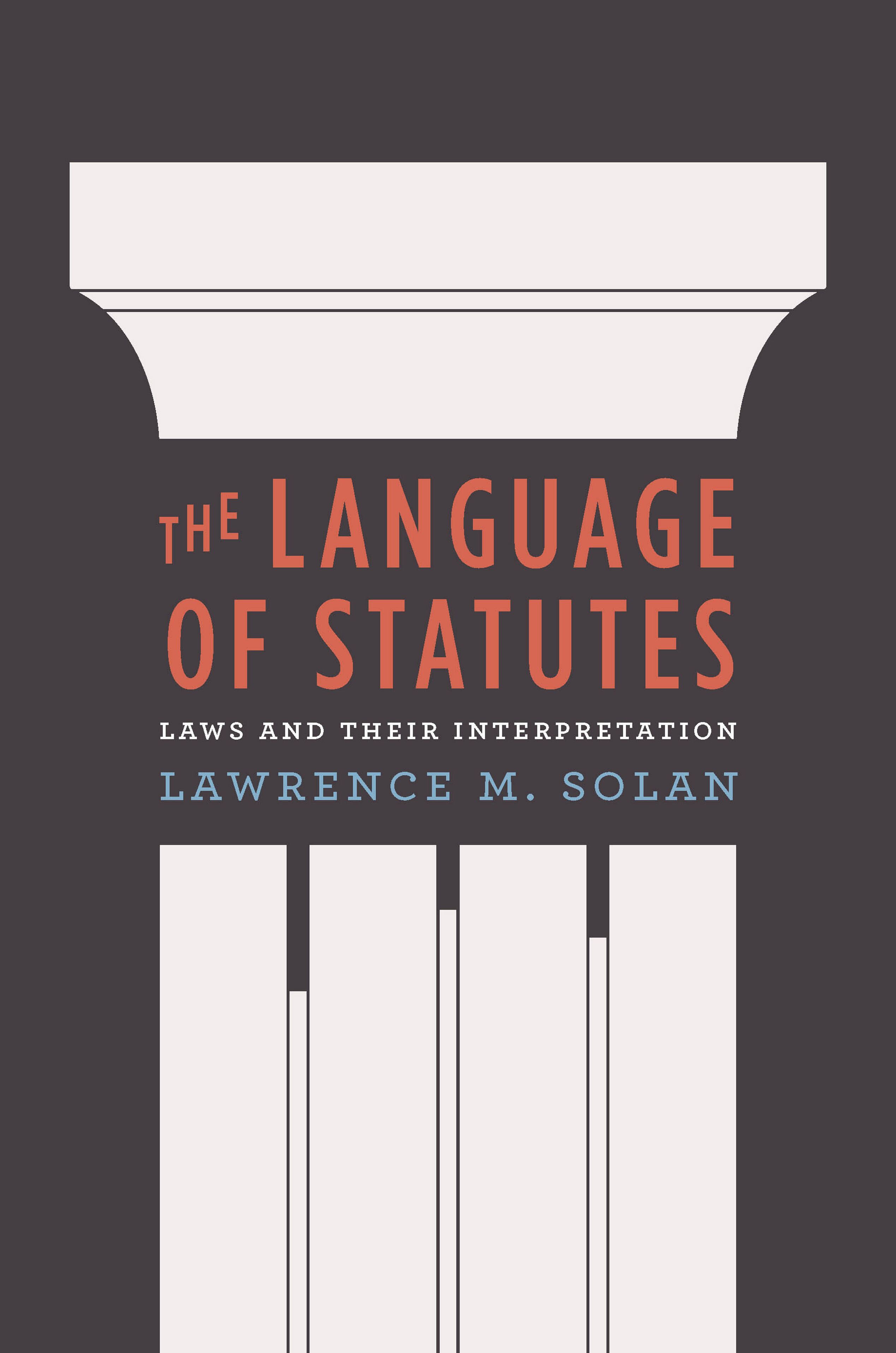
The Language of statutes
Pulling the rug out from debates about interpretation, The Language of Statutes joins together learning from law, linguistics, and cognitive science to illuminate the fundamental issues and problems in this highly contested area. Here, Lawrence M. Solan argues that statutory interpretation is alive, well, and not in need of the major overhaul that many have suggested. Rather, he suggests, the majority of people understand their rights and obligations most of the time, with difficult cases occurring in circumstances that we can predict from understanding when our minds do not work in a lawlike way. Solan explains that these cases arise because of the gap between our inability to write crisp yet flexible laws on one hand and the ways in which our cognitive and linguistic faculties are structured on the other. Making our lives easier and more efficient, we’re predisposed to absorb new situations into categories we have previously formed—but in the legislative and judicial realms this can present major difficulties. Solan provides an excellent introduction to statutory interpretation, rejecting the extreme arguments that judges have either too much or too little leeway, and explaining how and why a certain number of interpretive problems are simply inevitable.
eBook
Taking an educational psychology course improves neuroscience literacy but does not reduce belief in neuromyths
Educators are increasingly interested in applying neuroscience findings to improve educational practice. However, their understanding of the brain often lags behind their enthusiasm for the brain. We propose that educational psychology can serve as a bridge between basic research in neuroscience and psychology on one hand and educational practice on the other. We evaluated whether taking an educational psychology course is associated with increased neuroscience literacy and reduced belief in neuromyths in a sample of South Korean pre-service teachers. The results showed that taking an educational psychology course was associated with the increased neuroscience literacy, but there was no impact on belief in neuromyths. We consider the implications of these and other findings of the study for redesigning educational psychology courses and textbooks for improving neuroscience literacy.
Journal Article

Best practices for your confirmatory factor analysis: A JASP and lavaan tutorial
Confirmatory factor analysis (CFA) is a fundamental method for evaluating the internal structural validity of measurement instruments. In most CFA applications, the measurement model serves as a means to an end rather than an end in itself. To select the appropriate model, prior validity evidence is crucial, and items are typically assessed on an ordinal scale, which has been used in the applied social sciences. However, textbooks on structural equation modeling (SEM) often overlook this specific case, focusing on applications estimable using maximum likelihood (ML) instead. Unfortunately, several popular commercial SEM software packages lack suitable solutions for handling this ‘typical CFA’, leading to confusion and suboptimal decision-making when conducting CFA in this context. This article conceptually contributes to this ongoing discussion by presenting a set of guidelines for conducting a typical CFA, drawing from recent empirical research. We provide a practical contribution by introducing and developing a tutorial example within the JASP and
lavaan
software platforms. Supplementary materials such as videos, files, and scripts are freely available.
Journal Article

Developing Strategies to Improve Textbook Design Using Synergy of Native and Learner Corpora
The research aims to enhance the handling of modal verbs (MVs) in EFL textbooks by leveraging perspectives from corpora that include both native speakers’ language data and the language data of individuals who are learning the language. To assess the authenticity of language in textbooks, an analysis between the native corpus and a collection of language data compiled from textbook is conducted. The research delves into the developmental patterns of MV usage among learners through a stratified analysis of student essays (Grades 7, 8, 9). Comparisons between learner patterns and a graded textbook series are made to ascertain potential correlations. A novel aspect of the examination explores how the salience and complexity of L2 forms and functions shape the impact of EFL textbooks on learner production. Findings reveal significant differences in the use of MVs between EFL textbooks and the British National Corpus (BNC). Moreover, analysis of student essays indicates a substantial influence of textbooks on learners’ MV usage. The study proposes strategies to enhance EFL textbook design, advocating for authenticity and learner-centric approaches. Utilizing native and learner corpora facilitates targeted instruction, addressing common errors and challenges. The incorporation of authentic language examples from the native corpus is recommended to expose learners to real-world language use. This research underscores the significance of integrating native and learner corpora insights in EFL textbook design, ultimately fostering more effective language learning outcomes.
Journal Article
A large-scale database of Chinese characters and words collected from elementary school textbooks
Lexical databases are essential tools for studies on language processing and acquisition. Most previous Chinese lexical databases have focused on materials for adults, yet little is known about reading materials for children and how lexical properties from these materials affect children’s reading comprehension. In the present study, we provided the first large database of 2999 Chinese characters and 2182 words collected from the official textbooks recently issued by the Ministry of Education (MOE) of the People’s Republic of China for most elementary schools in Mainland China, as well as norms from both school-aged children and adults. The database incorporates key orthographic, phonological, and semantic factors from these lexical units. A word-naming task was used to investigate the effects of these factors in character and word processing in both adults and children. The results suggest that: (1) as the grade level increases, visual complexity of those characters and words increases whereas semantic richness and frequency decreases; (2) the effects of lexical predictors on processing both characters and words vary across children and adults; (3) the effect of age of acquisition shows different patterns on character and word-naming performance. The database is available on Open Science Framework (OSF) (
https://osf.io/ynk8c/?view_only=5186bd68549340bd923e9b6531d2c820
) for future studies on Chinese language development.
Journal Article

Word problems in mathematics education: a survey
Word problems are among the most difficult kinds of problems that mathematics learners encounter. Perhaps as a result, they have been the object of a tremendous amount research over the past 50 years. This opening article gives an overview of the research literature on word problem solving, by pointing to a number of major topics, questions, and debates that have dominated the field. After a short introduction, we begin with research that has conceived word problems primarily as problems of comprehension, and we describe the various ways in which this complex comprehension process has been conceived theoretically as well as the empirical evidence supporting different theoretical models. Next we review research that has focused on strategies for actually solving the word problem. Strengths and weaknesses of informal and formal solution strategies—at various levels of learners’ mathematical development (i.e., arithmetic, algebra)—are discussed. Fourth, we address research that thinks of word problems as exercises in complex problem solving, requiring the use of cognitive strategies (heuristics) as well as metacognitive (or self-regulatory) strategies. The fifth section concerns the role of graphical representations in word problem solving. The complex and sometimes surprising results of research on representations—both self-made and externally provided ones—are summarized and discussed. As in many other domains of mathematics learning, word problem solving performance has been shown to be significantly associated with a number of general cognitive resources such as working memory capacity and inhibitory skills. Research focusing on the role of these general cognitive resources is reviewed afterwards. The seventh section discusses research that analyzes the complex relationship between (traditional) word problems and (genuine) mathematical modeling tasks. Generally, this research points to the gap between the artificial word problems learners encounter in their mathematics lessons, on the one hand, and the authentic mathematical modeling situations with which they are confronted in real life, on the other hand. Finally, we review research on the impact of three important elements of the teaching/learning environment on the development of learners’ word problem solving competence: textbooks, software, and teachers. It is shown how each of these three environmental elements may support or hinder the development of learners’ word problem solving competence. With this general overview of international research on the various perspectives on this complex and fascinating kind of mathematical problem, we set the scene for the empirical contributions on word problems that appear in this special issue.
Journal Article

What is learning? On the nature and merits of a functional definition of learning
Learning has been defined functionally as changes in behavior that result from experience or mechanistically as changes in the organism that result from experience. Both types of definitions are problematic. We define learning as ontogenetic adaptation—that is, as changes in the behavior of an organism that result from regularities in the environment of the organism. This functional definition not only solves the problems of other definitions, but also has important advantages for cognitive learning research.
Journal Article