
Catalogue Search | MBRL


Are you sure you want to remove the book from the shelf?

{{itemTitle}}
13
result(s) for
"Cognitive therapy Problems, exercises, etc."
Sort by:


Mindfulness skills workbook for clinicians and clients : 111 tools, techniques, activities & worksheets
\"Like no other resource, Mindfulness Skills Workbook combines the latest research and best practices--all in a simple guide to successfully teach mindfulness to your clients. This comprehensive workbook provides the theory behind each tool, a step-by-step process to implement, and expert guidance on processing client results\"--Back cover.
Book

Unified Protocol for Transdiagnostic Treatment of Emotional Disorders
Unified Protocol for Transdiagnostic Treatment of Emotional Disorders, part of the TreatmentsThatWork series of therapist manuals and patient workbooks, is a radical departure from disorder-specific treatments of various emotional disorders, and is designed to be applicable to all anxiety and unipolar mood disorders, as well as other disorders with strong emotional components, such as many somatoform and dissociative disorders.
eBook

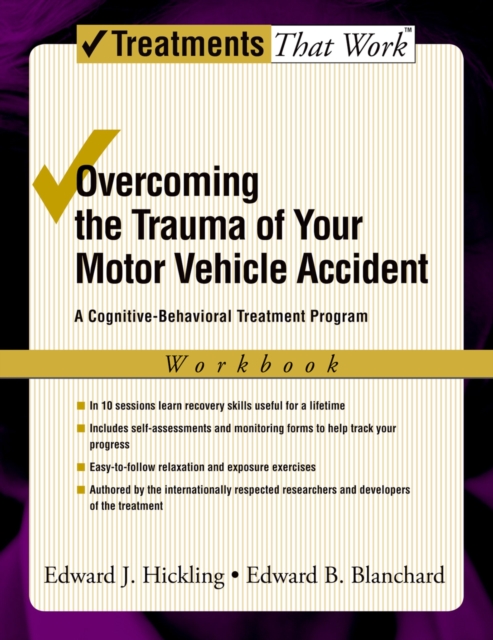
Overcoming the trauma of your motor vehicle accident: a cognitive-behavioral treatment program : workbook
This Workbook is designed to be used in conjunction with the Overcoming the Trauma of Your Motor Vehicle Accident, Therapist Guide. It is for use by survivors of motor vehicle accidents who have Posttraumatic Stress Disorder, and who may be experiencing travel anxiety and/or depression due to the accident. This 10-session program incorporates new procedures to help individuals learn to monitor their anxiety, gain control, and initiate needed change through cognitive restructuring, progressive muscle relaxation, and direct confrontation of their driving fears using imagery and in vivo exposure. The cognitive-behavioural treatment offered is evidence-based and proven to be effective. This user-friendly, interactive workbook includes blank forms and space for individuals to write, as well as assessment instruments to help them monitor their progress at various stages during treatment.
eBook

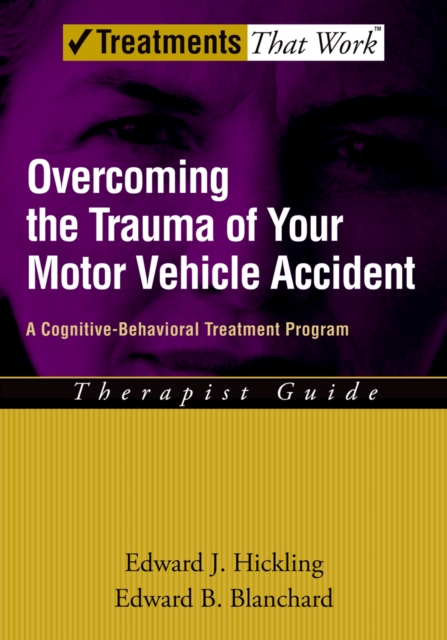
Overcoming the trauma of your motor vehicle accident : a cognitive-behavioral treatment program, therapist guide
Motor vehicle accidents account for over 3 million injuries annually and are one of the most common traumas individuals experience. But the physical injuries are often less impactful in the long run than the severe emotional distress, flashbacks, and substantial impairment in work or family life. Studies of the general population have found that approximately 9% of people who suvive an accident develop Posttraumatic Stress Disorder. And yet, few people seek treatment immediately, mostly because they are not aware of the nature of their condition or that successful brief treatments are available. Written by the creators of an empirically supported cognitive-behavioral therapy program developed at The Center for Stress and Anxiety Disorders in Albany, this Therapist Guide includes all the information and materials necessary to implement a successful program for treating accident-related PTSD. The therapeutic technique described in this book is research-based with a proven success rate. The renowned authors provide clinicians with step-by-step instructions for teaching their clients important skills that have been scientifically tested and shown to be effective in treating emotional trauma caused by involvement in a car accident. Designed to be used in conjunction with its corresponding workbook, this therapist guide outlines a treatment program that includes cognitive restructuring, relaxation techniques, and exposure exercises. User-friendly and comprehensive, Overcoming the Trauma of Your Motor Vehicle Accident, Therapist Guide is a resource that no clinician can do without.
eBook

Experiencing compassion-focused therapy from the inside out : a self-practice/self-reflection workbook for therapists
\"For therapists wishing to build their skills in compassion-focused therapy (CFT), this powerful workbook presents a unique evidence-based training approach. Self-practice/self-reflection (SP/SR) enables therapists to apply CFT techniques to themselves and reflect on the experience as they work through 34 brief, carefully crafted modules. The authors are master trainers who elucidate the multiple layers of CFT, which integrates cognitive-behavioral therapy, evolutionary science, mindfulness, and other approaches. Three extended therapist examples serve as companions throughout the SP/SR journey. In a large-size format for easy photocopying, the volume includes 12 reproducible worksheets. Purchasers get access to a Web page where they can download and print the reproducible materials.
\"-- Provided by publisher.
\"-- Provided by publisher.
Book

Overcoming the Trauma of Your Motor Vehicle Accident
It is estimated that over 3 million people per year are injured in motor vehicle accidents and up to 45% of people in a serious auto accident develop posttraumatic stress disorderl.
eBook