
Catalogue Search | MBRL


Are you sure you want to remove the book from the shelf?

{{itemTitle}}
1,252
result(s) for
"Cold War -- Historiography"
Sort by:


The Cold War
The traces of the Cold War are still visible in many places all around the world. It is the topic of exhibits and new museums, of memorial days and historic sites, of documentaries and movies, of arts and culture. There are historical and political controversies, both nationally and internationally, about how the history of the Cold War should be told and taught, how it should be represented and remembered. While much has been written about the political history of the Cold War, the analysis of its memory and representation is just beginning. Bringing together a wide range of scholars, this volume describes and analyzes the cultural history and representation of the Cold War from an international perspective. That innovative approach focuses on master narratives of the Cold War, places of memory, public and private memorialization, popular culture, and schoolbooks. Due to its unique status as a center of Cold War confrontation and competition, Cold War memory in Berlin receives a special emphasis.
eBook

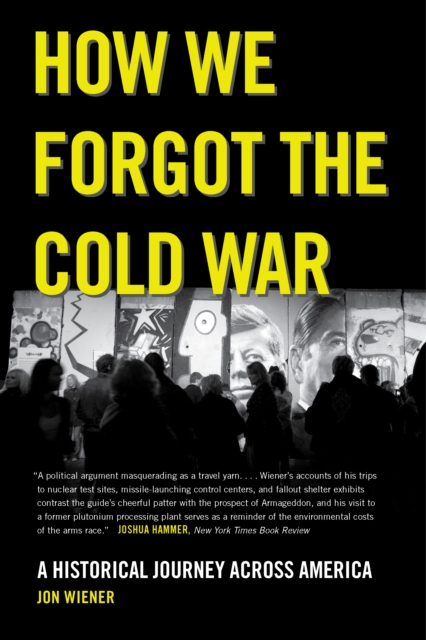
How we forgot the cold war
Hours after the USSR collapsed in 1991, Congress began making plans to establish the official memory of the Cold War. Conservatives dominated the proceedings, spending millions to portray the conflict as a triumph of good over evil and a defeat of totalitarianism equal in significance to World War II. In this provocative book, historian Jon Wiener visits Cold War monuments, museums, and memorials across the United States to find out how the era is being remembered. The author's journey provides a history of the Cold War, one that turns many conventional notions on their heads. In an engaging travelogue that takes readers to sites such as the life-size recreation of Berlin's \"Checkpoint Charlie\" at the Reagan Library, the fallout shelter display at the Smithsonian, and exhibits about \"Sgt. Elvis,\" America's most famous Cold War veteran, Wiener discovers that the Cold War isn't being remembered. It's being forgotten. Despite an immense effort, the conservatives' monuments weren't built, their historic sites have few visitors, and many of their museums have now shifted focus to other topics. Proponents of the notion of a heroic \"Cold War victory\" failed; the public didn't buy the official story. Lively, readable, and well-informed, this book expands current discussions about memory and history, and raises intriguing questions about popular skepticism toward official ideology.
eBook

The Cold War : historiography, memory, representation
\"This volume describes and analyzes the cultural history and representation of the Cold War from an international perspective. That innovative approach focuses on master narratives of the Cold War, places of memory, public and private memorialization, popular culture, and schoolbooks. These general themes are illustrated through a case study of Cold War memory in Berlin, which was a unique former center of Cold War confrontation and competition\"--Provided by publisher.
BOOK
Time No Longer
Americans cherish their national myths, some of which predate the country's founding. But the time for illusions, nostalgia, and grand ambition abroad has gone by, Patrick Smith observes in this original book. Americans are now faced with a choice between a mythical idea of themselves, their nation, and their global \"mission,\" on the one hand, and on the other an idea of America that is rooted in historical consciousness. To cling to old myths will ensure America's decline, Smith warns. He demonstrates with deep historical insight why a fundamentally new perspective and self-image are essential if the United States is to find its place in the twenty-first century.
In four illuminating essays, Smith discusses America's unusual (and dysfunctional) relation with history; the Spanish-American War and the roots of American imperial ambition; the Cold War years and the effects of fear and power on the American psyche; and the uneasy years from 9/11 to the present. Providing a new perspective on our nation's current dilemmas, Smith also offers hope for change through an embrace of authentic history.
eBook

Uncertain empire : American history and the idea of the Cold War
Uncertain Empire brings debates over national, global, and transnational history into focus and offers students of the Cold War a new framework for considering recent developments in the field.
eBook

‘The fringes in and of art historiography in post-1945 Europe’. Review of: Noemi de Haro García, Patricia Mayayo and Jesús Carrillo (eds.), Making Art History in Europe after 1945
The volume under review here investigates how politics in post-1945 Europe affected the academic, critical and political discourses on art. It focuses specifically (but not exclusively) on the fringes of the continent: the eastern and southern regions, thus highlighting the role played by the discipline of art history in former Communist countries and erstwhile military (fascist) regimes. The volume also sets out to expand upon the sources of art historiography by tying into the current strand of research on the exhibitionary complex, and by discussing cultural policies and art criticism. The result is an intellectual journey through time and geopolitical space, and across disciplines. Although the volume sets a new agenda in decentralising the approach of art historiography by shifting the focus from a regional to a geopolitical perspective, it has failed to convincingly fill this gap, largely because of the inclusion of criticism and cultural policy, inevitably leading to a fragmented and, at times, superficial view of how politics influences the discourse on the arts.
Journal Article