
Catalogue Search | MBRL


Are you sure you want to remove the book from the shelf?

{{itemTitle}}
104
result(s) for
"Cold War Humor."
Sort by:

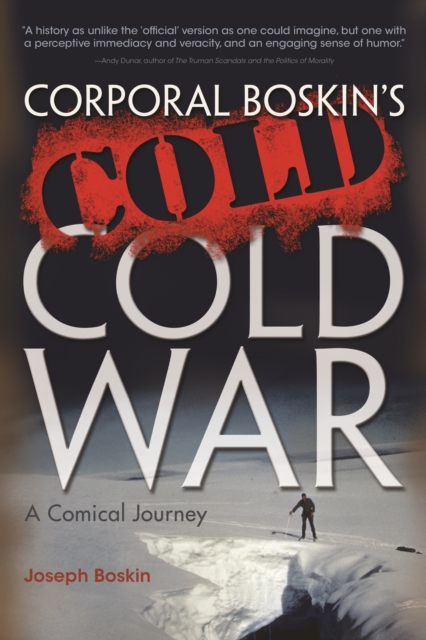
Corporal Boskin's Cold Cold War
At the height of the Korean War in 1952, a budding young historian was drafted into the U.S. Army just as the Pentagon was organizing a top-secret, scientific expeditionary unit, the Transportation Arctic Group (TRARG). Consisting of 275 military members and a cluster of civilian scientists from the United States and other countries, TRARG was sent to Thule Air Force Base, located on the west coast of northern Greenland. Its ostensible purpose was to map the terrain and test complex equipment at the edges of the Ice Cap. The covert objective, however, was to determine the feasibility of constructing yet another air base on the other side of Greenland, one that would be much closer to the enemy.
As the sole historian of the unit, Corporal Boskin was responsible for compiling and transmitting weekly progress reports to the Pentagon and, at the conclusion of the mission, for assisting in the final assessment. The multivolume report was itself technically worthy, yet it possessed barely a hint of the personal story: the outsized characters, the dark comedy and real tragedy, the frustrations and waste, and the ongoing tug'of'war between the company commander and his corporal historian over the status of the report's basic contents. Here Boskin tells that story, a keenly observed narrative that delivers both the absurd and the sublime in equal measure.
eBook

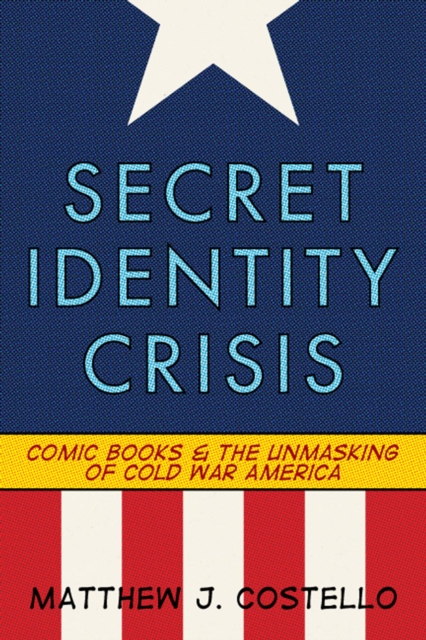
Secret identity crisis : comic books and the unmasking of cold war America
What Cold War-era superheroes reveal about American society and foreign policy Physicist Bruce Banner, caught in the nuclear explosion of his experimental gamma bomb, is transformed into the rampaging green monster, the Hulk.High school student Peter Parker, bitten by an irradiated spider, gains its powers and becomes Spiderman.
eBook

Dr. Strangelove and the Psychology of Comic Distance
Abstract In 1964, near the height of Cold War nuclear anxiety, millions of Americans flocked to movie theatres to see their own nuclear annihilation hilariously enacted for them in Stanley Kubrick's Dr. Strangelove. How did Kubrick transform one of his time's most pressing causes of psychological distress into a source of humorous pleasure? To answer this question, I offer a cognitive account of how comic distance works on film, building on research indicating humor to be an evolved response to benign violations. I show that Kubrick consistently optimized for psychological distance in Dr. Strangelove, comparing his narrative and stylistic choices to those of Sidney Lumet in Fail Safe, a contemporaneous film that plays the same essential story for drama instead of laughs.
Journal Article

Laughter Louder Than Bombs? Apocalyptic Graphic Satire in Cold War Cartooning, 1946–1959
In the postwar American media landscape, \"the bomb\" symbolized both security and insecurity. Two of the nation's leading syndicated cartoonists—the Washington Post's Herbert Block and the Village Voice's Jules Feiffer—played on this paradox by parodying the arms race, civil defense, nuclear testing, and deterrence. But the schisms within progressive politics in this period distinguished Block and Feiffer as social critics. At the height of anticommunist hysteria, Block's single-panel cartoons often featured the anthropomorphized Mr. Atom, who became a spectral figure within the Cold War imaginary. In the post-McCarthy era, Feiffer's narrative-driven strips spoofed military Keynesianism by critiquing the role capitalism played in the nuclear crisis. While Block and Feiffer both recognized the existential threat posed by nuclear weapons, they were representative of a left-liberal divide at a point when humor was undergoing transformations in the wider culture and a political struggle over the bomb's future was being fiercely waged. By foregrounding these cleavages, this essay argues that satirizing the full slate of contradictions of the nuclear era meant questioning the basic assumptions of the Cold War rivalry and breaking from the consensus framework altogether. Only by critiquing the ideology of the American Cold War commitment could the absurdities of the arms race be laid bare.
Journal Article
Amerikan Jokes
How did ideas about humor shape US allies’ perceptions of America and Americans during the Cold War? This essay offers a small part of the puzzle by examining a category of unfunny jokes that midcentury Turks came to call “Amerikan.” The structure of these jokes shifted between the late 1940s and 1990s, offering clues as to how disparate cultures can merge and transform across uneven power divides. The label itself and the connection to “unlaughter,” however, also operated as a political index. Turkish opinion leaders and journalists used Amerikan jokes to comment on US actions, including Cold War aid policy and the war in Vietnam, and to code local perceptions of American political leaders, including President Harry Truman, then senator Joseph Biden, and President Ronald Reagan. Using Turkish newspaper archives and Foreign Broadcast Information Service Daily Reports, this essay demonstrates how ideas about American national character coded through humor could influence local perceptions at a time when the United States was both seeking to differentiate itself from Europe as a “benevolent” world power and driving economic and cultural change in newly independent nations.
Journal Article

Hemingway's Requiem for Battle Fields: 'Atomic Jokes' after Hiroshima/Nagasaki in Across the River and into the Trees
Hemingway furiously wrote a letter, which was eventually not posted for Ehrenburg, saying that \"[f]or your information I not only oppose all atomic weapons but also all weapons above the potency of the .22 caliber sporting rifle and the shotgun\" (Welsh 309-10).[...]he seems to have refused to make nuclear weapons special, unlike Ehrenburg, who opposed them because of humanism and ethics. 7.According to Axelsson, an occupation novel typically depicts \"dramatic conflicts mainly inside their characters, making the chaotic conditions of post-World War II Europe both background and catalyst of the personal crises . . . the struggle between individual people and various manifestations of military power\" (12).In the following part of this dialogue, Cantwell plays a joke on Domenico, suggesting that Italy would be attacked by dropping \"botulism\" or \"anthrax\" (ARIT 184).[...]Hemingway seems to have had contempt not only for nuclear weapons, but also for any weapon of mass destruction.According to Stephen Endicott and Edward Hagerman, \"The decision of the U.S. government in 1947 to grant participants in the Japanese bacteriological program immunity from war crimes prosecution in return for exclusive acquisition of the results, especially results of deadly experiments on human subjects, indicated how intent policy makers were on pursuing the possibilities of biological warfare\" (37-38).
Journal Article

Çizgiler Üzerinden Notalar Savaşı: 1946 Sovyetler Birliği Muhtırası
Millî Mücadele'nin zaferle sonuçlanmasında bağımsızlık, milliyetçilik, özgürlük, vatan gibi ulusal kavramların manevi bir işlev gördüğü yadsınamaz bir gerçektir. Türk halkının gerek var olma savaşında gerekse de akabinde benimsediği demokratik sistemde hayati fonksiyona sahip olan bu millî değerlerin başlıca gayesi kurulan yeni devleti korumak ve kollamak üzerine bina edilmiştir. Misak-ı Millî sınırlarında filizlenip büyüyen yeni devletin yaşaması bu bilincin her daim taze, canlı, uyanık ve diri tutulmasına bağlıdır. Türkiye Cumhuriyeti'nin hayat sigortalarından biri olan bu millî şuur, vatan topraklarını savunma ve muhafaza etme konusundaki en büyük sınavlarından birini, II. Dünya Savaşı sonlarında Sovyetler Birliği'nin Boğazlar üzerindeki taleplerine karşı vermiştir. Türkiye, SSCB'ye karşı verdiği bu sınavında millî ruhla sarıp sarmalanan ve mizah dünyasının vurucu gücü olan karikatür dünyasından da büyük destek görmüştür. Bilhassa XIX. yüzyılın sonlarından itibaren ülkelerin savaşlarda ve yahut olağanüstü dönemlerde ruhsal mücadeleyi güçlendirmek için kullanmaya başladığı araçlarından olan karikatür, bu niteliği ile tarihin görsel veri kaynaklarından biri kimliğine dönüşmüştür. Tarihi bir done olan karikatürün bu misyonu Sovyetlerin Soğuk Savaş Dönemi'nde Boğazlar üzerindeki istemleri için de söz konusu olmuştur. Bu döneme şahitlik eden çizerler tuvale yansıttıkları renkli, büyülü, komik, ilginç, çekici karikatürleri vasıtasıyla mevcut sorunu kritize edip kamuoyunu bu konuda aydınlatıp bilinçlendirmelerinin yanı sıra SSCB'ye taleplerinin kabul edilemez olduğunun da mesajını vermişlerdir. Anahtar Kelimeler: Karikatür, Nota, Boğazlar, SSCB, Ulusal Bilinç.
Journal Article

Russell the Rainmaker: Touring in Early Cold War Australia
During his 1950 lecture tour of Australia, Bertrand Russell was given the nickname “Russell the Rainmaker” due to unseasonably wet weather in the eastern states that appeared to accompany his travels. This humorous name represents a central idea that shaped his tour. Russell was convinced that the technical ability to make rain could transform Australia’s largely dry landscape and boost the nation’s farming potential, which could, in turn, support a new age of happiness and prosperity. Russell used this vision of the future to imagine a safe refuge for Western civilization in case Europe was destroyed in a possible nuclear Third World War. This paper will discuss how his Australian tour was an important moment of both hope and anxiety in his life. Russell’s idea of a pastoral utopia in Australia that relied on optimism about the capability of science to transform the landscape can be understood as a key way in which he responded intellectually to the events of the early Cold War.
Journal Article