
Catalogue Search | MBRL


Are you sure you want to remove the book from the shelf?

{{itemTitle}}
498
result(s) for
"Collective memory Germany."
Sort by:


Memorializing the GDR
Since unification, eastern Germany has witnessed a rapidly changing memorial landscape, as the fate of former socialist monuments has been hotly debated and new commemorative projects have met with fierce controversy. Memorializing the GDR provides the first in-depth study of this contested arena of public memory, investigating the individuals and groups devoted to the creation or destruction of memorials as well as their broader aesthetic, political, and historical contexts. Emphasizing the interrelationship of built environment, memory and identity, it brings to light the conflicting memories of recent German history, as well as the nuances of national and regional constructions of identity.
eBook

Screening twentieth century Europe : television, history, memory
1. Introduction. A Century of Extremes and Profound Changes: Mediating European History.- 2. Memory and History as Mediated and Embodied Narratives.- 3. Historical Genres on Television: The Broader European Picture.- 4. The Meaning of Small Things: Everyday Drama and History from Below.- 5. History from Above: Historical Biopics.- 6. Grand illusions and The Great War: WW1 Narratives.- 7. Living on the Edge: The Roaring Twenties and World Crisis.- 8. Hell on Earth: WW2 War Narratives.- 9. Post-war Europe: Cold War, Welfare and Cultural Revolution.- 10. Europe 1989 and Beyond: Towards the New Millennium.- 11. Conclusion: History on Our Mind - the Forms and Functions of Mediated History.
BOOK

Difficult Heritage
How does a city and a nation deal with a legacy of perpetrating atrocity? How are contemporary identities negotiated and shaped in the face of concrete reminders of a past that most wish they did not have?
Difficult Heritage focuses on the case of Nuremberg – a city whose name is indelibly linked with Nazism – to explore these questions and their implications. Using an original in-depth research, using archival, interview and ethnographic sources, it provides not only fascinating new material and perspectives, but also more general original theorizing of the relationship between heritage, identity and material culture.
The book looks at how Nuremberg has dealt with its Nazi past post-1945. It focuses especially, but not exclusively, on the city’s architectural heritage, in particular, the former Nazi party rally grounds, on which the Nuremburg rallies were staged. The book draws on original sources, such as city council debates and interviews, to chart a lively picture of debate, action and inaction in relation to this site and significant others, in Nuremberg and elsewhere. In doing so, Difficult Heritage seeks to highlight changes over time in the ways in which the Nazi past has been dealt with in Germany, and the underlying cultural assumptions, motivations and sources of friction involved.
Whilst referencing wider debates and giving examples of what was happening elsewhere in Germany and beyond, Difficult Heritage provides a rich in-depth account of this most fascinating of cases. It also engages in comparative reflection on developments underway elsewhere in order to contextualize what was happening in Nuremberg and to show similarities to and differences from the ways in which other ‘difficult heritages’ have been dealt with elsewhere. By doing so, the author offers an informed perspective on ways of dealing with difficult heritage, today and in the future, discussing innovative museological, educational and artistic practice.
\"Sharon Macdonald deftly handles this complex terrain, offering a sophisticated theoretical analysis based on a well-grounded ethnographic study. In other words, this book is an exceptional piece of anthropology.\" - Chip Colwell-Chanthaphonh , Denver Museum of Nature and Science, Current Anthropology , Volume 51, Number 3, June 2010
1. Negotiating Difficult Heritage: Introduction 2. Building Heritage: Words in Stone? 3. Demolition, Cleansing and Moving On 4. Preservation, Profanation and Image-Management 5. Accompanied Witnessing: Education, Art and Alibis 6. Cosmopolitan Memory in the City of Human Rights 7. Negotiating on the Ground(s): Guided Tours of Nazi Heritage 8. Visting Difficult Heritage 9. Unsettling Difficult Heritage
eBook

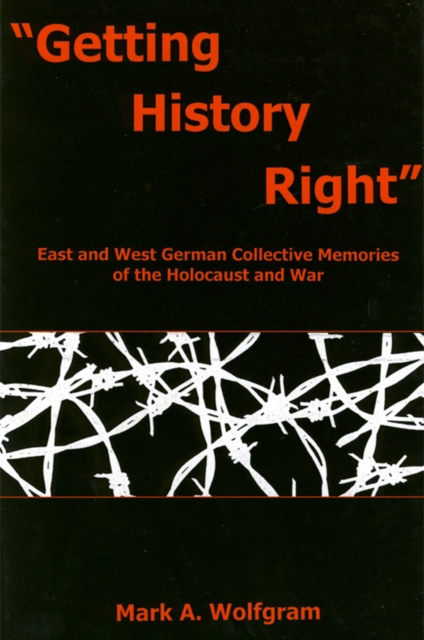
\Getting history right\
How do individuals, societies, and nations deal with their difficult pasts? \"Getting History Right\" examines this question in a comparative context by looking at an authoritarian East Germany and a pluralistic, democratic West Germany. Eschewing a narrow focus on elites, this work draws extensively on societal level discussions of the past in popular culture, such as film, television, radio, and newspapers. It examines how societal level discussions of the past shaped individual perceptions and interpretations of the past; and how individual perceptions and struggles over the meaning of the past shaped societal level discussions. These struggles over meaning and \"getting history right\" are not only shaped by political power, but are also a source of symbolic power. To understand political life, scholars must embrace not only material political power, but also the symbolic and cultural roots of power. The research presented here makes extensive use of public opinion data, cinema attendance, and television viewer data, as well as other sources, to look at the multiple meanings that East and West Germans assigned to the Holocaust and World War II across time. Rather than culture merely being an extension of political power, this work argues that culture and the boundaries of the cultural matrix shape the use of political power by different social actors. Getting history right is not only a reflection of political power; it is a source of power itself.
eBook


Phantoms of War in Contemporary German Literature, Films and Discourse
Phantoms of War in Contemporary German Literature, Films and Discourse offers an up-to-date and comprehensive analysis of fundamental shifts in German cultural memory. Focusing on the resurgence of family stories in fiction, autobiography and in film, this study challenges the institutional boundaries of Germany's memory culture that have guided and arguably limited German identity debates. Essays on contemporary German literature are complemented by explorations of heritage films and museum discourse. Together these essays put forward a compelling theory of family narratives and a critical evaluation of generational discourse.
eBook


German Colonialism, Visual Culture, and Modern Memory
There is no overarching master narrative in understanding the history of German colonialism, and over the past decade, the study of Germany’s colonial past has experienced a dramatic transformation in its scope of inquiry. Influenced by new theoretical and methodological approaches to the study of race, nationalism, and globalization, these new studies initiate a process of reevaluating and redefining the parameters within which German Colonialism is understood. The role of visual materials, in particular, is ideal for exploring the porousness of disciplinary boundaries, though visual culture studies pertaining to German history – and especially German colonialism – have previously been almost completely neglected. Investigating visual communication and mass culture, print culture and suggestive racial politics, racial aesthetics, racial politics and early German film, racial continuity and German film, and photography, German Colonialism, Visual Culture, and Modern Memory offers compelling evidence of a German society between 1884 and 1919 that produced vibrant and heterogeneous – and at times contradictory – cultures of colonialism.
This collection of new essays illustrates the dramatic changes and vast array of perspectives that have recently emerged in the study of German colonialism. In documenting the latest cutting-edge research of German colonial history, the contributors to this volume prove wrong the persistent assumptions that the creation of Germany’s colonial empire did not have any lasting impact on German political and cultural life. Their essays document how colonialism in its various forms was entwined with the inner workings of modern German life and society, especially through the cultural and technical innovations of its time. In contrast to existing research, these studies show that colonial Germany played a significant role in shaping German perceptions of racial difference, influenced German support for World War I, and facilitated the construction of German nationalism. German Colonialism, Visual Culture, and Modern Memory uniquely demonstrates that the visual culture of colonialism is closely linked to the fascination with new modes of seeing and the enigma of visual experience that have become trademarks of modernity.
Acknowledgements. Introduction: Picturing Race: Visuality and German Colonialism. Volker Langbehn. German Colonialism 1884–1919. 1. Advertising and the Optics of Colonial Power at the fin de siècle. David Ciarlo. 2. \"... will try to send you the best views from here\" – Postcards from the Colonial War in Namibia (1904–1908). Felix Axster. 3. Harmless \"Kolonialbiedermeier\"? Colonial and Exotic Trading Cards. Joachim Zeller. 4. Cakewalking the Anarchy of Empire around 1900. Astrid Kusser. 5. Satire Magazines and Racial Politics. Volker Langbehn. 6. Demystifying Colonial Settlement: Building Handbooks for Settlers, 1904–1930. Itohan Osayimwese. 7. Patriotism, Spectacle and Reverie: Colonialism in Early Cinema. Wolfgang Fuhrmann. German Postcolonialism 1919–Present. 8. Persuasive Maps and a Suggestive Novel – Hans Grimm’s Volk ohne Raum and German Cartography in Southwest Africa. Oliver Simons. 9. Colonial Disgust: The Colonial Master’s Emotion of Superiority. Thomas Schwarz. 10. Weimar Revisions of Germany’s Colonial Past: The Photomontages of Hannah Höch and László Moholy-Nagy. Brett M. Van Hoesen. 11. The \"Colonial Idea\" in Weimar Cinema. Christian Rogowski. 12. \"The Black Jew\": An After-Image of German Colonialism. Birgit Haehnel. 13. Reenacting Colonialism: Germany and its Former Colonies in Recent TV Productions. Wolfgang Struck. 14. Postcolonial Amnesia? Taboo Memories and Kanaks with Cameras. Deniz Göktürk. Contributors. References. Index.
‘[A] comprehensive collection of studies that examine materials from new and creative angles. The inclusion of essays on both issues of actual German colonialism, as well as its continuation in different shapes in postcolonial times, convincingly demonstrates that continuous engagement with its ideological legacy is still of relevance today. … What distinguishes most contributions is the interdisciplinary methods of inquiry their authors use to provide new insights into German colonialism and its impact.’ – German Studies Review
Volker Langbehn (Ph.D. University of Minnesota, Minneapolis, 1998) is Associate Professor of German at San Francisco State University, California. He is the author of Arno Schmidt's Zettels Traum: An Analysis (2003) and has published articles on Friedrich Nietzsche, Christa Wolf, Arno Schmidt, Fritz von Unruh, Novalis and Gert Heidenreich, and the visual representation of German Colonialism. He is the co-editor with Dr. Mohammad Salama of Colonial (Dis)-Continuities: Race, Holocaust, and Postwar Germany (2010). His current book project tentatively titled The Visual Representation of Cultural Identity in German Mass Culture Around 1900 focuses on visual representations of Africa in German mass culture. It is a study of how racism can develop in a modern society through subtle, everyday means, and it explores the negative consequences of race thinking upon the long-term development of German identity. He examines how images of Africa and Africans contained in four types of media – political caricatures in satirical magazines, picture postcards, black-and-white photographs, and illustrated children’s literature – helped foster a racialized German national identity.
eBook