
Catalogue Search | MBRL


Are you sure you want to remove the book from the shelf?

{{itemTitle}}
20
result(s) for
"Collective memory-Soviet Union"
Sort by:


The Great War in Russian memory
Karen Petrone shatters the notion that World War I was a forgotten war in the Soviet Union. Although never officially commemorated, the Great War was the subject of a lively discourse about religion, heroism, violence, and patriotism during the interwar period. Using memoirs, literature, films, military histories, and archival materials, Petrone reconstructs Soviet ideas regarding the motivations for fighting, the justification for killing, the nature of the enemy, and the qualities of a hero. She reveals how some of these ideas undermined Soviet notions of military honor and patriotism while others reinforced them. As the political culture changed and war with Germany loomed during the Stalinist 1930s, internationalist voices were silenced and a nationalist view of Russian military heroism and patriotism prevailed.
eBook


Warped mourning : stories of the undead in the land of the unburied
After Stalin's death in 1953, the Soviet Union dismantled the enormous system of terror and torture that he had created. But there has never been any Russian ban on former party functionaries, nor any external authority to dispense justice. Memorials to the Soviet victims are inadequate, and their families have received no significant compensation. This book's premise is that late Soviet and post-Soviet culture, haunted by its past, has produced a unique set of memorial practices. More than twenty years after the collapse of the Soviet Union, Russia remains \"the land of the unburied\": the events of the mid-twentieth century are still very much alive, and still contentious. Alexander Etkind shows how post-Soviet Russia has turned the painful process of mastering the past into an important part of its political present.
eBook

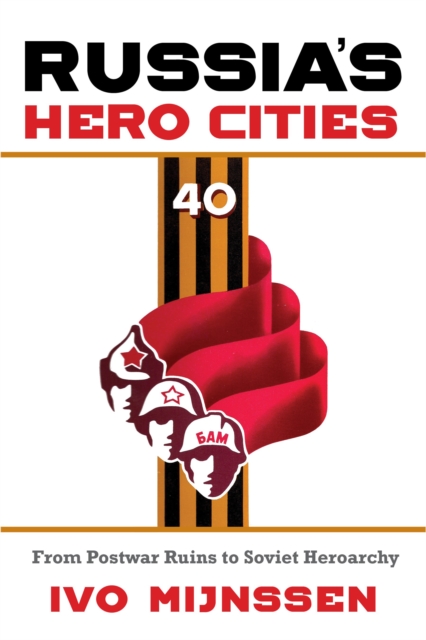
Russia's Hero Cities
By exploring the significance of Hero Cities in Soviet identity and the enduring but conflicted importance they hold for Russians today, Russia's Hero Cities exposes how the Great Patriotic War no longer has the power to mask the deep rifts still present in Russian society.
eBook


Tear Off the Masks!
When revolutions happen, they change the rules of everyday life--both the codified rules concerning the social and legal classifications of citizens and the unwritten rules about how individuals present themselves to others. This occurred in Russia after the Bolshevik Revolution of 1917, which laid the foundations of the Soviet state, and again in 1991, when that state collapsed.Tear Off the Masks!is about the remaking of identities in these times of upheaval. Sheila Fitzpatrick here brings together in a single volume years of distinguished work on how individuals literally constructed their autobiographies, defended them under challenge, attempted to edit the \"file-selves\" created by bureaucratic identity documentation, and denounced others for \"masking\" their true social identities.
Marxist class-identity labels--\"worker,\" \"peasant,\" \"intelligentsia,\" \"bourgeois\"--were of crucial importance to the Soviet state in the 1920s and 1930s, but it turned out that the determination of a person's class was much more complicated than anyone expected. This in turn left considerable scope for individual creativity and manipulation. Outright imposters, both criminal and political, also make their appearance in this book. The final chapter describes how, after decades of struggle to construct good Soviet socialist personae, Russians had to struggle to make themselves fit for the new, post-Soviet world in the 1990s--by \"de-Sovietizing\" themselves.
Engaging in style and replete with colorful detail and characters drawn from a wealth of sources,Tear Off the Masks!offers unique insight into the elusive forms of self-presentation, masking, and unmasking that made up Soviet citizenship and continue to resonate in the post-Soviet world.
eBook


Uprooted
With the stroke of a pen at the Potsdam Conference following the Allied victory in 1945, Breslau, the largest German city east of Berlin, became the Polish city of Wroclaw. Its more than six hundred thousand inhabitants--almost all of them ethnic Germans--were expelled and replaced by Polish settlers from all parts of prewar Poland.Uprootedexamines the long-term psychological and cultural consequences of forced migration in twentieth-century Europe through the experiences of Wroclaw's Polish inhabitants.
In this pioneering work, Gregor Thum tells the story of how the city's new Polish settlers found themselves in a place that was not only unfamiliar to them but outright repellent given Wroclaw's Prussian-German appearance and the enormous scope of wartime destruction. The immediate consequences were an unstable society, an extremely high crime rate, rapid dilapidation of the building stock, and economic stagnation. This changed only after the city's authorities and a new intellectual elite provided Wroclaw with a Polish founding myth and reshaped the city's appearance to fit the postwar legend that it was an age-old Polish city. Thum also shows how the end of the Cold War and Poland's democratization triggered a public debate about Wroclaw's \"amputated memory.\" Rediscovering the German past, Wroclaw's Poles reinvented their city for the second time since World War II.
Uprootedtraces the complex historical process by which Wroclaw's new inhabitants revitalized their city and made it their own.
eBook