
Catalogue Search | MBRL


Are you sure you want to remove the book from the shelf?

{{itemTitle}}
10,129
result(s) for
"Collective security"
Sort by:

The securitization of memorial space : rhetoric and public memory
\"In The Securitization of Memorial Space, the authors contend that the National September 11 Memorial Museum is a securitized site of remembrance that evokes feelings of insecurity that justify post-9/11 policies and war\"-- Provided by publisher.
Book

Nigeria's Security Architecture and the Challenges of the Proliferation of Small Arms and Light Weapons
The study examines the proliferation of small arms and light weapons (SALW) and the susceptible factors responsible for illicit SALW infiltration in Nigeria. The study investigates the implications of illegal acquisition of SALW on Nigeria’s security architecture and the institutional efforts to mitigate the influence of illicit SALWs on Nigerian soil. The study adopts descriptive survey research for rigorous analysis of the implication of the illegal proliferation of SALW on Nigeria's security architecture. The study found several measures have been rolled out to salvage the country from the imbroglio. Still, the efforts yielded little results because they cut the problem from the edge instead of uprooting it. Finally, collective security theory was used to analyse the subject matter; providing economic and cultural security was suggested to tackle the precarious country's insecurity challenges orchestrated by the proliferation of SALWs.
Journal Article

The Little Rock crisis : what desegregation politics says about us
\"The Little Rock Crisis describes the power of direct and learned memories of the 1957 desegregation crisis in Little Rock, Arkansas. Personal, dramatic experiences of Little Rockians - known and unknown - reflect on the impact of the crisis on their lives in the 21st century. Linking individual memories to collective action through the lens of social appropriation, the book explores how the crisis has impacted the political behavior of Little Rockians. Oral histories and survey research show how the events from the tumultuous 1950s in Little Rock school politics, inform and direct the national political engagement and local community involvement of diverse residents. Their commitment to political and social participation is linked to their crisis experience\"-- Provided by publisher.
Book

The Evolution of International Security Studies
International Security Studies (ISS) has changed and diversified in many ways since 1945. This book provides the first intellectual history of the development of the subject in that period. It explains how ISS evolved from an initial concern with the strategic consequences of superpower rivalry and nuclear weapons, to its current diversity in which environmental, economic, human and other securities sit alongside military security, and in which approaches ranging from traditional Realist analysis to Feminism and Post-colonialism are in play. It sets out the driving forces that shaped debates in ISS, shows what makes ISS a single conversation across its diversity, and gives an authoritative account of debates on all the main topics within ISS. This is an unparalleled survey of the literature and institutions of ISS that will be an invaluable guide for all students and scholars of ISS, whether traditionalist, 'new agenda' or critical.
eBook

الأمن الجمعي
لا تختلف العقول حول أهمية الأمن إذ هو من الأمور الفطرية الجبلية التي لا تحتاج إلى نظر، بل هي من الضروريات التي لا تحتاج إلى برهان لأنها تمس حياة الناس ومعاشهم، بل إن صراع الإنسان في معاشه ومعاده كله يعود إلى الأمن فيطلبه الناس في الدنيا ويرجونه في الآخرة. فجاء البحث ليوضح عناية التشريع الإسلامي بالأمن الجمعي وأسفر البحث عن معناه ومضمونه، وسبب اختيار هذه التسمية دون غيرها، ووضع البحث طريقاً ومسلكاً لاستنباط هذا المقصد وحد حدوده، وعرض لصور مختلفة للأمن الجمعي في أبواب متفرقة في التشريع الإسلامي مثل العبادات والمعاملات والحدود والجنايات وغيرها من أبواب التشريع الإسلامي. وفي سبيل التوصل إلى نتائج البحث استخدم الباحث المنهج الاستقرائي وأردفه بالمنهج الوصفي وذلك لتتبع نصوص الشريعة وأحداثها المختلفة - فيما يخدم البحث وفي حدوده- وذلك لاستنباط موارد هذا المقصد وأدلته. وانتهى البحث إلى عرض صور متفرقة ومتنوعة من الأمن الجمعي تدل كلها على كمال الشريعة ومحاسنها، وانتهى البحث إلى ضرورة عمل دراسات مستقلة لتوضح محاسن الإسلام ومقاصده في هذا الباب خاصة مقصد الأمن الجمعي في الحدود والجنايات، والحروب والإمامة والولاية، وأحكام الأسرة.
Journal Article

Activity of the Government Mashinery of the Russian Federation on Formation of the CSTO Management Bodies and the Legal Framework of Their Activities
Conflicts connected with territorial and national contradictions took place in the neighbouring states of Russia, and on Russian territories, that led the Russian government to the need of associating with these states. Their common goal is to protect the sovereignty, to stabilize the military and political situation and to consolidate peace. In this connection the government launched activity aiming at the formation of collective security system. The author points out main stages of activity by government bodies of Russian Federation on establishing the CSTO (Collective Security Treaty Organization) managing bodies and their legal base. The article describes basic stages of Russian government activity on the development of CSTO managing bodies. The author connects the beginning of CSTO managing bodies formation with the signing of Collective Security Contract and defines the role of the main documentation adopted in the context of CSTO. The article enlists the main difficulties arising in the process of establishing and developing the organization’s legal base and studies the key military and political operations which had influence on these processes. The author evaluates the activity of government machinery of the Russian Federation which allowed establishing the main legal base of managing bodies. As a result the conflicts between post-Soviet states were prevented and the tensions in collective security regions were reduced.
Journal Article

HISTORICAL ANTECEDENTS AND POST–WORLD WAR II REGIONALISM IN THE AMERICAS
After World War II, the US-led international security order exhibited substantial regional variation. Explaining this variation has been central to the debate over why is there no nato in Asia. But this debate overlooks the emergence of multilateral security arrangements between the United States and Latin American countries during the same critical juncture. These inter-American institutions are puzzling considering the three factors most commonly used to explain divergence between nato and Asia: burden-sharing, external threats, and collective identity. These conditions fail to explain contemporaneous emergence of inter-American security multilateralism. Although the postwar inter-American system has been characterized as the solidification of US dominance, at the time of its framing, Latin American leaders judged the inter-American system as their best bet for maintaining beneficial US involvement in the Western Hemisphere while reinforcing voice opportunities for weaker states and imposing institutional constraints on US unilateralism. Drawing on multinational archival research, the author advances a historical institutionalist account. Shared historical antecedents of regionalism shaped the range of choices for Latin American and US leaders regarding the desirability and nature of new regional institutions while facilitating institutional change through mechanisms of layering and conversion during this critical juncture.
Journal Article

Security integration in Europe
At a time when many observers question the EU's ability to achieve integration of any significance, and indeed Europeans themselves appear disillusioned, Mai'a K. Davis Cross argues that the EU has made remarkable advances in security integration, in both its external and internal dimensions. Moreover, internal security integration-such as dealing with terrorism, immigration, cross-border crime, and drug and human trafficking-has made even greater progress with dismantling certain barriers that previously stood at the core of traditional state sovereignty.
Such unprecedented collaboration has become possible thanks to knowledge-based transnational networks, or \"epistemic communities,\" of ambassadors, military generals, scientists, and other experts who supersede national governments in the diplomacy of security decision making and are making headway at remarkable speed by virtue of their shared expertise, common culture, professional norms, and frequent meetings. Cross brings together nearly 80 personal interviews and a host of recent government documents over the course of five separate case studies to provide a microsociological account of how governance really works in today's EU and what future role it is likely to play in the international environment.
\"This is an ambitious work which deals not only with European security and defense but also has much to say about the policy-making process of the EU in general.\"-Ezra Suleiman, Princeton University
eBook

Critical Approaches to Security in Europe: A Networked Manifesto
In the last decade, critical approaches have substantially reshaped the theoretical landscape of security studies in Europe. Yet, despite an impressive body of literature, there remains fundamental disagreement as to what counts as critical in this context. Scholars are still arguing in terms of 'schools', while there has been an increasing and sustained cross-fertilization among critical approaches. Finally, the boundaries between critical and traditional approaches to security remain blurred. The aim of this article is therefore to assess the evolution of critical views of approaches to security studies in Europe, discuss their theoretical premises, investigate their intellectual ramifications, and examine how they coalesce around different issues (such as a state of exception). The article then assesses the political implications of critical approaches. This is done mainly by analysing processes by which critical approaches to security percolate through a growing number of subjects (such as development, peace research, risk management). Finally, ethical and research implications are explored.
Journal Article
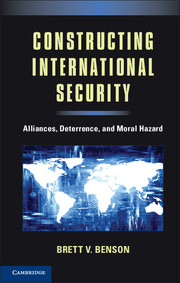
Constructing International Security
Constructing International Security helps policy makers and students recognize effective third-party strategies for balancing deterrence and restraint in security relationships. Brett V. Benson shows that there are systematic differences among types of security commitments. Understanding these commitments is key, because commitments, such as formal military alliances and extended deterrence threats, form the basis of international security order. Benson argues that sometimes the optimal commitment conditions military assistance on specific hostile actions the adversary might take. At other times, he finds, it is best to be ambiguous by leaving an ally and adversary uncertain about whether the third party will intervene. Such uncertainty transfers risk to the ally, thereby reducing the ally's motivation to behave too aggressively. The choice of security commitment depends on how well defenders can observe hostilities leading to war and on their evaluations of dispute settlements, their ally's security and the relative strength of the defender.
eBook