
Catalogue Search | MBRL


Are you sure you want to remove the book from the shelf?

{{itemTitle}}
17
result(s) for
"Collectors and collecting United States Biography."
Sort by:


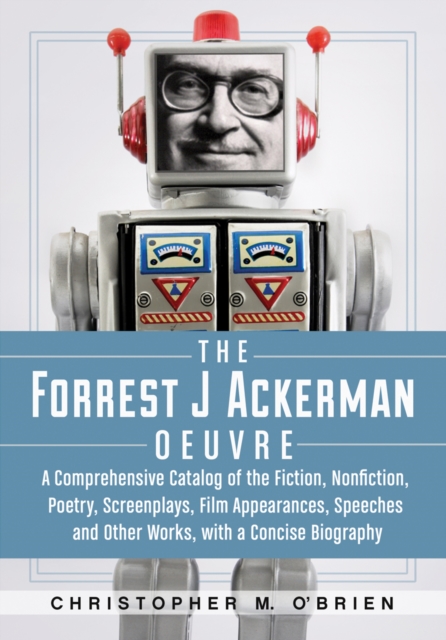
The Forrest J Ackerman Oeuvre
Although he is most remembered for his vast collection of science fiction memorabilia; his influential magazine, Famous Monsters of Filmland ; and his frequent sci-fi convention appearances, Forrest J Ackerman (1916-2008) also left a sizeable body of work in print.
eBook


Travels with Frances Densmore
Over the first half of the twentieth century, scientist and scholar Frances Densmore (1867-1957) visited thirty-five Native American tribes, recorded more than twenty-five hundred songs, amassed hundreds of artifacts and Native-crafted objects, and transcribed information about Native cultures. Her visits to indigenous groups included meetings with the Ojibwes, Lakotas, Dakotas, Northern Utes, Ho-chunks, Seminoles, and Makahs. A \"New Woman\" and a self-trained anthropologist, she not only influenced government attitudes toward indigenous cultures but also helped mold the field of anthropology.
Densmore remains an intriguing historical figure. Although researchers use her vast collections at the Smithsonian and Minnesota Historical Society, as well as her many publications, some scholars critique her methods of \"salvage anthropology\" and concepts of the \"vanishing\" Native American.Travels with Frances Densmoreis the first detailed study of her life and work. Through narrative descriptions of her life paired with critical essays about her work, this book is an essential guide for understanding how Densmore formed her collections and the lasting importance they have had for researchers in a variety of fields.
eBook

Urban outlaw : dirt don't slow you down
Magnus Walker is one of life's originals. Serial entrepreneur, fashion designer, TV presenter, motivational speaker and one of the world's most prolific Porsche collectors, the dreadlocked, tattooed hoarder of individual creativity is a very modern incarnation of idiosyncratic success. Raised in the grim, urban decay of Thatcher's Britain, Sheffield-born Magnus Walker left school with just two O levels and drifted for several years before buying a one-way ticket to America. Now, 30 years and three successful businesses later, by following his instincts, rejecting convention and pursuing his passions Magnus has succeeded against all the odds. Here, for the first time, is the full story of his journey from a Northern steel town to the bright lights of Hollywood, from a boy with little hope to an anti-establishment hero. Along the way we'll witness his potent combination of inspiration and graft, discover his motivations and his ambitions, and come to understand his philosophy and the keys to his success. Inspiring and exhilarating, URBAN OUTLAW is a compelling tale of succeeding through pure instinct and determination by a man who was brave enough to follow his own path.
Book

Collecting Shakespeare : the story of Henry and Emily Folger
The first biography of Henry and Emily Folger, who acquired the largest and finest collection of Shakespeare in the world. In Collecting Shakespeare, Stephen H. Grant recounts the American success story of Henry and Emily Folger. Shortly after marrying in 1885, the Folgers started buying, cataloging, and storing all manner of items about Shakespeare and his era. Emily earned a master's degree in Shakespeare studies. The frugal couple worked passionately as a tight-knit team during the Gilded Age, financing their hobby with the fortune Henry earned as president of Standard Oil Company of New York, where he was a trusted associate of John D. Rockefeller Sr. While a number of American universities offered to house the collection, the Folgers wanted to give it to the American people. Afraid the price of antiquarian books would soar if their names were revealed, they secretly acquired prime real estate on Capitol Hill near the Library of Congress. They commissioned the design and construction of an elegant building with a reading room, public exhibition hall, and the Elizabethan Theatre. The Folger Shakespeare Library was dedicated on the Bard's birthday on April 23, 1932. The library houses 82 First Folios, 277,000 books, and 60,000 manuscripts. It welcomes more than 100,000 visitors a year and provides professors, scholars, graduate students, and researchers from around the world with access to the collections. It is also a vibrant center in Washington, DC, for cultural programs, including theater, concerts, lectures, and poetry readings. With unprecedented access to the primary sources within the Folger vault, Grant draws on interviews with surviving Folger relatives and visits to 35 related archives in the United States and in Britain to create a portrait of the remarkable couple who ensured that Shakespeare would have a beautiful home in America.
eBook


Little Big World
Jeffrey Hammond'sLittle Big World: Collecting Louis Marx and the American Fiftiesis the story of a middle-aged man's sudden compulsion to collect the toys of his childhood: specifically themed playsets produced by the Louis Marx Toy Company. Hammond never made a conscious decision to become a collector of any kind, so he was surprised when his occasional visits to web sites turned into hours spent gazing at, and then impulsively purchasing, the tiny plastic people and animals in the Civil War set, the Fort Apache set, Roy Rogers Ranch, and Happi-Time Farm-just a few of the dozens of playsets the Marx Company produced.
Hammond interweaves childhood memories with reflections on what they reveal about the culture and values of cold war America, offering an extended meditation on toys as powerful catalysts for the imagination of both children and adults. Never sentimentalizing his childhood in an effort to get his old toys back, Hammond exposes the dangers of nostalgia by casting an unsettling light on the culture of the fifties and the era's lasting impact on those who grew up in it.
Writing in a lovably quirky voice, Hammond not only attempts to understand his personal connection to the Marx toys but also examines the psychology of his fellow eBay denizens. In this warm, funny, and contemplative work, the reader encounters an online community of serious adult collectors who, as the author suspects, are driven to obsession by middle-aged nostalgia. When Hammond questions this preoccupation with the past, he comes to realize that his own collecting has prevented him from moving forward. With this insight, he offers an insider's take on the culture and psychology of collecting.
eBook