
Catalogue Search | MBRL


Are you sure you want to remove the book from the shelf?

{{itemTitle}}
24,594
result(s) for
"College Choice"
Sort by:

Should I go to college?
\"For many teens, college is the expected next step after high school graduation. Yet college may not be the right choice for every person\"--Provided by publisher.
Book

African Americans and college choice
Acknowledging the disparity between the number of African American high school students who aspire toward higher education and the number who actually attend, this book uncovers factors that influence African American students’ decisions regarding college. Kassie Freeman brings new insights to the current body of research on African Americans and higher education by examining the impact that family, school, community, and home have in the decision-making process. She explores specific factors that contribute to a student’s predisposition toward higher education, including gender, economics, and high school curriculum, and seeks to bridge the gap in understanding why aspiration does not immediately translate into participation. Educators and policy makers interested in increasing African American students’ participation in higher education will benefit from the exploration of this paradox.
eBook

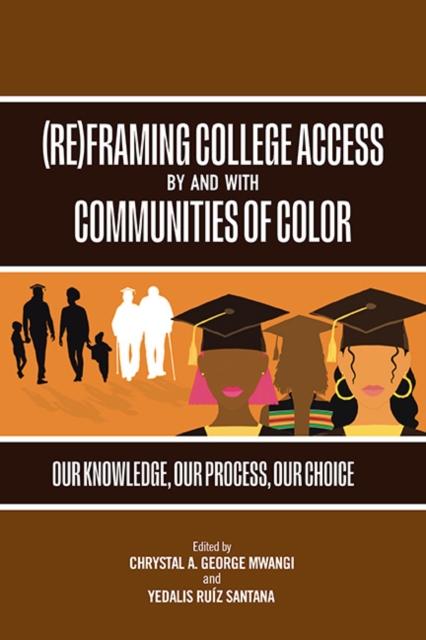
(Re)Framing College Access by and with Communities of Color
Offers novel frameworks and models for understanding
college access and choice among communities of
Color.
This much-needed volume brings together academics,
practitioners, students, and community members of Color to
thoroughly reframe college access and choice in research and
practice. Enrollment rates continue to differ substantially by
race and ethnicity. While Black, Indigenous, and other People
of Color remain inequitably stratified in the pursuit of higher
education, many models of college choice are simply
insufficient for understanding the college-going processes of
diverse students. Continually centering BIPOC knowledge,
assets, and needs, contributors provide a series of varied yet
connected frameworks grounded in culturally sustaining,
community-oriented research. Like the educational journeys it
represents, the volume is a communal activity that invites
participation. Each chapter concludes with a series of critical
reflection questions to guide readers in deeper learning and
engagement.
eBook

The truth about college admission : a family guide to getting in and staying together
\"The coauthors, a college admissions officer and a high school guidance counselor, demystify the process of college admissions and bring sanity to what has become a source of great anxiety for families with college-bound kids. This book is rooted in experience from both sides of the college admission profession, and it provides valuable insight and practical tips about choosing and applying to schools\"-- Provided by publisher.
Book

Unequal Choices
High-achieving students from socioeconomically disadvantaged backgrounds are more likely to end up at less selective institutions compared to their socioeconomically advantaged peers with similar academic qualifications. A key reason for this is that few highly able, socioeconomically disadvantaged students apply to selective institutions in the first place. In Unequal Choices, Yang Va Lor examines the college application choices of high-achieving students, looking closely at the ways the larger contexts of family, school, and community influence their decisions. For students today, contexts like high schools and college preparation programs shape the type of colleges that they deem appropriate, while family upbringing and personal experiences influence how far from home students imagine they can apply to college. Additionally, several mechanisms reinforce the reproduction of social inequality, showing how institutions and families of the middle and upper-middle class work to procure advantages by cultivating dispositions among their children for specific types of higher education opportunities.
eBook


The State of College Access and Completion
Despite decades of substantial investments by the federal government, state governments, colleges and universities, and private foundations, students from low-income families as well as racial and ethnic minority groups continue to have substantially lower levels of postsecondary educational attainment than individuals from other groups. The State of College Access and Completion draws together leading researchers nationwide to summarize the state of college access and success and to provide recommendations for how institutional leaders and policymakers can effectively improve the entire spectrum of college access and completion.
Springboarding from a seminar series organized by the Advisory Committee on Student Financial Assistance, chapter authors explore what is known and not known from existing research about how to improve student success. This much-needed book calls explicit attention to the state of college access and success not only for traditional college-age students, but also for the substantial and growing number of \"nontraditional\" students. Describing trends in various outcomes along the pathway from college access to completion, this volume documents persisting gaps in outcomes based on students' demographic characteristics and offers recommendations for strategies to raise student attainment. Graduate students, scholars, and researchers in higher education will find The State of College Access and Completion to be an important and timely resource.
eBook

Who gets in? : strategies for fair and effective college admissions
Disputes about college admissions are never far from the public eye. At the core of these controversies is the fact that an admissions policy cannot be evaluated in a vacuum--it must be judged with reference to the mission of the institution and the goals of the society at large. There is no all-purpose entitlement to be admitted to college. Who Gets In? explores the goals, effectiveness, and fairness of competing admissions policies, drawing on current events, as well as literature from education, psychology, sociology, political science, economics, and law. The book illustrates the effects of 16 admissions procedures through analyses of nationally representative survey data from college applicants, implementing the selection methods and then comparing the resulting \"entering classes\" in terms of demographic makeup and college performance. A final chapter offers recommendations for improving the fairness and effectiveness of college admissions policy.-- Provided by the publisher
Book

Disentangling Trait Affect From Situational Affect in the Prediction of Academic Major Satisfaction
This study clarifies the role of emotions in determining college students’ satisfaction with their choice of academic major by separating trait affect from situational affect. Students (N = 196) first completed a measure of trait affect administered via an online survey. Two weeks later, on a second survey, they reported the frequency of positive and negative emotions they experienced in major‐related classes (i.e., situational affect) and a measure of academic major satisfaction. Emotions experienced in classes were associated with major satisfaction after controlling for trait affect, suggesting satisfaction is not merely a function of disposition. This finding suggests interventions targeting emotions could hold promise as a way to facilitate major satisfaction.
Journal Article