
Catalogue Search | MBRL


Are you sure you want to remove the book from the shelf?

{{itemTitle}}
8,102
result(s) for
"College integration"
Sort by:

The legacy of desegregation : the struggle for equality in higher education
This book provides a powerful assessment of the legacy of desegregation in American public institutions of higher education and reveals the continuing impact of de facto segregation in contemporary society, seen in court orders that limit the use of race in college admission. Based on race/color as a social construct for American nationality, the imprint of race is seen in the development of separate and unequal systems of higher education. The relevancy of this study brings to the forefront the veil of race that shrouds democratic principles in the United States. The author chronicles the legal history of barriers to the enrollment of African Americans in higher education before and after court ordered desegregation.
Book

Poison in the Ivy
The world of elite campuses is one of rarified social circles, as well as prestigious educational opportunities. W. Carson Byrd studied twenty-eight of the most selective colleges and universities in the United States to see whether elite students' social interactions with each other might influence their racial beliefs in a positive way, since many of these graduates will eventually hold leadership positions in society. He found that students at these universities believed in the success of the 'best and the brightest,' leading them to situate differences in race and status around issues of merit and individual effort.Poison in the Ivychallenges popular beliefs about the importance of cross-racial interactions as an antidote to racism in the increasingly diverse United States. He shows that it is the context and framing of such interactions on college campuses that plays an important role in shaping students' beliefs about race and inequality in everyday life for the future political and professional leaders of the nation.Poison in the Ivyis an eye-opening look at race on elite college campuses, and offers lessons for anyone involved in modern American higher education.
eBook


Turning the Tide
This book documents the period when a handful of University
of Alabama student activists formed an alliance with President
Frank A. Rose, his staff, and a small group of progressive-minded
professors in order to transform the university during a time of
social and political turmoil. Together they engaged in a struggle
against Governor George Wallace and a state legislature that
reflected the worst aspects of racism in a state where the
passage of civil rights legislation in 1964 and 1965 did little
to reduce segregation and much to inflame the fears and passions
of many white Alabamians. Earl H. Tilford details the origins of
the student movement from within the Student Government
Association, whose leaders included Ralph Knowles and future
governor Don Siegelman, among others; the participation of key
members of “The Machine,” the political faction made
up of the powerful fraternities and sororities on campus; and the
efforts of more radical non-Greek students like Jack Drake, Ed
Still, and Sondra Nesmith. Tilford also details the political
maneuverings that drove the cause of social change through
multiple administrations at the university.
Turning the Tide highlights the contributions of
university presidents Frank A. Rose and David Mathews, as well as
administrators like the dean of men John L. Blackburn, who
supported the student leaders but also encouraged them to work
within the system rather than against it. Based on archival
research, interviews with many of the principal participants, and
the author’s personal experiences, Tilford’s
Turning the Tide is a compelling portrait of a
university in transition during the turbulence surrounding the
civil rights and anti-war movements of the 1960s.
eBook

Poison in the ivy : race relations and the reproduction of inequality on elite college campuses
\"The world of elite campuses is one of rarified social circles, as well as prestigious educational opportunities. W. Carson Byrd studied twenty-eight of the most selective colleges and universities in the United States to see whether elite students' social interactions with each other might influence their racial beliefs in a positive way, since many of these graduates will eventually hold leadership positions in society. He found that students at these universities believed in the success of the 'best and the brightest,' leading them to situate differences in race and status around issues of merit and individual effort. Poison in the Ivy challenges popular beliefs about the importance of cross-racial interactions as an antidote to racism in the increasingly diverse United States. He shows that it is the context and framing of such interactions on college campuses that plays an important role in shaping students' beliefs about race and inequality in everyday life for the future political and professional leaders of the nation. Poison in the Ivy is an eye-opening look at race on elite college campuses, and offers lessons for anyone involved in modern American higher education\"-- Provided by publisher.
Book

Constructing Black education at Oberlin College
In 1835 Oberlin became the first institute of higher education to make a cause of racial egalitarianism when it decided to educate students \"irrespective of color.\" Yet the visionary college's implementation of this admissions policy was uneven. InConstructing Black Education at Oberlin College: A Documentary History,Roland M. Baumannpresents a comprehensive documentary history of the education of African American students at Oberlin College.Following the Reconstruction era, Oberlin College mirrored the rest of society as it reduced its commitment to black students by treating them as less than equals of their white counterparts. By the middle of the twentieth century, black and white student activists partially reclaimed the Oberlin legacy by refusing to be defined by race. Generations of Oberlin students, plus a minority of faculty and staff, rekindled the college's commitment to racial equality by 1970. In time, black separatism in its many forms replaced the integrationist ethic on campus as African Americans sought to chart their own destiny and advance curricular change.Oberlin's is not a story of unbroken progress, but rather of irony, of contradictions and integrity, of myth and reality, and of imperfections. Baumann takes readers directly to the original sources by including thirty complete documents from the Oberlin College Archives. This richly illustrated volume is an important contribution to the college's 175th anniversary celebration of its distinguished history, for it convincingly documents how Oberlin wrestled over the meaning of race and the destiny of black people in American society.
eBook


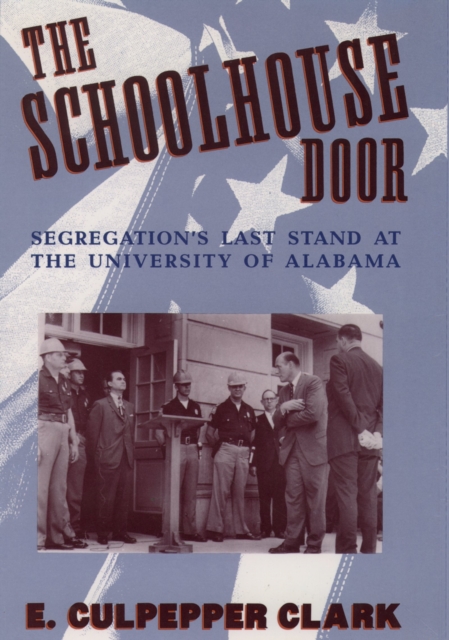
The Schoolhouse Door
The Schoolhosue Door tells the story of how the University of Alabama experienced the end of segregation and how two dramatic events on that campus sparked a struggle that heavily influenced the civil rights movement, exposing the massive resistance to such social change in the South.
eBook