
Catalogue Search | MBRL


Are you sure you want to remove the book from the shelf?

{{itemTitle}}
27
result(s) for
"Colombian drug war"
Sort by:

Democracy and Displacement in Colombia's Civil War
Democracy and Displacement in Colombia's Civil War is
one of few books available in English to provide an overview of the
Colombian civil war and drug war. Abbey Steele draws on her own
original field research as well as on Colombian scholars' work in
Spanish to provide an expansive view of the country's political
conflicts. Steele shows how political reforms in the context of
Colombia's ongoing civil war produced unexpected, dramatic
consequences: democratic elections revealed Colombian citizens'
political loyalties and allowed counterinsurgent armed groups to
implement political cleansing against civilians perceived as loyal
to insurgents.
Combining evidence collected from remote archives, more than two
hundred interviews, and quantitative data from the government's
displacement registry, Steele connects Colombia's political
development and the course of its civil war to purposeful
displacement. By introducing the concepts of collective targeting
and political cleansing, Steele extends what we already know about
patterns of ethnic cleansing to cases where expulsion of civilians
from their communities is based on nonethnic traits.
eBook
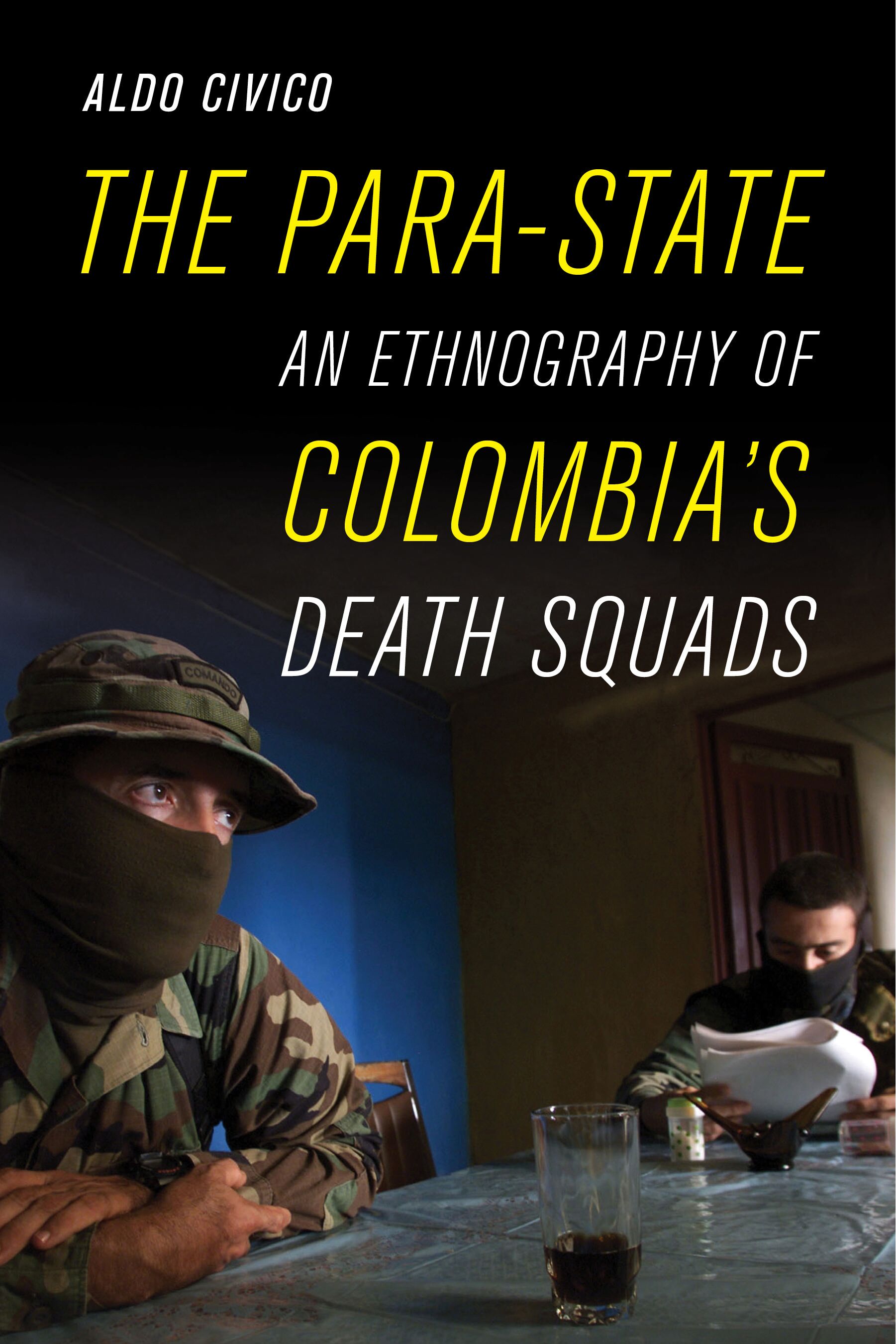
The para-state
Since its independence in the nineteenth century, the South American state of Colombia has been shaped by decades of bloody political violence. In The Para-State, Aldo Civico draws on interviews with paramilitary death squads and drug lords to provide a cultural interpretation of the country's history of violence and state control. Between 2003 and 2008, Civico gained unprecedented access to some of Colombia's most notorious leaders of the death squads. He also conducted interviews with the victims of paramilitary, with drug kingpins, and with vocal public supporters of the paramilitary groups. Drawing on the work of Deleuze and Guattari, this riveting work demonstrates how the paramilitaries have in essence become a war machine deployed by the Colombian state to control and maintain its territory and political legitimacy.
eBook

DECOMPOSITION AS LIFE POLITICS
How is life in a criminalized ecology in the Andean-Amazonian foothills of southwestern Colombia? In what way does antinarcotics policy that aims to eradicate la mata que mata (the plant that kills) pursue peace through poison? Relatedly, how do people keep on cultivating a garden, caring for forest, or growing food when at any moment a crop-duster plane may pass overhead, indiscriminately spraying herbicides over entire landscapes? Since 2000, the U.S.–Colombian War on Drugs has relied on the militarized aerial fumigation of coca plants, coupled with alternative development interventions that aim to forcibly eradicate illicit livelihoods. Through ethnographic engagement with small farmers in the frontier department of Putumayo, the gateway to the country’s Amazon and a region that has been the focus of counternarcotic operations, this article explores the different possibilities and foreclosures for life and death that emerge in a tropical forest ecology under military duress. By following farmers, their material practices, and their life philosophies, I trace the ways in which human-soil relations come to potentiate forms of resistance to the violence and criminalization produced by militarized, growth-oriented development. Rather than productivity—one of the central elements of modern capitalist growth—the regenerative capacity of these ecologies relies on organic decay, impermanence, decomposition, and even fragility that complicates modernist bifurcations of living and dying, allowing, I argue, for ecological imaginaries and life processes that do not rely on productivity or growth to strive into existence.
Journal Article

Land, justice, and memory: challenges for peace in Colombia
In this introduction, the editors present the seven articles that constitute this special issue on Colombia. They explain the context of the war that has wracked the country for more than 50 years and highlight the central themes that connect the articles. This essay also analyzes how the 2016 accord between the Colombian government and the Revolutionary Armed Forces of Colombia (FARC) aims to address the causes of the conflict so as to establish a durable peace with justice. The essay then looks at the challenges ahead for the implementation of the agreement. Issues of rural inequality, displacement, impunity, the illegal drug economy, the military, private armed groups, new social demands, innovative memory projects, and the changing role of the state are discussed. The bibliography provides a guide to some of the best Colombian literature on the armed conflict, its impact, and possible outcomes of the peace process.
Journal Article

Desestruturação de uma nação
O presente artigo busca analisar o desenvovimento histórico da Colombia que culminaram em sua atual deestruturação.
Journal Article

Estimating Effectiveness of the Control of Violence and Socioeconomic Development in Colombia: An Application of Dynamic Data Envelopment Analysis and Data Panel Approach
This paper develops an index to evaluate the level of effectiveness of the control of violence based on the data envelopment analysis approach. The index is used to examine the grade of effectiveness of the control of violence at the level of Colombian departments between 1993 and 2007. Comparing the results across Colombian departments, we find that the majority of departments show improvement in their scores of effectiveness. A second stage of the regression model reveals that departments with a higher gross domestic product and higher education and employment are more effective in the control of violence, whereas departments with higher political violence, unemployment rates, unsatisfied basic needs, a displaced population, and hectares cultivated with coca show lower effectiveness in the control of violence. All these findings are of particular interest in the formulation and development of policies against violence, taking into account that organised forms of violence, such as drug trafficking, impede the adequate effectiveness of its control. Moreover, violence decreases social investments, generating alterations in social services that produce long-run deterioration in faith in the government's ability to govern, which should become an incentive to further violence.
Journal Article

Drugs, Guns and Rebellion: A Comparative Analysis of the Arms Procurement of Insurgent Groups in Colombia and Myanmar
Several insurgent groups have financed their arms procurement through drug trafficking, explaining in part the long duration of conflicts in drug producing countries. Incomes generated from this trade do
not
however automatically translate into improved military capabilities, since access to military-grade weapons typically requires tacit or active state support. Hence, two groups with similar types of funding can still have access to very different types of armaments, impacting their operational capability. This paper compares the arms procurement of the Fuerzas Armadas Revolucionarias de Colombia (FARC) and the United Wa State Army (UWSA) in Myanmar. Both insurgent groups have procured arms through networks and with finances from the drug trade. The UWSA's 20,000-strong force and significant armaments, including Man-portable air defense systems (MANPADS) believed to be provided by China, is largely supported by these illicit activities and the networks they provide. FARC has ample access to small arms, the acquisition of which has been financed by taxation of the drug trade. In spite of significant incomes, FARC however until very recently lacked access to MANPADS, a fact which has significantly hampered its ability to withstand the Colombian counterinsurgency campaign, specifically targeted aerial assaults. The exploratory comparisons drawn in this paper offer insights into how insurgent groups can pass a crucial threshold of arms procurement, funded by illicit activities, that renders their dissolution far more difficult, while also highlighting the continued importance of state support in explaining rebel group resilience.
Journal Article

Participatory Performances by Tania Bruguera: Untitled and Tatlin's Whisper #6
According to Bishop, participatory performance is a kind of art that is capable of repairing the social bond through the act of witnessing in proximity, because it includes what is otherwise excluded from society (28). Instead of what we see (or hear), staying with the feeling of not getting it becomes a productive way to be together in a state of unknowing, even with the specter of contentiousness. [...]by presenting the ethical in an art form with a reduced aesthetic project-reduced because of the inherent frustration in not seeing or not being able to see the larger project, because it is internal or unknown- the spectator's focus is drawn to what is felt. [...]in Untitled, part of not getting it means experiencing frustration from not grasping the whole of the piece. Because the performance presents itself as an accumulation of its parts, but not its whole, even an understanding of several of the work's components can still leave the entirety of the piece unknown. Here, with regular people on stage, speaking briefly, but publicly to other audience members who are afforded the same opportunity, Tatlin 's Whisper #6 lays bare the everyday lack of other Cuban venues for public self-expression that includes critique. Since in Cuba an open and amplified platform for free speech is rare, and speaking openly can constitute risky behavior, whether to speak and what to say is laden with personal and political weight.
Journal Article

DERECHOS HUMANOS Y CORPOREIDAD EN \LOS EJÉRCITOS\ DE EVELIO ROSERO
La novela Los ejércitos (2007) del escritor colombiano Evelio Rosero (1958) ha conseguido un amplio público lector en el mercado internacional, gracias en parte a un conjunto importante de premios, entre los cuales se cuentan el Tusquets 2006, el Independent Foreign Fiction Prize 2009. el Aloa del Danish Center for Culture and Development 2011. Propongo que Los ejércitos está narrada desde una perspectiva corporeizada desde la cual se recrean las consecuencias del conflicto interno en la sociedad colombiana, en el cual se han perpetrado atrocidades y abusos durante décadas, asociados a ciclos de olvido y memoria. En este artículo analizo el discurso de los derechos humanos imbricado en Los ejércitos a partir de las reflexiones de Joseph Slaughter y Femando Rosenberg. Exploro en la novela las relaciones entre las narrativas de derechos humanos y corporeidad desde las criticas al sujeto liberal propuestas por Elizabeth Anker y Nick Mansfield, enlazándolas con los marcos de guerra propuestos por Judith Butler.
Journal Article