
Catalogue Search | MBRL


Are you sure you want to remove the book from the shelf?

{{itemTitle}}
2,863
result(s) for
"Colombians."
Sort by:

The veins of the ocean
\"Reina Castillo is [an] alluring young woman whose beloved brother is serving a death sentence for a crime that shocked the community: throwing a baby off a bridge--a crime for which Reina secretly blames herself. With her brother's death, though devastated and in mourning, Reina is finally released from her prison vigil. Seeking anonymity, she moves to a sleepy town in the Florida Keys where she meets Nesto Cadena, a recently exiled Cuban awaiting with hope the arrival of the children he left behind in Havana\"--Amazon.com.
Book
Callada escritura
Frágil materia de paso siempre a su antigua quietud o de regreso a su efervescencia inicial, la palabra apenas si roza esa vicisitud con el nombre que solemos ponerle a las cosas pero que nos resulta insuficiente, un nombre que no nombra, solamente indica esa revelación como quien pone una señal para que el peregrino no se extravíe. De resto todo se halla en el cambio, a veces espléndido y soberbio, otras inhibido y cauto, pero en todo caso de tránsito. Quien percibe así este acontecer y se yergue en medio de esas livianas aporías y atiende con medido júbilo sus encriptados mensajes, es una eremita que hace mucho tiempo bebe silencio, que le enseña a callar a las palabras, que les doma el alegato y ese afán de explicarlo todo y ahora pasea con ellas del ocaso al alba como unas criaturas de modales domésticos que dicen el buenos días en los amaneceres o el buenas noches cuando se encienden los fogones en las casas. La poesía de Claudia Trujillo conquista la vía media, no interviene, no modifica nada que esté allí ocupando su lugar en la naturaleza, no incurre en una orientación moral, las pasiones humanas discurren en estos breves Hai kues, o –más humildemente, así lo quisiera ella–, pictogramas, como iluminaciones súbitas que alteran de modo perenne nuestro modo de estar en el mundo.
eBook

Infinite country : a novel
Moving their family to what they believe will be a safer but temporary home in Houston, two young parents are forced to choose between an undocumented status in America and returning to the violence of war-torn Bogotá.
Book
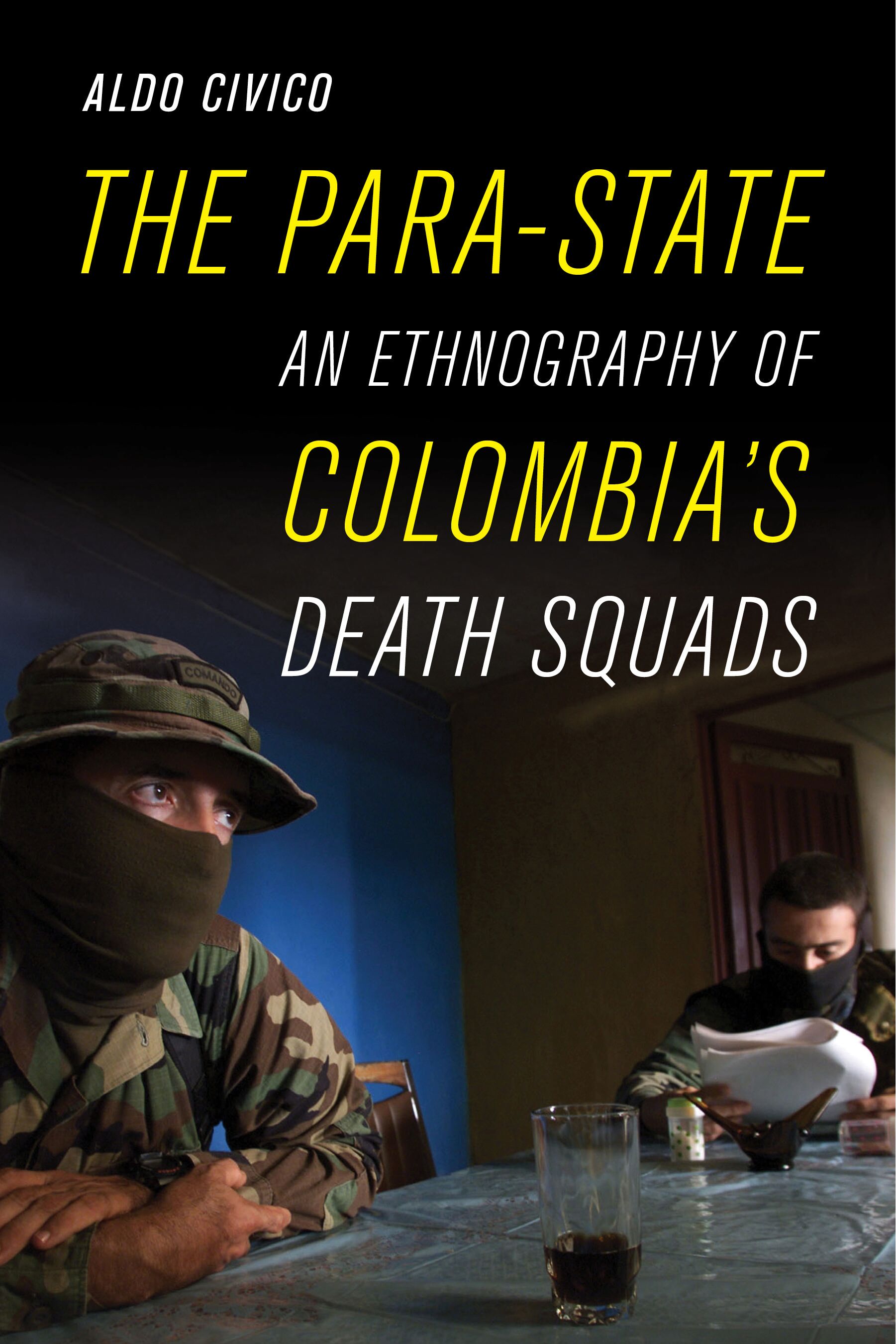
The para-state
Since its independence in the nineteenth century, the South American state of Colombia has been shaped by decades of bloody political violence. In The Para-State, Aldo Civico draws on interviews with paramilitary death squads and drug lords to provide a cultural interpretation of the country's history of violence and state control. Between 2003 and 2008, Civico gained unprecedented access to some of Colombia's most notorious leaders of the death squads. He also conducted interviews with the victims of paramilitary, with drug kingpins, and with vocal public supporters of the paramilitary groups. Drawing on the work of Deleuze and Guattari, this riveting work demonstrates how the paramilitaries have in essence become a war machine deployed by the Colombian state to control and maintain its territory and political legitimacy.
eBook
First report of Psecas euoplus Chamberlin amp; Ivie, 1936 from Colombia, with new salticid records for the department of C oacute;rdoba (Araneae, Salticidae)
Psecas euoplus Chamberlin & Ivie, 1936 is recorded for the first time from Colombia. In addition, the known distribution of the species Lyssomanes amazonicus G.W. Peckham, E.G. Peckham & Wheeler, 1889, Lyssomanes bitaeniatus G.W. Peckham, E.G. Peckham & Wheeler, 1889, Lyssomanes remotus G.W. Peckham & E.G. Peckham, 1896, and Sarinda armata (G.W. Peckham & E.G. Peckham, 1892), are extended to the department of Córdoba. We provide descriptions of the species reported here as well as images and drawings of both type material and our new records.
Journal Article
First record of Scaphiodontophis annulatus (Dum eacute;ril, Bibron amp; Dum eacute;ril, 1854) (Squamata, Sibynophiidae) from Serran iacute;a Montes de Mar iacute;a, department of Sucre, Colombia
We present a new record of Scaphiodontophis annulatus (Duméril, Bibron & Duméril, 1854) from Serranía Montes de María, department of Sucre, Colombia. This represents the second record of this species from the Colombian Caribbean region and the first from a tropical dry forest habitat. We discuss color variation across this species range, as the taxonomy of this species remains unresolved.
Journal Article

Democracy and Displacement in Colombia's Civil War
Democracy and Displacement in Colombia's Civil War is
one of few books available in English to provide an overview of the
Colombian civil war and drug war. Abbey Steele draws on her own
original field research as well as on Colombian scholars' work in
Spanish to provide an expansive view of the country's political
conflicts. Steele shows how political reforms in the context of
Colombia's ongoing civil war produced unexpected, dramatic
consequences: democratic elections revealed Colombian citizens'
political loyalties and allowed counterinsurgent armed groups to
implement political cleansing against civilians perceived as loyal
to insurgents.
Combining evidence collected from remote archives, more than two
hundred interviews, and quantitative data from the government's
displacement registry, Steele connects Colombia's political
development and the course of its civil war to purposeful
displacement. By introducing the concepts of collective targeting
and political cleansing, Steele extends what we already know about
patterns of ethnic cleansing to cases where expulsion of civilians
from their communities is based on nonethnic traits.
eBook

Childhood adversities and post-traumatic stress disorder: evidence for stress sensitisation in the World Mental Health Surveys
Although childhood adversities are known to predict increased risk of post-traumatic stress disorder (PTSD) after traumatic experiences, it is unclear whether this association varies by childhood adversity or traumatic experience types or by age.
To examine variation in associations of childhood adversities with PTSD according to childhood adversity types, traumatic experience types and life-course stage.
Epidemiological data were analysed from the World Mental Health Surveys (
= 27 017).
Four childhood adversities (physical and sexual abuse, neglect, parent psychopathology) were associated with similarly increased odds of PTSD following traumatic experiences (odds ratio (OR) = 1.8), whereas the other eight childhood adversities assessed did not predict PTSD. Childhood adversity-PTSD associations did not vary across traumatic experience types, but were stronger in childhood-adolescence and early-middle adulthood than later adulthood.
Childhood adversities are differentially associated with PTSD, with the strongest associations in childhood-adolescence and early-middle adulthood. Consistency of associations across traumatic experience types suggests that childhood adversities are associated with generalised vulnerability to PTSD following traumatic experiences.
Journal Article
Childhood adversities and adult psychopathology in the WHO World Mental Health Surveys
Although significant associations of childhood adversities with adult mental disorders are widely documented, most studies focus on single childhood adversities predicting single disorders.
To examine joint associations of 12 childhood adversities with first onset of 20 DSM-IV disorders in World Mental Health (WMH) Surveys in 21 countries.
Nationally or regionally representative surveys of 51 945 adults assessed childhood adversities and lifetime DSM-IV disorders with the WHO Composite International Diagnostic Interview (CIDI).
Childhood adversities were highly prevalent and interrelated. Childhood adversities associated with maladaptive family functioning (e.g. parental mental illness, child abuse, neglect) were the strongest predictors of disorders. Co-occurring childhood adversities associated with maladaptive family functioning had significant subadditive predictive associations and little specificity across disorders. Childhood adversities account for 29.8% of all disorders across countries.
Childhood adversities have strong associations with all classes of disorders at all life-course stages in all groups of WMH countries. Long-term associations imply the existence of as-yet undetermined mediators.
Journal Article
A vulnerability paradox in the cross-national prevalence of post-traumatic stress disorder
Determinants of cross-national differences in the prevalence of mental illness are poorly understood.
To test whether national post-traumatic stress disorder (PTSD) rates can be explained by (a) rates of exposure to trauma and (b) countries' overall cultural and socioeconomic vulnerability to adversity.
We collected general population studies on lifetime PTSD and trauma exposure, measured using the WHO Composite International Diagnostic Interview (DSM-IV). PTSD prevalence was identified for 24 countries (86 687 respondents) and exposure for 16 countries (53 038 respondents). PTSD was predicted using exposure and vulnerability data.
PTSD is related positively to exposure but negatively to country vulnerability. Together, exposure, vulnerability and their interaction explain approximately 75% of variance in the national prevalence of PTSD.
Contrary to expectations based on individual risk factors, we identified a paradox whereby greater country vulnerability is associated with a decreased, rather than increased, risk of PTSD for its citizens.
Journal Article