
Catalogue Search | MBRL


Are you sure you want to remove the book from the shelf?

{{itemTitle}}
9,063
result(s) for
"Colonization (Ecology)"
Sort by:


Landslide ecology / Lawrence R. Walker, University of Nevada, Las Vegas, Nevada, USA ; Aaron B. Shiels, USDA National Wildlife Research Center, Hilo, Hawaii, USA
\"Despite their often dangerous and unpredictable nature, landslides provide fascinating templates for studying how soil organisms, plants, and animals respond to such destruction. The emerging field of landslide ecology helps us to understand these responses, aiding slope stabilization and restoration and contributing to progress made in geological approaches to landslide prediction and mitigation. Summarizing the growing body of literature on the ecological consequences of landslides, this book provides a framework for the promotion of ecological tools in predicting, stabilizing, and restoring biodiversity to landslide scars at both local and landscape scales. It explores nutrient cycling; soil development; and how soil organisms disperse, colonize, and interact in what is often an inhospitable environment. Recognizing the role that these processes play in providing solutions to the problem of unstable slopes, the authors present ecological approaches as useful, economical, and resilient supplements to landslide management\"--
eBook


Population Structure and the Colonization Route of One of the Oldest North American Invasive Insects: Stories from the Worn Road of the Hessian Fly, Mayetiola destructor (Say)
An integral part to understanding the biology of an invasive species is determining its origin, particularly in pest species. As one of the oldest known invasive species, the goals of this study were to evaluate the evidence of a westward expansion of Hessian fly into North America, from a potential singular introduction event, and the population genetic structure of current populations. Levels of genetic diversity and population structure in the Hessian fly were compared across North America, Europe, North Africa, Western Asia, and New Zealand. Furthermore, Old World populations were evaluated as possible sources of introduction. We tested diversity and population structure by examining 18 microsatellite loci with coverage across all four Hessian fly chromosomes. Neither genetic diversity nor population genetic structure provided evidence of a westward movement from a single introduction in North America. Introduced populations in North America did not show identity or assignment to any Old World population, likely indicating a multiple introduction scenario with subsequent gene flow between populations. Diversity and selection were assessed on a chromosomal level, with no differences in diversity or selection between chromosomes or between native and introduced populations.
Journal Article

The nature of empires and the empires of nature : Indigenous peoples and the Great Lakes environment
Explores the power of Nature and the attempts by Empires (United States, Canada, and Britain) to control it from Indigenous or Indigenous influenced perspectives. This title hopes to inspire ways of looking at the Great Lakes watershed and the people and empires contained within it.
Book
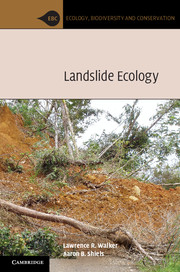
Landslide Ecology
Despite their often dangerous and unpredictable nature, landslides provide fascinating templates for studying how soil organisms, plants and animals respond to such destruction. The emerging field of landslide ecology helps us understand these responses, aiding slope stabilisation and restoration and contributing to the progress made in geological approaches to landslide prediction and mitigation. Summarising the growing body of literature on the ecological consequences of landslides, this book provides a framework for the promotion of ecological tools in predicting, stabilising, and restoring biodiversity to landslide scars at both local and landscape scales. It explores nutrient cycling; soil development; and how soil organisms disperse, colonise and interact in what is often an inhospitable environment. Recognising the role that these processes play in providing solutions to the problem of unstable slopes, the authors present ecological approaches as useful, economical and resilient supplements to landslide management.
eBook

Decline in vitality of propagules of Phytophthora pluvialis and Phytophthora kernoviae and their inability to contaminate or colonise bark and sapwood in Pinus radiata export log simulation studies
Investigates whether propagules of Phytophthora pluvialis and Phytophthora kernoviae, two fungal pathogens which can cause red needle cast disease in Pinus Radiata, are able to colonise bark of Pinus radiata logs or survive on the bark surface long enough to be carried overseas. Examines three aspects : natural occurrence of propagules on the bark surface; survival of propagules artificially applied to the bark surface; and colonisation of bark and sapwood by Phytophthora propagules. Source: National Library of New Zealand Te Puna Matauranga o Aotearoa, licensed by the Department of Internal Affairs for re-use under the Creative Commons Attribution 3.0 New Zealand Licence.
Journal Article

Impact of Human Colonization on the Landscape: A View from the Western Pacific
Reviews the impact of colonizing peoples on their landscape. Focuses on the initial human colonization of New Guinea by hunter-foraging populations; and the colonization of offshore islands of the Bismarck Archipelago by peoples argued to have practical agriculture. Assess the impact of these different subsistence strategies by comparing and contrasting these two colonization processes on the environment is, Source: National Library of New Zealand Te Puna Matauranga o Aotearoa, licensed by the Department of Internal Affairs for re-use under the Creative Commons Attribution 3.0 New Zealand Licence.
Journal Article
On the Rat Trail in Near Oceania: Applying the Commensal Model to the Question of the Lapita Colonization
Presents results of studies of Rattus exulans in which several locations in the Pacific were sampled to determine distribution of R. exulans mitochondrial DNA (mtDNA) haplotypes in an attempt to understand the movement of Lapita peoples across the region. Suggests that movement of people and rats may not have been as linear as originally thought. Source: National Library of New Zealand Te Puna Matauranga o Aotearoa, licensed by the Department of Internal Affairs for re-use under the Creative Commons Attribution 3.0 New Zealand Licence.
Journal Article

Lack of pre-dispersal seed predators in introduced Asteraceae in New Zealand
The idea that naturalised invading plants have fewer phytophagous insects associated with them in their new environment relative to their native range is often assumed, but quantitative data are few and mostly refer to pests on crop species. In this study, the incidence of seed-eating insect larvae in flowerheads of naturalised Asteraceae in New Zealand is compared with that in Britain where the species are native. Similar surveys were carried out in both countries by sampling 200 flowerheads of three populations of the same thirteen species. In the New Zealand populations only one seed-eating insect larva was found in 7800 flowerheads (0.013% infected flowerheads, all species combined) in contrast with the British populations which had 487 (6.24%) flowerheads infested. Possible reasons for the low colonization level of the introduced Asteraceae by native insects in New Zealand are 1) the relatively recent introduction of the plants (100-200 years), 2) their phylogenetic distance from the native flora, and 3) the specialised nature of the bud-infesting habit of the insects.
Journal Article