
Catalogue Search | MBRL


Are you sure you want to remove the book from the shelf?

{{itemTitle}}
269,123
result(s) for
"Color"
Sort by:


Living Color
Living Color is the first book to investigate the social history of skin color from prehistory to the present, showing how our body's most visible trait influences our social interactions in profound and complex ways. In a fascinating and wide-ranging discussion, Nina G. Jablonski begins with the biology and evolution of skin pigmentation, explaining how skin color changed as humans moved around the globe. She explores the relationship between melanin pigment and sunlight, and examines the consequences of rapid migrations, vacations, and other lifestyle choices that can create mismatches between our skin color and our environment. Richly illustrated, this book explains why skin color has come to be a biological trait with great social meaning— a product of evolution perceived by culture. It considers how we form impressions of others, how we create and use stereotypes, how negative stereotypes about dark skin developed and have played out through history—including being a basis for the transatlantic slave trade. Offering examples of how attitudes about skin color differ in the U.S., Brazil, India, and South Africa, Jablonski suggests that a knowledge of the evolution and social importance of skin color can help eliminate color-based discrimination and racism.
eBook

Universal principles of color : 100 key concepts for understanding, analyzing, and working with color
\"A comprehensive, cross-disciplinary overview of color, Universal Principles of Color presents 100 core concepts and guidelines that are critical to a successful use of color. Richly illustrated and easy to navigate, it pairs clear explanations of every topic with visual examples of it applied in theory and in practice. The book is organized alphabetically so that principles can be easily and quickly referenced. For those interested in addressing a specific color challenge or application problem, the principles are also indexed by pathways based on nine topics of color study ranging from science, art and design, and industry.\"-- Publisher.
Book

A very brief history of colour metaphysics
These are five playfully pessimistic meditations on the metaphysics of colour, arguing that metaphysical thinking does not fit well with the beautiful universe of colours: Neither Platonism nor relativism nor reductionism nor the distinction between primary and secondary qualities nor the denial of the existence of some colours at the expense of others offers convincing ways of dealing with the phenomena of colour. In the final, sixth meditation the standard analysis of magenta is challenged with some unorthodox ideas that can be traced back to Johann Wolfgang von Goethe’s colour research.
Journal Article
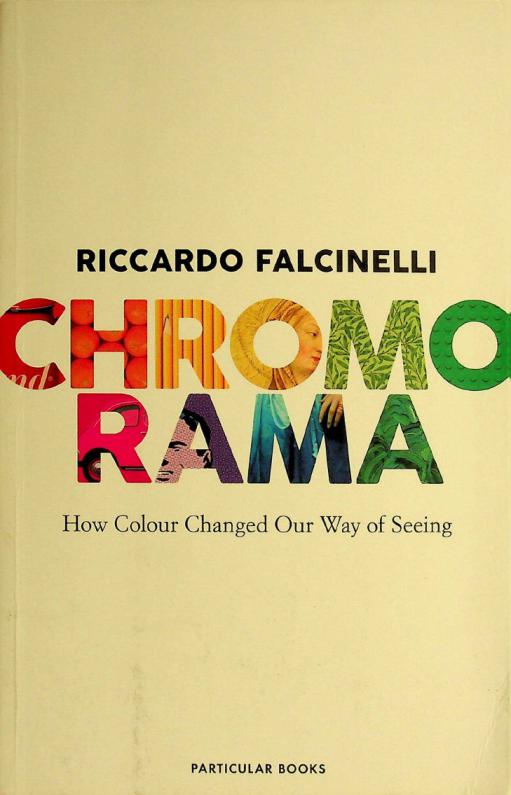
Chromorama : how colour changed our way of seeing
\"In Chromorama, acclaimed graphic designer Riccardo Falcinelli delves deep into the history of colour to show how it has shaped the modern gaze. With over four hundred illustrations throughout and with examples ranging widely across art and culture - from Flaubert's novels to The Simpsons, from Byzantine jewellery to misshapen fruit, from the black lines of Mondrian to the thrillers of Hitchcock - Falcinelli traces the evolution of our long relationship with colour, and how first the industrial revolution, and then the dawn of the internet age, changed it forever. Beautiful, warm and wise, taking in the lives of philosophers, entrepreneurs, designers, astrologists, shop assistants and pastry chef, Chromorama is an engrossing account of shade and light, of tone and hue, of dyes, pigments and pixels. It is the story of why we now see the world the way we do.\" -- flap of front cover.
Book

The Art and Technique of Digital Color Correction
How to\" books are a dime a dozen. What makes this book special is that it is also a \"Why\" book. Hullfish sits down with world-class colorists and records not only what they do but why they do it. That's where the magic lies.
\"How\" is the question to ask if you want to become a craftsman. \"Why\" is the question that creates artists. I bought the first edition for \"How\" and came away with a lot of \"Why.\" This edition has lots more of both, with material from several additional world class colorists.
If you want an inside look into the art and craft of the professional colorist there's no better way to do it in book form. Whether you're learning to be a colorist or just want to understand what really happens when you decide something can be \"fixed in post,\" you need to read this book. -Art Adams, cinematographer/educator, ProVideoCoalition.com. This book just keeps getting better with each new edition. Steve Hullfish's approach is designed to teach techniques that transfer to a wide range of popular and accessible color correction tools. The intent is to demystify the process, so readers can learn the concepts and apply them, regardless of whether the software has sliders, wheels or curves. Best of all, Hullfish features extensive tips and tricks from some of the premier colorists in the country, so you can learn from the masters. If you only purchase one book on color correction, this is the essential guide to include in your library. -Oliver Peters, Oliver Peters Peters Post Production Services, LLC A terrific and much-needed book for anybody serious about digital color correction. Starting with the basics, it helps the reader work through a series of specific, well-illustrated examples, covering all the major software applications, and supports the text with insightful comments from prominent working colorists. All in all, it's essential reading for anyone who wants to improve their skills in this rapidly changing field. -Steve Cohen, editor, Emmy and ACE Eddie winner, author of Avid Agility.
eBook

Cultures of Colour
Colour permeates contemporary visual and material culture and affects our senses beyond the superficial encounter by infiltrating our perceptions and memories and becoming deeply rooted in thought processes that categorise and divide along culturally constructed lines. Colour exists as a cultural as well as psycho-physical phenomenon and acquires a multitude of meanings within differing historical and cultural contexts. The contributors examine how colour becomes imbued with specific symbolic and material meanings that tint our constructions of race, gender, ideal bodies, the relationship of the self to others and of the self to technology and the built environment. By highlighting the relationship of colour across media and material culture, this volume reveals the complex interplay of cultural connotations, discursive practices and socio-psychological dynamics of colour in an international context.
eBook


Foundations of Colour Science
Presents the science of colour from new perspectives and outlines results obtained from the authors' work in the mathematical theory of colour
This innovative volume summarizes existing knowledge in the field, attempting to present as much data as possible about colour, accumulated in various branches of science (physics, phychophysics, colorimetry, physiology) from a unified theoretical position. Written by a colour specialist and a professional mathematician, the book offers a new theoretical framework based on functional analysis and convex analysis. Employing these branches of mathematics, instead of more conventional linear algebra, allows them to provide the knowledge required for developing techniques to measure colour appearance to the standards adopted in colorimetric measurements. The authors describe the mathematics in a language that is understandable for colour specialists and include a detailed overview of all chapters to help readers not familiar with colour science.
Divided into two parts, the book first covers various key aspects of light colour, such as colour stimulus space, colour mechanisms, colour detection and discrimination, light-colour perception typology, and light metamerism. The second part focuses on object colour, featuring detailed coverage of object-colour perception in single- and multiple-illuminant scenes, object-colour solid, colour constancy,
metamer mismatching, object-colour indeterminacy and more. Throughout the book, the authors combine differential geometry and topology with the scientific principles on which colour measurement and specification are currently based and applied in industrial applications.
* Presents a unique compilation of the author's substantial contributions to colour science
* Offers a new approach to colour perception and measurement, developing the theoretical framework used in colorimetry
* Bridges the gap between colour engineering and a coherent mathematical theory of colour
* Outlines mathematical foundations applicable to the colour vision of humans and animals as well as technologies equipped with artificial photosensors
* Contains algorithms for solving various problems in colour science, such as the mathematical problem of describing metameric lights
* Formulates all results to be accessible to non-mathematicians and colour specialists
Foundations of Colour Science: From Colorimetry to Perception is an invaluable resource for academics, researchers, industry professionals and undergraduate and graduate students with interest in a mathematical approach to the science of colour.
eBook