
Catalogue Search | MBRL


Are you sure you want to remove the book from the shelf?

{{itemTitle}}
1,413
result(s) for
"Color Social aspects"
Sort by:

On color
Ranging from Homer to Picasso, and from the Iranian Revolution to The Wizard of Oz, this spirited and radiant book awakens us anew to the role of color in our lives. Our lives are saturated by color. We live in a world of colors, and color marks our psychological and social existence. But for all color's inescapability, we don't know much about it. Authors David Scott Kastan and Stephen Farthing offer a fresh and imaginative exploration of one of the most intriguing and least understood aspects of everyday experience. Kastan and Farthing, a scholar and a painter, investigate color from numerous perspectives: literary, historical, cultural, anthropological, philosophical, art historical, political, and scientific. In ten wide-ranging chapters, each devoted to a different color, they examine the various ways colors have shaped and continue to shape our social and moral imaginations. Each individual color becomes the focal point for a consideration of one of the extraordinary ways in which color appears and matters in our lives.
BOOK

Living Color
Living Color is the first book to investigate the social history of skin color from prehistory to the present, showing how our body's most visible trait influences our social interactions in profound and complex ways. In a fascinating and wide-ranging discussion, Nina G. Jablonski begins with the biology and evolution of skin pigmentation, explaining how skin color changed as humans moved around the globe. She explores the relationship between melanin pigment and sunlight, and examines the consequences of rapid migrations, vacations, and other lifestyle choices that can create mismatches between our skin color and our environment. Richly illustrated, this book explains why skin color has come to be a biological trait with great social meaning— a product of evolution perceived by culture. It considers how we form impressions of others, how we create and use stereotypes, how negative stereotypes about dark skin developed and have played out through history—including being a basis for the transatlantic slave trade. Offering examples of how attitudes about skin color differ in the U.S., Brazil, India, and South Africa, Jablonski suggests that a knowledge of the evolution and social importance of skin color can help eliminate color-based discrimination and racism.
eBook


Shades of Difference
Was there such a thing as a modern notion of race in the English Renaissance, and, if so, was skin color its necessary marker? In fact, early modern texts described human beings of various national origins-including English-as turning white, brown, tawny, black, green, or red for any number of reasons, from the effects of the sun's rays or imbalance of the bodily humors to sexual desire or the application of makeup. It is in this cultural environment that the seventeenth-centuryLondon Gazetteused the term \"black\" to describe both dark-skinned African runaways and dark-haired Britons, such as Scots, who are now unquestioningly conceived of as \"white.\" InShades of Difference, Sujata Iyengar explores the cultural mythologies of skin color in a period during which colonial expansion and the slave trade introduced Britons to more dark-skinned persons than at any other time in their history. Looking to texts as divergent as sixteenth-century Elizabethan erotic verse, seventeenth-century lyrics, and Restoration prose romances, Iyengar considers the construction of race during the early modern period without oversimplifying the emergence of race as a color-coded classification or a black/white opposition. Rather, \"race,\" embodiment, and skin color are examined in their multiple contexts-historical, geographical, and literary. Iyengar engages works that have not previously been incorporated into discussions of the formation of race, such as Marlowe's \"Hero and Leander\" and Shakespeare's \"Venus and Adonis.\" By rethinking the emerging early modern connections between the notions of race, skin color, and gender,Shades of Differencefurthers an ongoing discussion with originality and impeccable scholarship.
eBook
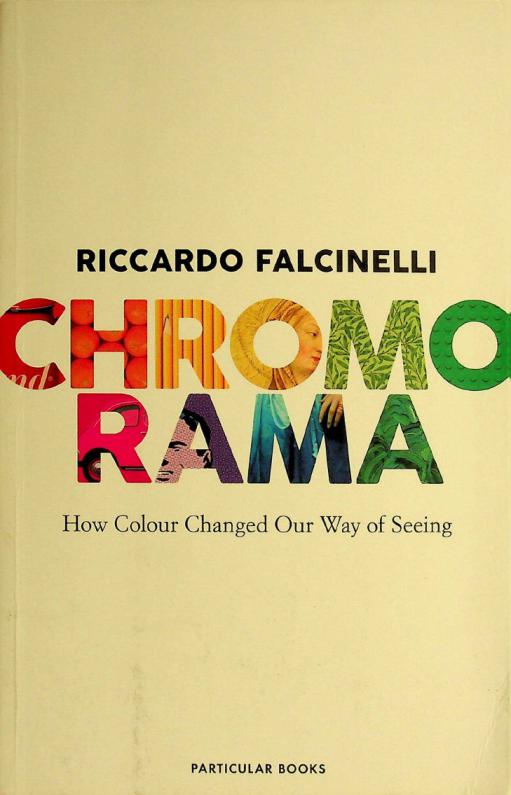
Chromorama : how colour changed our way of seeing
\"In Chromorama, acclaimed graphic designer Riccardo Falcinelli delves deep into the history of colour to show how it has shaped the modern gaze. With over four hundred illustrations throughout and with examples ranging widely across art and culture - from Flaubert's novels to The Simpsons, from Byzantine jewellery to misshapen fruit, from the black lines of Mondrian to the thrillers of Hitchcock - Falcinelli traces the evolution of our long relationship with colour, and how first the industrial revolution, and then the dawn of the internet age, changed it forever. Beautiful, warm and wise, taking in the lives of philosophers, entrepreneurs, designers, astrologists, shop assistants and pastry chef, Chromorama is an engrossing account of shade and light, of tone and hue, of dyes, pigments and pixels. It is the story of why we now see the world the way we do.\" -- flap of front cover.
Book

Race, Gender, and the Politics of Skin Tone
Race, Gender, and the Politics of Skin Tone tackles the hidden yet painful issue of colorism in the African American and Mexican American communities. Beginning with a historical discussion of slavery and colonization in the Americas, the book quickly moves forward to a contemporary analysis of how skin tone continues to plague people of color today. This is the first book to explore this well-known, yet rarely discussed phenomenon.
Margaret Hunter is Assistant Professor of Sociology at Loyola Marymount University in Los Angeles.
eBook

The secret lives of colour
The Secret Lives of Colour tells the unusual stories of the 75 most fascinating shades, dyes and hues. From blonde to ginger, the brown that changed the way battles were fought to the white that protected against the plague, Picasso's blue period to the charcoal on the cave walls at Lascaux, acid yellow to kelly green, and from scarlet women to imperial purple, these surprising stories run like a bright thread throughout history.
Book

Color in the age of impressionism : commerce, technology, and art
This study analyzes the impact of color-making technologies on the visual culture of nineteenth-century France, from the early commercialization of synthetic dyes to the Lumière brothers' perfection of the autochrome color photography process. Focusing on Impressionist art, Laura Anne Kalba examines the importance of dyes produced in the second half of the nineteenth century to the vision of artists such as Edgar Degas, Pierre-Auguste Renoir, and Claude Monet.
The proliferation of vibrant new colors in France during this time challenged popular understandings of realism, abstraction, and fantasy in the realms of fine art and popular culture. More than simply adding a touch of spectacle to everyday life, Kalba shows, these bright, varied colors came to define the development of a consumer culture increasingly based on the sensual appeal of color. Impressionism—emerging at a time when inexpensively produced color functioned as one of the principal means by and through which people understood modes of visual perception and signification—mirrored and mediated this change, shaping the ways in which people made sense of both modern life and modern art.
Demonstrating the central importance of color history and technologies to the study of visuality, Color in the Age of Impressionism adds a dynamic new layer to our understanding of visual and material culture.
eBook


Is lighter better?
Colorism is defined as \"discriminatory treatment of individuals falling within the same 'racial' group on the basis of skin color.\" In other words, some people, particularly women, are treated better or worse on account of the color of their skin relative to other people who share their same racial category. Colorism affects Asian Americans from many different backgrounds and who live in different parts of the United States. Is Lighter Better? discusses this often-overlooked topic. Joanne L. Rondilla and Paul Spickard ask important questions such as: What are the colorism issues that operate in Asian American communities? Are they the same issues for all Asian Americans—for women and for men, for immigrants and the American born, for Chinese, Filipinos, Koreans, Vietnamese, and other Asian Americans? Do they reflect a desire to look like White people, or is some other motive at work? Including numerous stories about and by people who have faced discrimination in their own lives, this book is an invaluable resource for people interested in colorism among Asian Americans.
eBook