
Catalogue Search | MBRL


Are you sure you want to remove the book from the shelf?

{{itemTitle}}
27,887
result(s) for
"Color in design"
Sort by:

Universal principles of color : 100 key concepts for understanding, analyzing, and working with color
\"A comprehensive, cross-disciplinary overview of color, Universal Principles of Color presents 100 core concepts and guidelines that are critical to a successful use of color. Richly illustrated and easy to navigate, it pairs clear explanations of every topic with visual examples of it applied in theory and in practice. The book is organized alphabetically so that principles can be easily and quickly referenced. For those interested in addressing a specific color challenge or application problem, the principles are also indexed by pathways based on nine topics of color study ranging from science, art and design, and industry.\"-- Publisher.
Book

The Color Revolution
When the fashion industry declares that lime green is the new black, or instructs us to \"think pink!,\" it is not the result of a backroom deal forged by a secretive cabal of fashion journalists, designers, manufacturers, and the editor of Vogue. It is the latest development of a color revolution that has been unfolding for more than a century. In this book, the award-winning historian Regina Lee Blaszczyk traces the relationship of color and commerce, from haute couture to automobile showrooms to interior design, describing the often unrecognized role of the color profession in consumer culture. Blaszczyk examines the evolution of the color profession from 1850 to 1970, telling the stories of innovators who managed the color cornucopia that modern artificial dyes and pigments made possible. These \"color stylists,\" \"color forecasters,\" and \"color engineers\" helped corporations understand the art of illusion and the psychology of color. Blaszczyk describes the strategic burst of color that took place in the 1920s, when General Motors introduced a bright blue sedan to compete with Ford's all-black Model T and when housewares became available in a range of brilliant hues. She explains the process of color forecasting--not a conspiracy to manipulate hapless consumers but a careful reading of cultural trends and consumer taste. And she shows how color information flowed from the fashion houses of Paris to textile mills in New Jersey. Today professional colorists are part of design management teams at such global corporations as Hilton, Disney, and Toyota. The Color Revolution tells the history of how colorists help industry capture the hearts and dollars of consumers.
eBook
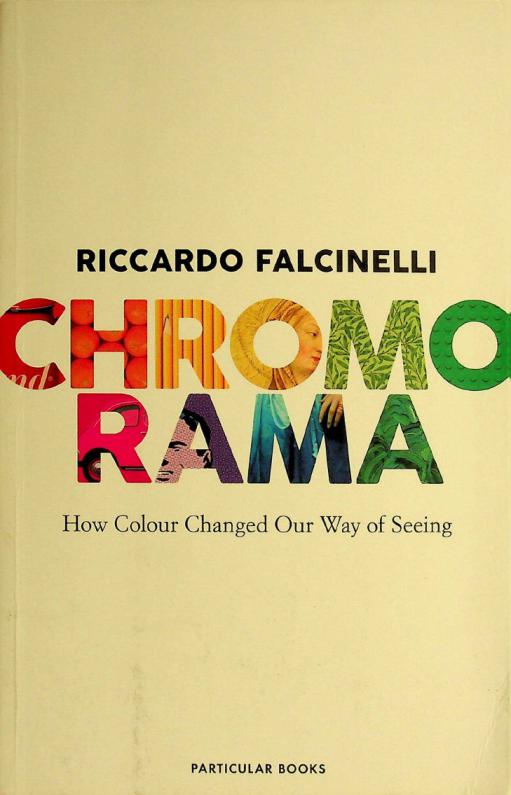
Chromorama : how colour changed our way of seeing
\"In Chromorama, acclaimed graphic designer Riccardo Falcinelli delves deep into the history of colour to show how it has shaped the modern gaze. With over four hundred illustrations throughout and with examples ranging widely across art and culture - from Flaubert's novels to The Simpsons, from Byzantine jewellery to misshapen fruit, from the black lines of Mondrian to the thrillers of Hitchcock - Falcinelli traces the evolution of our long relationship with colour, and how first the industrial revolution, and then the dawn of the internet age, changed it forever. Beautiful, warm and wise, taking in the lives of philosophers, entrepreneurs, designers, astrologists, shop assistants and pastry chef, Chromorama is an engrossing account of shade and light, of tone and hue, of dyes, pigments and pixels. It is the story of why we now see the world the way we do.\" -- flap of front cover.
Book

Research on the construction of an urban underground parking space color system from the perspective of psychological perception
Color, an intuitive element affecting human senses, can adapt to the environment of a space, evoke emotional responses, trigger and accumulate visual experiences, and enhance the effectiveness of color in shaping spatial atmosphere and reinforcing spatial divisions. In the context of rapid urban underground space development, examining the rational application of color in underground parking spaces is crucial for improving guidance, comfort, and aesthetics. This exploration is essential for achieving high-quality development in urban underground parking environments. Based on color psychology and using typical cities in China as case studies, this paper develops a color analytical framework for urban underground parking spaces through the process of “color field investigation—analysis of color influencing factors—color system construction—color application and control” and proposes a detailed chromatographic scheme. Within this framework, color field investigation serves as the foundation for determining color usage. Key influencing factors for color selection include color elements and their relationships, the type of underground parking space, and public color perception demands. The color system has been constructed including safe colors, prohibited colors, and theme colors, which has been further divided into basic, auxiliary, and accent colors. This study provides a replicable and practical theoretical and applied framework for urban underground space management and urban color planning. The framework facilitates the establishment of a standardized color system and chromatographic scheme that aligns with urban aesthetics and public psychology, thereby improving development quality and supporting the high-quality development of urban underground spaces.
Journal Article

Colorful living : simple ways to brighten your world through design, décor, fashion, and more
\"A bright, stylish, and practical guide to adding color to your life through home decor, fashion, art, and more to create joyful spaces that convey personal style, from the color enthusiast and DIY maven behind The Crafted Life\"-- Provided by publisher.
BOOK
Exploration of street space architectural color measurement based on street view big data and deep learning—A case study of Jiefang North Road Street in Tianjin
Urban space architectural color is the first feature to be perceived in a complex vision beyond shape, texture and material, and plays an important role in the expression of urban territory, humanity and style. However, because of the difficulty of color measurement, the study of architectural color in street space has been difficult to achieve large-scale and fine development. The measurement of architectural color in urban space has received attention from many disciplines. With the development and promotion of information technology, the maturity of street view big data and deep learning technology has provided ideas for the research of street architectural color measurement. Based on this background, this study explores a highly efficient and large-scale method for determining architectural colors in urban space based on deep learning technology and street view big data, with street space architectural colors as the research object. We conducted empirical research in Jiefang North Road, Tianjin. We introduced the SegNet deep learning algorithm to semantically segment the street view images, extract the architectural elements and optimize the edges of the architecture. Based on K-Means clustering model, we identified the colors of the architectural elements in the street view. The accuracy of the building color measurement results was cross-sectionally verified by means of a questionnaire survey. The validation results show that the method is feasible for the study of architectural colors in street space. Finally, the overall coordination, sequence continuity, and primary and secondary hierarchy of architectural colors of Jiefang North Road in Tianjin were analyzed. The results show that the measurement model can realize the intuitive expression of architectural color information, and also can assist designers in the analysis of architectural color in street space with the guidance of color characteristics. The method helps managers, planners and even the general public to summarize the characteristics of color and dig out problems, and is of great significance in the assessment and transformation of the color quality of the street space environment.
Journal Article


Sustainable Color Development Strategies for Ancient Chinese Historical Commercial Areas: A Case Study of Suzhou’s Xueshi Street–Wuzounfang Street
This study focuses on the issue of visual sustainability of colors in commercial historical districts, taking the historical area of Xueshi Street–Wuzoufang Street in Suzhou, China as a case study. It explores how to balance modern commercial development with the protection of historical culture. Due to the impact of commercialization and the introduction of various immature protection policies, historical districts often face the dilemma of coexisting “color conflict” and “color poverty”. Traditional color protection methods are either overly subjective or excessively quantitative, making it difficult to balance scientific rigor and adaptability. Therefore, this study provides a detailed literature review, compares and selects current quantitative color research methods, and proposes a comprehensive color analysis framework based on ViT (Vision Transformer), the CIEDE2000 color difference model, and K-means clustering (V-C-K framework). Using this framework, we conducted an in-depth analysis of the color-harmony situation in the studied area, aiming to accurately identify color issues in the district and provide optimization strategies. The experimental results show that the commercial colors of the Xueshi Street–Wuzoufang Street historical district exhibit a clear phenomenon of polarization: some areas have colors that are overly bright, leading to visual conflict, while others have colors that are too dull, lacking vitality and energy; furthermore, some areas display a mix of both conditions. Based on this situation, we then compared the extracted negative colors to the prohibited colors in the mainstream Munsell color system’s urban-color management guidelines. We found that colors with “high lightness and high saturation”, which are strictly limited by traditional color criteria, are not necessarily disharmonious, while “low lightness and low saturation” colors that are not restricted may not guarantee harmony either and could exacerbate the area’s “dilapidated feeling”. In other words, traditional color-protection standards often emphasize the safety of “low saturation and low lightness” colors unilaterally, ignoring that they can also cause dullness and discordance in certain environments. Under the ΔE (color difference value) threshold framework, color recognition is relatively more sensitive, balancing the inclusivity of “vibrant” colors and the caution against “dull” colors. Based on the above experimental results, this study proposes the following recommendations: (1) use the ΔE00 threshold to control the commercial colors in the district, ensuring that the colors align with the historical atmosphere while possessing commercial vitality; (2) in protection practices, comprehensively utilize the ViT, CIEDE2000, and K-means quantitative methods (i.e., the V-C-K framework) to reduce subjective errors; (3) based on the above quantitative framework, while referencing the reasonable parts of existing protection guidelines, combine cooperative collaboration, cultural group color preference surveys, policy incentives, and continuous monitoring and feedback to construct an operable plan for the entire “recognition–analysis–control” process.
Journal Article

The gardener's book of color
\"This guide takes color way beyond the existing guides for gardeners. It adds new dimensions to the art of gardening, and shows the gardener how to put plants together to make personal and effective combinations. It explores not only single-color plantings, but also the wide range of color associations available to the gardener for \"painting\" pictures with plants.\"-- Provided by publisher.
Book

Effect of smoking and finishing and polishing protocol on color stability and surface roughness of resin composite
Purpose
To investigate the influence of smoking and finishing and polishing protocol on color stability and surface roughness of resin composite.
Materials and methods
Seventy-two discs fabricated from supra-nanofilled composite were divided to 6 groups according to: Tobacco Product (Conventional Cigarette/CS and Heated Tobacco/HTP); and Finishing and Polishing Protocol (Control/C, Multi-step finishing system/FS, and Medium-grit abrasive bur + two-step polishing system/PS). After finishing and polishing, specimens were exposed to a total of 600 cigarettes, divided into 20 each day, simulating 30 days of smoking. Color parameters were detected using a spectrophotometer. Surface roughness (Ra) was measured before and after smoking exposure using a surface roughness tester. Surface morphology was assessed under SEM. Data were analyzed using ANOVA/Tukey’s and student t-test.
Results
For CS, ∆E values of C group was significantly higher than both finishing/polishing groups, which were statistically similar. For HTP, no significant difference in ∆E values between all groups. ∆E values of CS were significantly higher than HTP in all groups. For CS, C group showed significantly higher change in Ra than FS group; whilst no significant difference in Ra change values of PS and those of C and FS groups. For HTP, no significant difference in Ra change between all groups. Within C group, Ra change of both smoking groups was statistically similar. Within FS and PS groups, change in Ra of HTP was significantly higher than CS.
Conclusion
Conventional cigarette smoking resulted in pronounced color change in the supra-nanofilled composite. While heated tobacco product produced an increased surface roughness. Both multi-step finishing system and two-step polishing system displayed comparable color change and surface roughness in supra-nanofilled composite.
Journal Article