
Catalogue Search | MBRL


Are you sure you want to remove the book from the shelf?

{{itemTitle}}
6,568
result(s) for
"Columbia University"
Sort by:


Harlem vs. Columbia University
In 1968-69, Columbia University became the site for a collision of American social movements. Black Power, student power, antiwar, New Left, and Civil Rights movements all clashed with local and state politics when an alliance of black students and residents of Harlem and Morningside Heights openly protested the school's ill-conceived plan to build a large, private gymnasium in the small green park that separates the elite university from Harlem. Railing against the university's expansion policy, protesters occupied administration buildings and met violent opposition from both fellow students and the police._x000B__x000B_In this dynamic book, Stefan M. Bradley describes the impact of Black Power ideology on the Students' Afro-American Society (SAS) at Columbia. While white students--led by Mark Rudd and Students for a Democratic Society (SDS)--sought to radicalize the student body and restructure the university, black students focused on stopping the construction of the gym in Morningside Park. Through separate, militant action, black students and the black community stood up to the power of an Ivy League institution and stopped it from trampling over its relatively poor and powerless neighbors._x000B__x000B_Comparing the events at Columbia with similar events at Harvard, Cornell, Yale, and the University of Pennsylvania, Bradley locates this dramatic story within the context of the Black Power movement and the heightened youth activism of the 1960s. Harnessing the Civil Rights movement's spirit of civil disobedience and the Black Power movement's rhetoric and methodology, African American students were able to establish an identity for themselves on campus while representing the surrounding black community of Harlem. In doing so, Columbia's black students influenced their white peers on campus, re-energized the community's protest efforts, and eventually forced the university to share its power.
eBook

Columbia Business School
Featuring interviews with topflight scholars discussing their work and that of their colleagues, this retrospective of the first hundred years of Columbia Business School recounts the role of the preeminent institution in transforming education, industry, and global society. From its early years as the birthplace of value investing to its seminal influence on Warren Buffett and Benjamin Graham, the school has been a profound incubator of ideas and talent, determining the direction of American business.
In ten chapters, each representing a single subject of the school's research, senior faculty members recount the collaborative efforts and innovative approaches that led to revolutionary business methods in fields like finance, economics, and accounting. They describe the pioneering work that helped create new quantitative and stochastic tools to enhance corporate decision making, and they revisit the groundbreaking twentieth-century marketing and management paradigms that continue to affect the fundamentals of global business. The volume profiles several prominent centers and programs that have helped the school adapt to recent advancements in international business, entrepreneurship, and social enterprise. Columbia Business School has long offered its diverse students access to the best leaders and thinkers in the industry. This book not only reflects on these relationships but also imagines what might be accomplished in the next hundred years.
eBook


Nicholas miraculous
To those who loved him, like Teddy Roosevelt, he was \"Nicholas Miraculous,\" the fabled educator who had a hand in everything; to those who did not, like Upton Sinclair, he was \"the intellectual leader of the American plutocracy,\" a champion of \"false and cruel ideals.\" Ezra Pound branded him \"one of the more loathsome figures\" of the age. Whether celebrated or despised, Nicholas Murray Butler (1862-1947) was undeniably an irresistible force who helped shape American history.
With wit and irony, Michael Rosenthal traces Butler's rise to prominence as president of Columbia University, which he presided over for forty-four years and developed into one of the world's most distinguished institutions of research and teaching. Butler also won the Nobel Peace Prize and headed both the Carnegie Endowment and the American Academy of Arts and Letters, among innumerable other organizations. In 1920, he sought the Republican nomination for president, managing to garner more votes on the first ballot than the eventual winner, Warren Harding. Rosenthal's richly detailed, elegantly crafted narrative captures the mania and genius that propelled Butler to these extraordinary achievements and more. Thick with social, cultural, and political history,Nicholas Miraculousrecreates Butler's prodigious career and the dynamic age that nourished him.
eBook

An Improbable Life
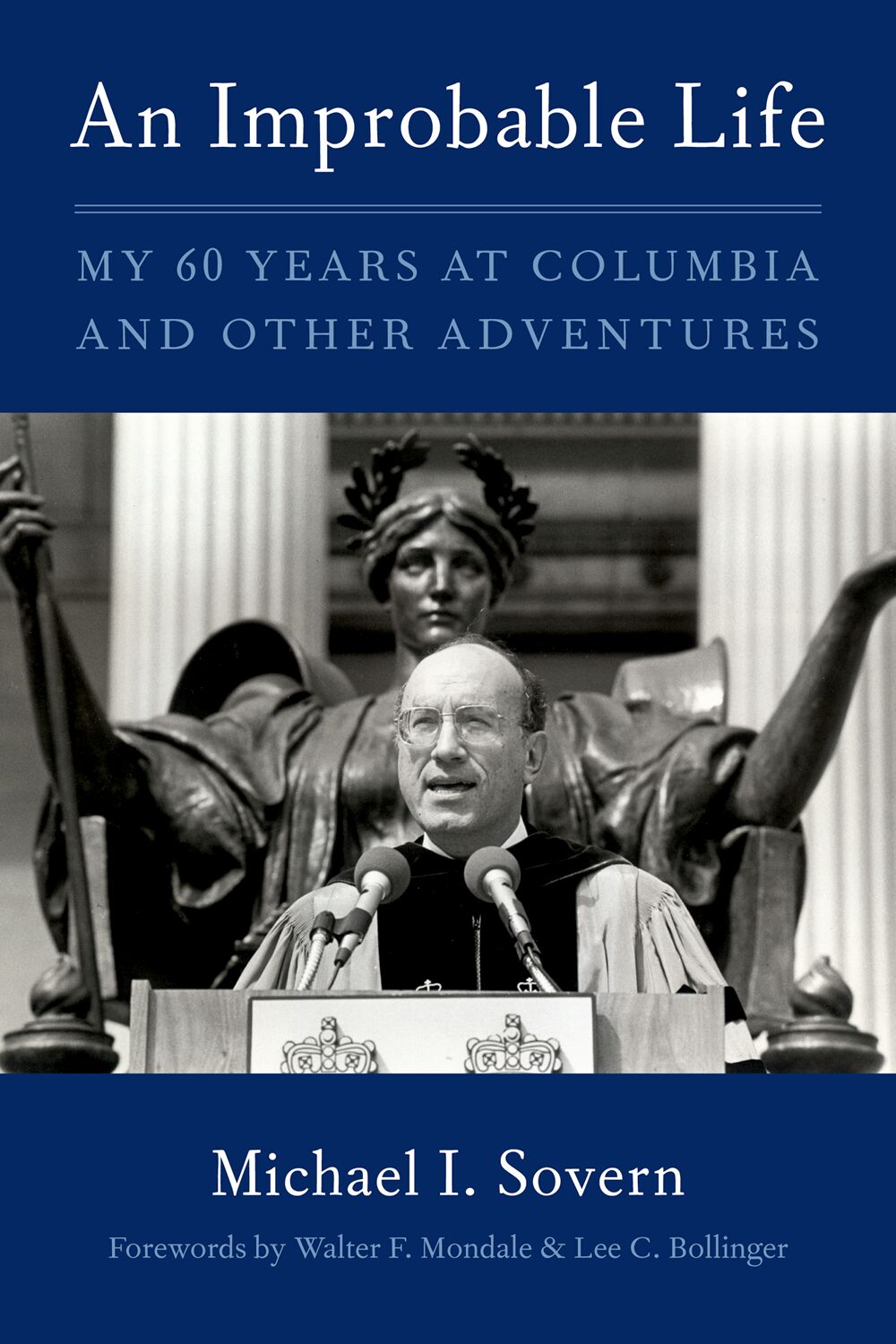
Columbia University began the second half of the twentieth century in decline, bottoming out with the student riots of 1968. Yet by the close of the century, the institution had regained its stature as one of the greatest universities in the world. According to the New York Times, \"If any one person is responsible for Columbia's recovery, it is surely Michael Sovern.\" In this memoir, Sovern, who served as the university's president from 1980 to 1993, recounts his sixty-year involvement with the institution, as well as his experiences growing up poor in the South Bronx and attending Columbia. Sovern addresses key debates in academia, such as how to make college available to all, whether affirmative action is fair, whether great researchers are paid too much and valuable teachers too little, what are the strengths and weaknesses of lifetime tenure, and what is the government's responsibility for funding universities. A labor-law specialist, Sovern also discusses his personal and professional accomplishments off campus, particularly his work to compensate victims of racial exploitation and his recommendations as chairman of the Commission on Integrity in Government.
eBook

From Da Ponte to the Casa Italiana : A Brief History of Italian Studies at Columbia University
\"The Casa Italiana--a neo-Renaissance palazzo located on Amsterdam Avenue near 117th Street--has been the most important expression of the Italian presence on Columbia University's campus since its construction in 1927. As a site of interdisciplinary scholarship and promotion of Italian culture, the Casa Italiana has made a substantial contribution to the academic study of Italy in America and the understanding of Italian cultural identity abroad. Celebrating the Casa's ninetieth anniversary, From Da Ponte to the Casa Italiana documents and recounts the history of the individuals, both Italian and American, who contributed to the formation of Columbia University's rich tradition of Italian studies. Barbara Faedda's succinct yet detailed historical survey begins at the dawn of Italian studies at Columbia with Lorenzo Da Ponte, Mozart's witty librettist who became the charismatic founder of the New York Metropolitan Opera and Columbia's first professor of Italian. Covering figures such as the former revolutionary Eleuterio Felice Foresti, Faedda elucidates the complex and often controversial dimensions of the Casa's history, highlighting protagonists such as Giuseppe Prezzolini and Nicholas M. Butler as well as Italian American students and community members. The Casa played a significant role in U.S.-Italian relations from its foundation, and at one point it came under fire, accused of ties to Mussolini and pro-Fascist leanings. Synthesizing archival documents with the work of historians, From Da Ponte to the Casa Italiana tells the compelling stories of the Casa and several of its leading figures, whose influence on the university can still be felt today\"--Provided by publisher.
Book

Columbia Business School
Foreword / Glenn Hubbard -- Finance and economics / Andrew Ang, Ann P. Bartel, Patrick Bolton, Wouter Dessein, Frank Edwards, Larry Glosten, Geoffrey Heal, Gur Huberman, Charles Jones, Chris Mayer, Frederic Mishkin, Eli Noam, Andrea Prat, Jonah Rockoff, Lynne Sagalyn, Stephen P. Zeldes, and Brian Thomas -- Value investing / Bruce Greenwald and Paul Johnson -- Management / Kathryn R. Harrigan -- Marketing / Morris Holbrook, Donald R. Lehmann, and Bernd Schmitt -- Decision, risk, and operations / Peter Kolesar, Costis Maglaras, Assaf Zeevi, Awi Federgruen, Fangruo Chen, Linda Green, Paul Glasserman, Garrett J. van Ryzin, and Mark N. Broadie -- Accounting / Trevor S. Harris -- Entrepreneurship / Murray Low -- International business / Shang-Jin Wei -- Social enterprise / Ray Horton and Sandra Navalli -- Contributors -- Index
Book