
Catalogue Search | MBRL


Are you sure you want to remove the book from the shelf?

{{itemTitle}}
121
result(s) for
"Common knowledge (logic)"
Sort by:

Rational ritual
Why do Internet, financial service, and beer commercials dominate Super Bowl advertising? How do political ceremonies establish authority? Why does repetition characterize anthems and ritual speech? Why were circular forms favored for public festivals during the French Revolution? This book answers these questions using a single concept: common knowledge.
Game theory shows that in order to coordinate its actions, a group of people must form \"common knowledge.\" Each person wants to participate only if others also participate. Members must have knowledge of each other, knowledge of that knowledge, knowledge of the knowledge of that knowledge, and so on. Michael Chwe applies this insight, with striking erudition, to analyze a range of rituals across history and cultures. He shows that public ceremonies are powerful not simply because they transmit meaning from a central source to each audience member but because they let audience members know what other members know. For instance, people watching the Super Bowl know that many others are seeing precisely what they see and that those people know in turn that many others are also watching. This creates common knowledge, and advertisers selling products that depend on consensus are willing to pay large sums to gain access to it. Remarkably, a great variety of rituals and ceremonies, such as formal inaugurations, work in much the same way.
By using a rational-choice argument to explain diverse cultural practices, Chwe argues for a close reciprocal relationship between the perspectives of rationality and culture. He illustrates how game theory can be applied to an unexpectedly broad spectrum of problems, while showing in an admirably clear way what game theory might hold for scholars in the social sciences and humanities who are not yet acquainted with it.
In a new afterword, Chwe delves into new applications of common knowledge, both in the real world and in experiments, and considers how generating common knowledge has become easier in the digital age.
eBook

Mechanizing common knowledge logic using COQ
This paper presents a formalization in Coq of Common Knowledge Logic and checks its adequacy on case studies. Those studies allow exploring experimentally the proof-theoretic side of Common Knowledge Logic. This work is original in that nobody has considered Higher Order Common Knowledge Logic from the point of view of proofs performed on a proof assistant. As a matter of facts, it is experimental by nature as it tries to draw conclusions from experiments.
Journal Article

Group problem solving
Experimental research by social and cognitive psychologists has established that cooperative groups solve a wide range of problems better than individuals. Cooperative problem solving groups of scientific researchers, auditors, financial analysts, air crash investigators, and forensic art experts are increasingly important in our complex and interdependent society. This comprehensive textbook--the first of its kind in decades--presents important theories and experimental research about group problem solving. The book focuses on tasks that have demonstrably correct solutions within mathematical, logical, scientific, or verbal systems, including algebra problems, analogies, vocabulary, and logical reasoning problems.
The book explores basic concepts in group problem solving, social combination models, group memory, group ability and world knowledge tasks, rule induction problems, letters-to-numbers problems, evidence for positive group-to-individual transfer, and social choice theory. The conclusion proposes ten generalizations that are supported by the theory and research on group problem solving.
Group Problem Solvingis an essential resource for decision-making research in social and cognitive psychology, but also extremely relevant to multidisciplinary and multicultural problem-solving teams in organizational behavior, business administration, management, and behavioral economics.
eBook
Rational decisions
It is widely held that Bayesian decision theory is the final word on how a rational person should make decisions. However, Leonard Savage--the inventor of Bayesian decision theory--argued that it would be ridiculous to use his theory outside the kind of small world in which it is always possible to \"look before you leap.\" If taken seriously, this view makes Bayesian decision theory inappropriate for the large worlds of scientific discovery and macroeconomic enterprise. When is it correct to use Bayesian decision theory--and when does it need to be modified? Using a minimum of mathematics, Rational Decisions clearly explains the foundations of Bayesian decision theory and shows why Savage restricted the theory's application to small worlds.
eBook
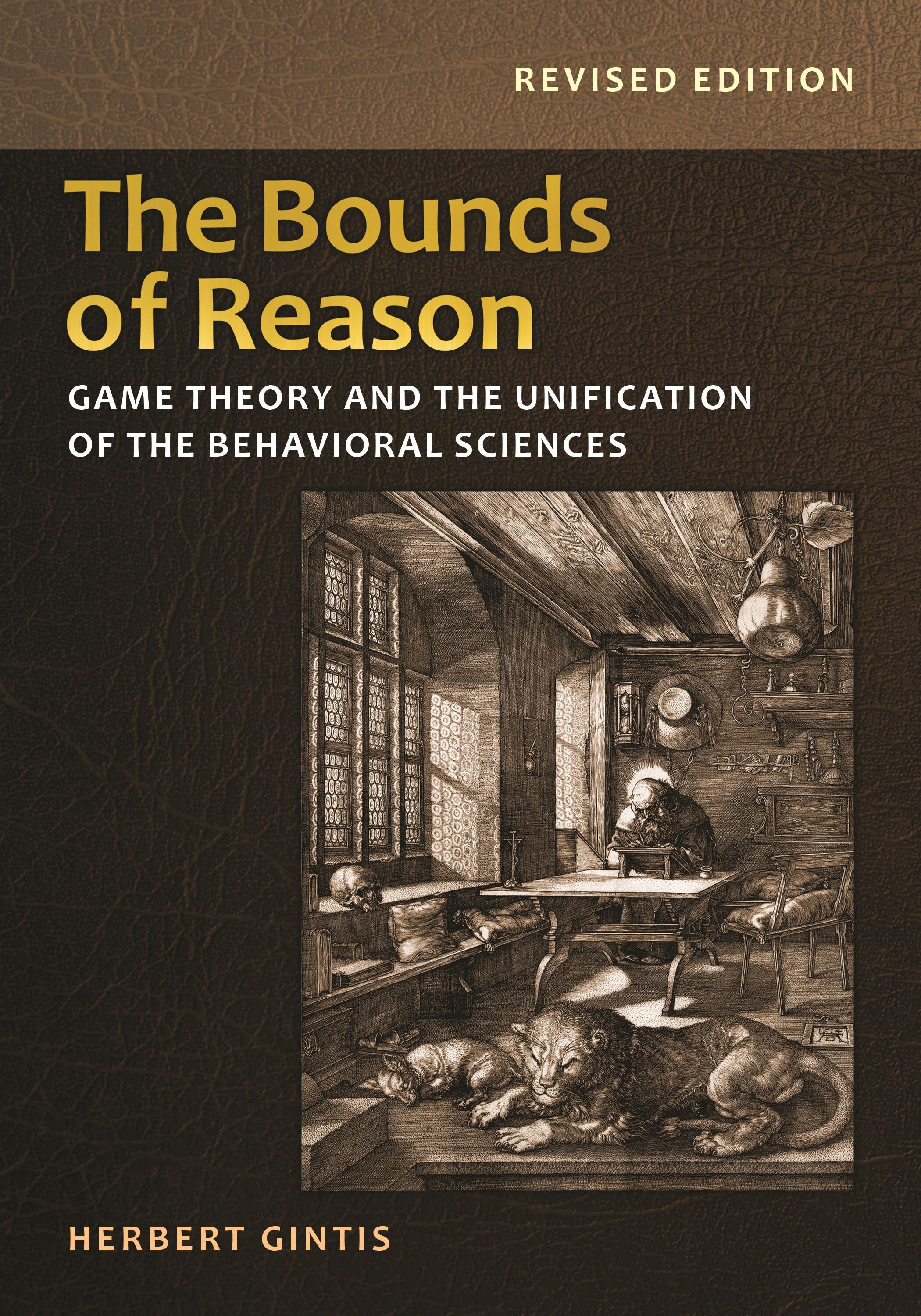
The bounds of reason
Game theory is central to understanding human behavior and relevant to all of the behavioral sciences—from biology and economics, to anthropology and political science. However, as The Bounds of Reason demonstrates, game theory alone cannot fully explain human behavior and should instead complement other key concepts championed by the behavioral disciplines. Herbert Gintis shows that just as game theory without broader social theory is merely technical bravado, so social theory without game theory is a handicapped enterprise. This edition has been thoroughly revised and updated.
Reinvigorating game theory, The Bounds of Reason offers innovative thinking for the behavioral sciences.
eBook

Epistemic Logics and Their Game Theoretic Applications: Introduction
This paper is written as an introduction to epistemic logics and their game theoretic applications. It starts with both semantics and syntax of classical logic, and goes to the Hilbert-style proof-theory and Kripke-style model theory of epistemic logics. In these theories, we discuss individual decision making in some simple game examples. In particular, we will discuss the distinction between beliefs and knowledge, and how false beliefs play roles in game theoretic decision making. Finally, we discuss extensions of epistemic logics to incorporate common knowledge. In the extension, we discuss also false beliefs on common knowledge.
Journal Article

Common knowledge logic and game logic
We show the faithful embedding of common knowledge logic CKL into game logic GL, that is, CKL is embedded into GL and GL is a conservative extension of the fragment obtained by this embedding. Then many results in GL are available in CKL, and vice versa. For example, an epistemic consideration of Nash equilibrium for a game with pure strategies in GL is carried over to CKL. Another important application is to obtain a Gentzen-style sequent calculus formulation of CKL and its cut-elimination. The faithful embedding theorem is proved for the KD4-type propositional CKL and GL, but it holds for some variants of them.
Journal Article

Quantifying over information change with common knowledge
Public announcement logic (PAL) extends multi-agent epistemic logic with dynamic operators modelling the effects of public communication. Allowing quantification over public announcements lets us reason about the
existence
of an announcement that reaches a certain epistemic goal. Two notable examples of logics of quantified announcements are arbitrary public announcement logic (APAL) and group announcement logic (GAL). While the notion of common knowledge plays an important role in PAL, and in particular in characterisations of epistemic states that an agent or a group of agents might make come about by performing public announcements, extensions of APAL and GAL with common knowledge still haven’t been studied in detail. That is what we do in this paper. In particular, we consider both conservative extensions, where the semantics of the quantifiers is not changed, as well as extensions where the scope of quantification also includes common knowledge formulas. We compare the expressivity of these extensions relative to each other and other connected logics, and provide sound and complete axiomatisations. Finally, we show how the completeness results can be used for other logics with quantification over information change.
Journal Article

Logic and the Foundations of Game and Decision Theory (LOFT 7)
This volume collects together revised papers originally presented at the 7th Conference on Logic and the Foundations of Game and Decision Theory (LOFT 2006). LOFT is a key venue for presenting research at the intersection of logic, economics and computer science, and the present collection gives a lively and wide-ranging view of an exciting and rapidly growing area. This title is available in the OAPEN Library - http://www.oapen.org.
eBook

Interval Multi-agent Logic with Reliability Operator
В предлагаемой статье мы изучаем нетранзитивную временную многоагентную логику с мультиозначиванием агентов и реляционные модели, представляющие надёжные состояния. Эти логики определяются семантически, как множества формул, истинных на линейных моделях с мультиозначиванием. В работе мы предложили основу для такого подхода и разработали технику для вычисления истинностных значений формул. Основной результат касается проблемы разрешимости. Доказано, что рассматриваемая логика разрешима.
Journal Article