
Catalogue Search | MBRL


Are you sure you want to remove the book from the shelf?

{{itemTitle}}
1,329
result(s) for
"Communication in science -- Europe -- History"
Sort by:


Measuring the new world
Prior to 1735, South America was largely terra incognita to many Europeans. But that year, the Paris Academy of Sciences sent a joint French and Spanish mission to the Spanish American province of Quito (in present-day Ecuador) to study the curvature of the Earth at the Equator—an expedition that would put South America on the map and in the minds of Europeans for centuries to come. Equipped with quadrants and telescopes, the mission’s participants referred to the transfer of scientific knowledge from Europe to the Andes as a “sacred fire” passing mysteriously through European astronomical instruments to curious observers in South America. By looking at the social and material traces of this expedition, Measuring the New World examines the transatlantic flow of knowledge in reverse—from West to East. Through ephemeral monuments and geographical maps, from the Andes to the Amazon River, the book explores how the social and cultural worlds of South America contributed to the production of European scientific knowledge during the Enlightenment. Neil Safier uses the notebooks of traveling philosophers, including Charles-Marie de La Condamine and others, as well as maps and specimens from the expedition, to place this particular scientific endeavor in the larger context of early modern print culture and the emerging intellectual category of scientist as author.
eBook

Knowledge and the Public Interest, 1575-1725
\"Many studies relate modern science to modern political and economic thought. Using one shift in order to explain the other, however, has begged the question of modernity's origins. New scientific and political reasoning emerged simultaneously as controversial forms of probabilistic reasoning. Neither could ground the other. They both rejected logical systems in favor of shifting, incomplete, and human-oriented forms of knowledge which did not meet accepted standards of speculative science. This study follows their shared development by tracing one key political stratagem for linking human desires to the advancement of knowledge: the collaborative wish list. Highly controversial at the beginning of the seventeenth century, charismatic desiderata lists spread across Europe, often deployed against traditional sciences. They did not enter the academy for a century but eventually so shaped the deep structures of research that today this once controversial genre appears to be a musty and even pedantic term of art\"-- Provided by publisher.
Book

The circulation of knowledge between Britain, India and China : the early-modern world to the twentieth century
In The Circulation of Knowledge Between Britain, India and China, twelve scholars examine how knowledge, things and people moved within, and between, the East and the West from the early modern period to the twentieth century.
eBook

Too much to know
The flood of information brought to us by advancing technology is often accompanied by a distressing sense of \"information overload,\" yet this experience is not unique to modern times. In fact, says Ann M. Blair in this intriguing book, the invention of the printing press and the ensuing abundance of books provoked sixteenth- and seventeenth-century European scholars to register complaints very similar to our own. Blair examines methods of information management in ancient and medieval Europe as well as the Islamic world and China, then focuses particular attention on the organization, composition, and reception of Latin reference books in print in early modern Europe. She explores in detail the sophisticated and sometimes idiosyncratic techniques that scholars and readers developed in an era of new technology and exploding information.
eBook

Hemispheres and Stratospheres
Recognizing distance as a central concern of the Enlightenment, this volume offers eight essays on distance in art and literature; on cultural transmission and exchange over distance; and on distance as a topic in science, a theme in literature, and a central issue in modern research methods. Through studies of landscape gardens, architecture, imaginary voyages, transcontinental philosophical exchange, and cosmological poetry, Hemispheres and Stratospheres unfurls the early history of a distance culture that influences our own era of global information exchange, long-haul flights, colossal skyscrapers, and space tourism.Published by Bucknell University Press. Distributed worldwide by Rutgers University Press.
eBook

Dissimulation and the Culture of Secrecy in Early Modern Europe
\"Larvatus prodeo,\" announced René Descartes at the beginning of the seventeenth century: \"I come forward, masked.\" Deliberately disguising or silencing their most intimate thoughts and emotions, many early modern Europeans besides Descartes-princes, courtiers, aristocrats and commoners alike-chose to practice the shadowy art of dissimulation. For men and women who could not risk revealing their inner lives to those around them, this art of incommunicativity was crucial, both personally and politically. Many writers and intellectuals sought to explain, expose, justify, or condemn the emergence of this new culture of secrecy, and from Naples to the Netherlands controversy swirled for two centuries around the powers and limits of dissimulation, whether in affairs of state or affairs of the heart. This beautifully written work crisscrosses Europe, with a special focus on Italy, to explore attitudes toward the art of dissimulation in the sixteenth and seventeenth centuries. Discussing many canonical and lesser-known works, Jon R. Snyder examines the treatment of dissimulation in early modern treatises and writings on the court, civility, moral philosophy, political theory, and in the visual arts.
eBook

States of credit
States of Creditprovides the first comprehensive look at the joint development of representative assemblies and public borrowing in Europe during the medieval and early modern eras. In this pioneering book, David Stasavage argues that unique advances in political representation allowed certain European states to gain early and advantageous access to credit, but the emergence of an active form of political representation itself depended on two underlying factors: compact geography and a strong mercantile presence.
Stasavage shows that active representative assemblies were more likely to be sustained in geographically small polities. These assemblies, dominated by mercantile groups that lent to governments, were in turn more likely to preserve access to credit. Given these conditions, smaller European city-states, such as Genoa and Cologne, had an advantage over larger territorial states, including France and Castile, because mercantile elites structured political institutions in order to effectively monitor public credit. While creditor oversight of public funds became an asset for city-states in need of finance, Stasavage suggests that the long-run implications were more ambiguous. City-states with the best access to credit often had the most closed and oligarchic systems of representation, hindering their ability to accept new economic innovations. This eventually transformed certain city-states from economic dynamos into rentier republics.
Exploring the links between representation and debt in medieval and early modern Europe,States of Creditcontributes to broad debates about state formation and Europe's economic rise.
eBook

Black Legacies
Black Legacies looks at color-based prejudice in medieval and modern texts in order to reveal key similarities. Bringing far-removed time periods into startling conversation, this book argues that certain attitudes and practices present in Europe's Middle Ages were foundational in the development of the western concept of race.
Using historical, literary, and artistic sources, Lynn Ramey shows that twelfth- and thirteenth-century discourse was preoccupied with skin color and the coding of black as \"evil\" and white as \"good.\" Ramey demonstrates that fears of miscegenation show up in all medieval European societies. She pinpoints these same ideas in the rhetoric of later centuries. Mapmakers and travel writers of the colonial era used medieval lore of \"monstrous peoples\" to question the humanity of indigenous New World populations, and medieval arguments about humanness were employed to justify the slave trade. Ramey even analyzes how race is explored in films set in medieval Europe, revealing an enduring fascination with the Middle Ages as a touchstone for processing and coping with racial conflict in the West today.
eBook
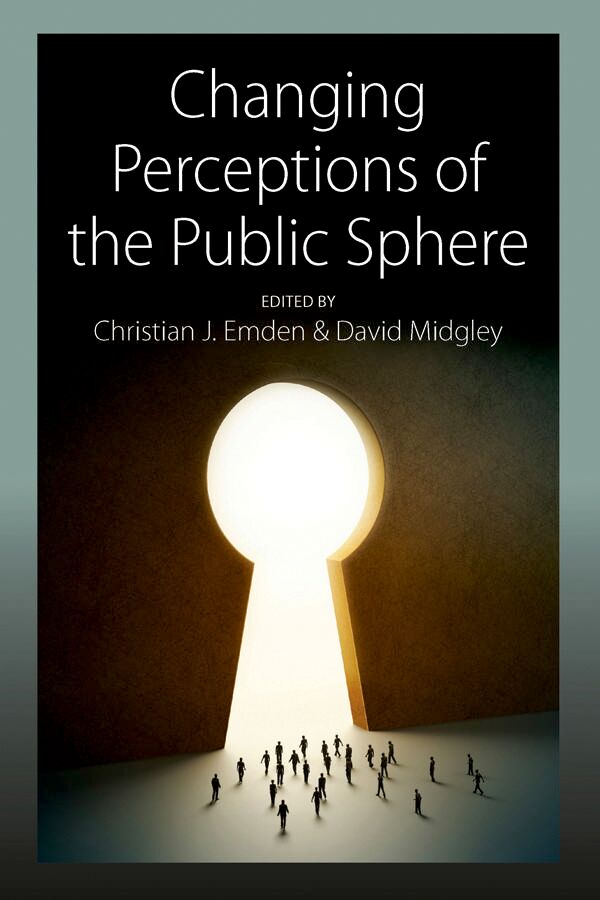
Changing perceptions of the public sphere
Initially propounded by the philosopher Jurgen Habermas in 1962 in order to describe the realm of social discourse between the state on one hand, and the private sphere of the market and the family on the other, the concept of a bourgeois public sphere quickly became a central point of reference in the humanities and social sciences. This volume reassesses the validity and reach of Habermas's concept beyond political theory by exploring concrete literary and cultural manifestations in early modern and modern Europe. The contributors ask whether, and in what forms, a social formation that rightfully can be called the \"public sphere\" really existed at particular historical junctures, and consider the senses in which the \"public sphere\" should rather be replaced by a multitude of interacting cultural and social \"publics.\" This volume offers insights into the current status of the \"public sphere\" within the disciplinary formation of the humanities and social sciences at the beginning of the twenty-first century.
eBook