
Catalogue Search | MBRL


Are you sure you want to remove the book from the shelf?

{{itemTitle}}
19,994
result(s) for
"Communication in science United States."
Sort by:

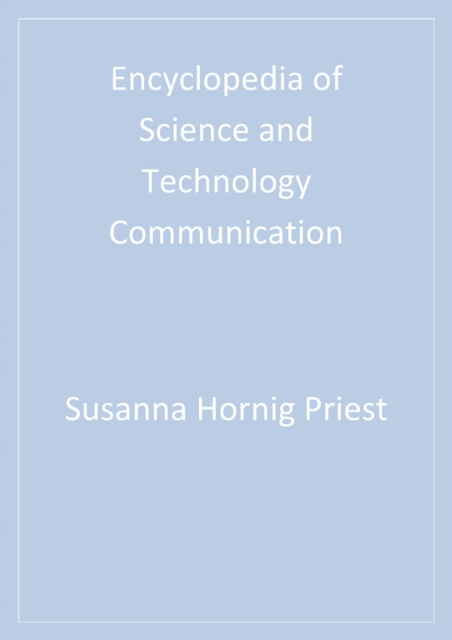
Encyclopedia of science and technology communication
In the academic world, the term “science communication” refers both to a set of professions (such as science journalism and public information work) and to an interdisciplinary scholarly research specialization. Much of this research is aimed at improving our understanding of the best ways to communicate complex information, especially to people who are not scientists. Science communication specialists are concerned with giving people useful information about health, environment, and technology – as well as science itself. In order to do this, we also need to improve our understanding of how people think, form opinions, and process information.Additionally, professional practitioners in science communication are engaged in strategic and ethical decisions every day, such as: How should reporters cover the issue of climate change? Should the views of scientists who do not believe that climate change has been caused by human activity be included alongside the views of those who do, in order to give a “balanced” story, or does this mislead the public into thinking that both of these positions are equally accepted within the scientific community?The Encyclopedia of Science and Technology Communication provides information on the entire range of interrelated issues in this interdisciplinary field in one place, along with clear suggestions on where to begin the search for more. Geared towards undergraduate and graduate students in journalism, communication, mass communication, and media studies, as well as towards working journalists, public information officers, and public relations specialists, this encyclopedia introduces this vast, fascinating field while challenging the reader to question assumptions inherent in communication across disciplinary boundaries.Key Themes Venues and Channels
eBook
The brain development revolution : science, the media, and public policy
\"Today we perceive children and the influences on them with regard to their developing brains. This book documents how brain development became the dominant lens for understanding children's development, the benefits and missed opportunities for children that resulted, and why brain development compels our attention\"-- Provided by publisher.
Book

Unscientific America
Climate change, the energy crisis, nuclear proliferationmany of the most urgent problems of the twenty-first century require scientific solutions, yet America is paying less and less attention to scientists. For every five hours of cable news, less than one minute is devoted to science, and the number of newspapers with science sections has shrunk from ninety-five to thirty-three in the last twenty years. In Unscientific America, journalist and best-selling author Chris Mooney and scientist Sheril Kirshenbaum explain this dangerous state of affairs, proposing a broad array of initiatives that could reverse the current trend. An impassioned call to arms, Unscientific America exhorts Americans to reintegrate science into public discoursebefore it is too late.
eBook
Communicating politics online : changing modes, changing information
\"Shifting to an online world has drastically changed political communication. From producers of news and the consumers receiving it, from how campaigns communicate with voters to how elected officials connect with constituents, technology has disrupted political communication by making the speed of messages faster, creating a social environment that allows for mobile creation and consumption of content. In Communicating Politics Online, Chapman Rackaway shows how every actor involved in the political world, from the President to the everyday voter, has to rethink the process and strategy of political communication. Using online supplements linked to the main text allows the book to capture the hyper-accelerated pace of new media political communication\"-- Provided by publisher.
Book

Interacademy Programs Between the United States and Eastern Europe 1967-2009
Interacademy Programs Between the United States and Eastern Europe 1967-2009 documents how interacademy programs have played a significant role in establishing and maintaining American scientific contacts with colleagues in Eastern Europe prior to and following the lifting of the Iron Curtain. The book also discusses the changing roles of the academies of the region and the changing nature of interacademy cooperation that has emerged since 1991. The countries of interest are Poland, the Czech Republic, Slovakia, Hungary, Romania, Bulgaria, the former German Democratic Republic, and the countries that previously were united politically within the framework of the former Yugoslavia.
The book should be of interest to officials and specialists in both the United States and the countries of Eastern Europe who are actively engaged in promoting scientific cooperation through bilateral and other channels. Also, an emerging audience for this book is the growing group of analysts in the United States interested in \"science diplomacy\" involving U.S. cooperation with countries that have political agendas that differ in important respects from the objectives of U.S. policies.
eBook

The politics of common sense : how social movements use public discourse to change politics and win acceptance
\"The way that movements communicate with the general public matters for their chances of lasting success. Devo Woodly argue that the potential for movement-led political change is significantly rooted in mainstream democratic discourse and specifically in the political acceptance of new issues by news media, the general public, and elected officials. This is true to some extent for any group wishing to alter status quo distributions of rights and/or resources, but is especially important for grassroots challengers who do not already have a place of legitimated influence in the polity. By examining the talk of two contemporary movements, the living wage and marriage equality, during the critical decade after their emergence between 1994-2004, Woodly shows that while the living wage movement experienced over 120 policy victories and the marriage equality movement suffered many policy defeats, the overall impact that marriage equality had on changing American politics was much greater than that of the living wage because of its deliberate effort to change mainstream political discourse, and thus, the public understanding of the politics surrounding the issue\"-- Provided by publisher.
Book
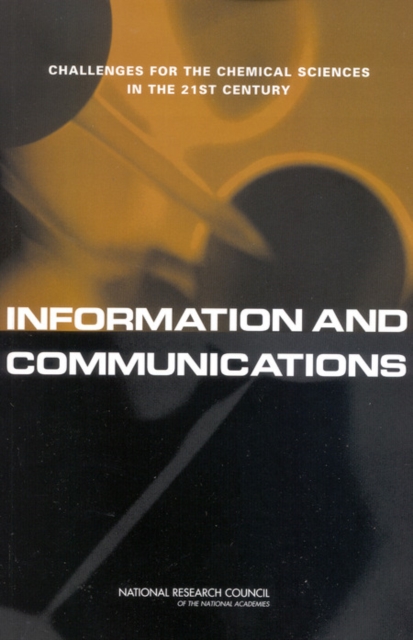
Information and Communications
Since publication of the National Research Council (NRC) reports on chemistry in 1985 and chemical engineering in 1988,1,2 dramatic advances in information technology (IT) have totally changed these communities. During this period, the chemical enterprise and information technology have enjoyed both a remarkably productive and mutually supportive set of advances. These synergies sparked unprecedented growth in the capability and productivity of both fields including the definition of entirely new areas of the chemical enterprise. The chemical enterprise provided information technology with device fabrication processes, new materials, data, models, methods, and (most importantly) people. In turn, information technology provided chemical science and technology with truly remarkable and revolutionary resources for computations, communications, and data management. Indeed, computation has become the strong third component of the chemical science research and development effort, joining experiment and theory. Sustained mutual growth and interdependence of the chemical and information communities should take account of several unique aspects of the chemical sciences. These include extensive and complex databases that characterize the chemical disciplines; the importance of multiscale simulations that range from molecules to technological processes; the global economic impact of the chemical industry; and the industry's major influence on the nation's health, environment, security, and economic well-being. In planning the future of the chemical sciences and technology, it is crucial to recognize the benefits already derived from advances in information technology as well as to point the way to future benefits that will be derived.
eBook

The party politics of presidential rhetoric
\"This book demonstrates that presidents are successful leaders of public opinion - once we recognize the dynamics of public opinion, and the partisan nature of the presidents' activities and public response to them. Presidents have a significant advantage over every other political actor in reaching and affecting the views and preferences of Americans\"-- Provided by publisher.
Book

Beyond 'Fortress America'
The national security controls that regulate access to and export of science and technology are broken. As currently structured, many of these controls undermine our national and homeland security and stifle American engagement in the global economy, and in science and technology. These unintended consequences arise from policies that were crafted for an earlier era. In the name of maintaining superiority, the U.S. now runs the risk of becoming less secure, less competitive and less prosperous.
Beyond \"Fortress America\" provides an account of the costs associated with building walls that hamper our access to global science and technology that dampen our economic potential. The book also makes recommendations to reform the export control process, ensure scientific and technological competitiveness, and improve the non-immigrant visa system that regulates entry into the United States of foreign science and engineering students, scholars, and professionals.
Beyond \"Fortress America\" contains vital information and action items for the President and policy makers that will affect the United States' ability to compete globally. Interested parties-including military personnel, engineers, scientists, professionals, industrialists, and scholars-will find this book a valuable tool for stemming a serious decline affecting broad areas of the nation's security and economy.
eBook