
Catalogue Search | MBRL


Are you sure you want to remove the book from the shelf?

{{itemTitle}}
27,232
result(s) for
"Communism History."
Sort by:


Post-Communist Mafia State
Having won a two-third majority in Parliament at the 2010 elections, the Hungarian political party Fidesz removed many of the institutional obstacles of exerting power. Just like the party, the state itself was placed under the control of a single individual, who since then has applied the techniques used within his party to enforce submission and obedience onto society as a whole. In a new approach the author characterizes the system as the ‘organized over-world’, the ‘state employing mafia methods’ and the ’adopted political family', applying these categories not as metaphors but elements of a coherent conceptual framework.The actions of the post-communist mafia state model are closely aligned with the interests of power and wealth concentrated in the hands of a small group of insiders. While the traditional mafia channeled wealth and economic players into its spheres of influence by means of direct coercion, the mafia state does the same by means of parliamentary legislation, legal prosecution, tax authority, police forces and secret service. The innovative conceptual framework of the book is important and timely not only for Hungary, but also for other post-communist countries subjected to autocratic rules.
eBook


Remembering Communism
Remembering Communism examines the formation and transformation of the memory of communism in the post-communist period. The majority of the articles focus on memory practices in the post-Stalinist era in Bulgaria and Romania, with occasional references to the cases of Poland and the GDR. Based on an interdisciplinary approach, including history, anthropology, cultural studies and sociology, the volume examines the mechanisms and processes that influence, determine and mint the private and public memory of communism in the post-1989 era. The common denominator to all essays is the emphasis on the process of remembering in the present, and the modalities by means of which the present perspective shapes processes of remembering, including practices of commemoration and representation of the past.
The volume deals with eight major thematic blocks revisiting specific practices in communism such as popular culture and everyday life, childhood, labor, the secret police, and the perception of \"the system\".
eBook


The Emergence of Global Maoism
The Emergence of Global Maoism
examines the spread of Mao Zedong's writings, ideology, and
institutions when they traveled outside of China. Matthew
Galway links Chinese Communist Party efforts to globalize Maoism to
the dialectical engagement of exported Maoism by Cambodian Maoist
intellectuals.
How do ideas manifest outside of their place of origin? Galway
analyzes how universal ideological systems became localized, both
in Mao's indigenization of Marxism-Leninism and in the Communist
Party of Kampuchea's indigenization of Maoism into its own
revolutionary ideology. By examining the intellectual journeys of
CPK leaders who, during their studies in Paris in the 1950s, became
progressive activist-intellectuals and full-fledged Communists, he
shows that they responded to political and socioeconomic crises by
speaking back to Maoism-adapting it through practice, without
abandoning its universality. Among Mao's greatest achievements, the
Sinification of Marxism enabled the CCP to canonize Mao's thought
and export it to a progressive audience of international
intellectuals. These intellectuals would come to embrace the
ideology as they set a course for social change.
The Emergence of Global Maoism illuminates the process
through which China moved its goal from class revolution to a
larger anticolonial project that sought to cast out European and
American imperialism from Asia.
eBook

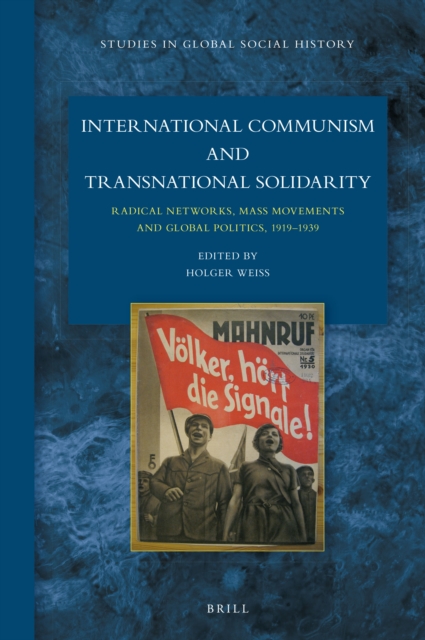
International communism and transnational solidarity : radical networks, mass movements and global politics, 1919-1939
This book provides an analysis of the articulation and organisation of radical international solidarity by organisations that were either connected to or had been established by the Communist International (Comintern), such as the International Red Aid, the International Workers' Relief, the League Against Imperialism, the International of Seamen and Harbour Workers and the International Trade Union Committee of Negro Workers. The guiding light of these organisations was a radical interpretation of international solidarity, usually in combination with concepts and visions of gender, race and class as well as anti-capitalism, anti-imperialism, anti-colonialism and anti-fascism. All of these new transnational networks form a controversial part of the contemporary history of international organisations. Like the Comintern these international organisations had an ambigious character that does not fit nicely into the traditional typologies of international organisations as they were neither international governmental organisations nor international non-governmental organisations. They constituted a radical continuation of the pre-First World War Left and exemplified an attempt to implement the ideas and movements of a new type of radical international solidarity not only in Europe, but on a global scale. Contributors are: Gleb J. Albert, Bernhard H. Bayerlein, Kasper Braskén, Fredrik Petersson, Holger Weiss.
eBook


State Building in Putin’s Russia
This book argues that Putin's strategy for rebuilding the state was fundamentally flawed. Taylor demonstrates that a disregard for the way state officials behave toward citizens - state quality - had a negative impact on what the state could do - state capacity. Focusing on those organizations that control state coercion, what Russians call the 'power ministries', Taylor shows that many of the weaknesses of the Russian state that existed under Boris Yeltsin persisted under Putin. Drawing on extensive field research and interviews, as well as a wide range of comparative data, the book reveals the practices and norms that guide the behavior of Russian power ministry officials (the so-called siloviki), especially law enforcement personnel. By examining siloviki behavior from the Kremlin down to the street level, State Building in Putin's Russia uncovers the who, where and how of Russian state building after communism.
eBook