
Catalogue Search | MBRL


Are you sure you want to remove the book from the shelf?

{{itemTitle}}
27
result(s) for
"Community activists Fiction."
Sort by:

The soil
\"A major, never before translated novel by the author of Mujông / The Heartless -- often called the first modern Korean novel -- The Soil tells the story of an idealist dedicating his life to helping the inhabitants of the rural community in which he was raised. Striving to influence the poor farmers of the time to improve their lots, become self-reliant, and thus indirectly change the reality of colonial life on the Korean peninsula, The Soil was vitally important to the social movements of the time, echoing the effects and reception of such English-language novels as Upton Sinclair's The Jungle\"-- Provided by publisher.
Book

Like a Love/Hate Story: Reckoning with Adultism and Youth Critique in Intergenerational LGBTQ+ Literacy Spaces
Reflecting on their facilitation of an online book club for LGBTQ+ youth, the authors discuss the importance of teaching queer histories, making space for youth critique, and following the lead of LGBTQ+ youth when reading and teaching queerly.
Journal Article

Birnam Wood
The Booker-winning author of The Luminaries delivers a gripping thriller of high drama and kaleidoscopic insight into what drives us to survive -- Provided by publisher.
Book


Distribution, Recognition, and Participation: The Paradigm for the Human Right to a Sustainable Environment and Eco-justice in Mahasweta Devi’s Eco-critical Writing
Fifty-one years ago, in April 2023, the first Chipko protest saw
Adivasis,
or indigenous Indian women, embracing trees to prevent the logging of the green Himalayan forests. The Chipko Movement got its name from the Hindi word ‘
chipko
’ meaning ‘to hug’ or ‘to cling to’ when the indigenous communities of India exhibited their close ties of existence with nature. This grassroots environmental non-violent movement supports the preservation of human rights enumerated in the UDHR (
1948
) like the rights to freedom, social justice, economic equity, and access to social and international order, as well as the right to a clean and sustainable environment as in the UN Human Rights Council Resolution 48/13 (October 2021). Social worker Mahasweta Devi (1926–2016) lived with these
Adivasi
communities and documented their oral narratives. This paper unravels the call for the human right to eco-justice in her stories and novellas and show how Devi creates an imaginative community that can embrace characters, authors, and readers in their quest for the human right to a sustainable environment. Devi’s experiences with the Indigenous folks speaks to the dire need to reframe environmental justice. This paper explores how her fiction is not just an ethno-historical-fictional account but is one propelled by the narrative sleight of hand of a postcolonial social worker, writer, and human rights activist. In colonial times, these communities were perceived as ‘uncivilized’ with the colonial masters striving to bring ‘order’ over ‘chaos’. Their existence remains precarious with the present-day postcolonial government implementing dam-building projects in the name of greater common good. This paper considers how Devi’s eco-critical writing underscored the need to reframe environmental justice in postcolonial times by referring to David Schlosberg’s paradigm ‘distribution, recognition, and participation’, where all stakeholders should partake in the distribution of environmental harm, recognize and annihilate injury to voiceless actors who depend on the produce of the Earth for their daily sustenance, and participate in preserving and cherishing the Earth.
Journal Article

Indianizing Film
Latin American indigenous media production has recently experienced a noticeable boom, specifically in Bolivia, Ecuador, and Colombia.Indianizing Filmzooms in on a selection of award-winning and widely influential fiction and docudrama shorts, analyzing them in the wider context of indigenous media practices and debates over decolonizing knowledge. Within this framework, Freya Schiwy approaches questions of gender, power, and representation.
Schiwy argues that instead of solely creating entertainment through their work indigenous media activists are building communication networks that encourage interaction between diverse cultures. As a result, mainstream images are retooled, permitting communities to strengthen their cultures and express their own visions of development and modernization.Indianizing Filmencourages readers to consider how indigenous media contributes to a wider understanding of decolonization and anticolonial study against the universal backdrop of the twenty-first century.
eBook


Hacking the Border: Undocumented Migration and Technologies of Resistance in Alex Rivera’s Sleep Dealer and Digital Media
Peruvian-American filmmaker Alex Rivera uses film and web-based media to document immigrant life in the U.S. and the network of transnational connections that result from displacement. Rivera's web-based documentaries, themselves subversive uses of technology, critique neoliberalism and the hyper-vigilance and violence under which we live while also pointing to the creativity, ingenuity, and technological savvy of the 21st century clandestine migrant to invent ever new forms of resistance. This study situates Rivera's 2008 feature-length film, Sleep Dealer, in the context of U.S.-Mexico border films and the current trend in anti-globalization, digitally mediated activism. Radical action happens in Sleep Dealer as a result of technological advances that create solidarity between people of vastly different, but interconnected, social, political and geographical positions. Rivera's work disrupts the image of the undocumented immigrant, bringing it more in line with the 21st century realities that inspire us all to get connected and fight, take part in the global coalitions working for justice.
Journal Article

Rooted in Wonder
Historically, Indigenous wisdom and wonder have had a fraught relationship with the fields of folklore and fairy-tale studies, cultural anthropology, and ethnography, with Indigenous knowledges being relegated to folk wisdom or fairy tales as a way to undermine their authority in colonial knowledge systems, to make way for colonial projects of modernization or development on Indigenous lands. Dakota Decolonization and the Eli Taylor Narratives foregrounds the importance of memory and stories in Indig-enous struggles for land and sovereignty; Steven Winduo, who recenters the Indigenous in relation to the colonial categories of literary and folk in the service of nation building in Oceania; and Grace Dillon, who advocates for the incorporation of Indigenous \"modes of imagination\" into genres such as science fiction and fantasy as a commitment to social justice. Bryan Kamaoli Kuwada also explores the importance of retelling stories in new and traditional forms through his translation of an 1893 \"legendizing\" of a contemporary story of heroism.
Journal Article
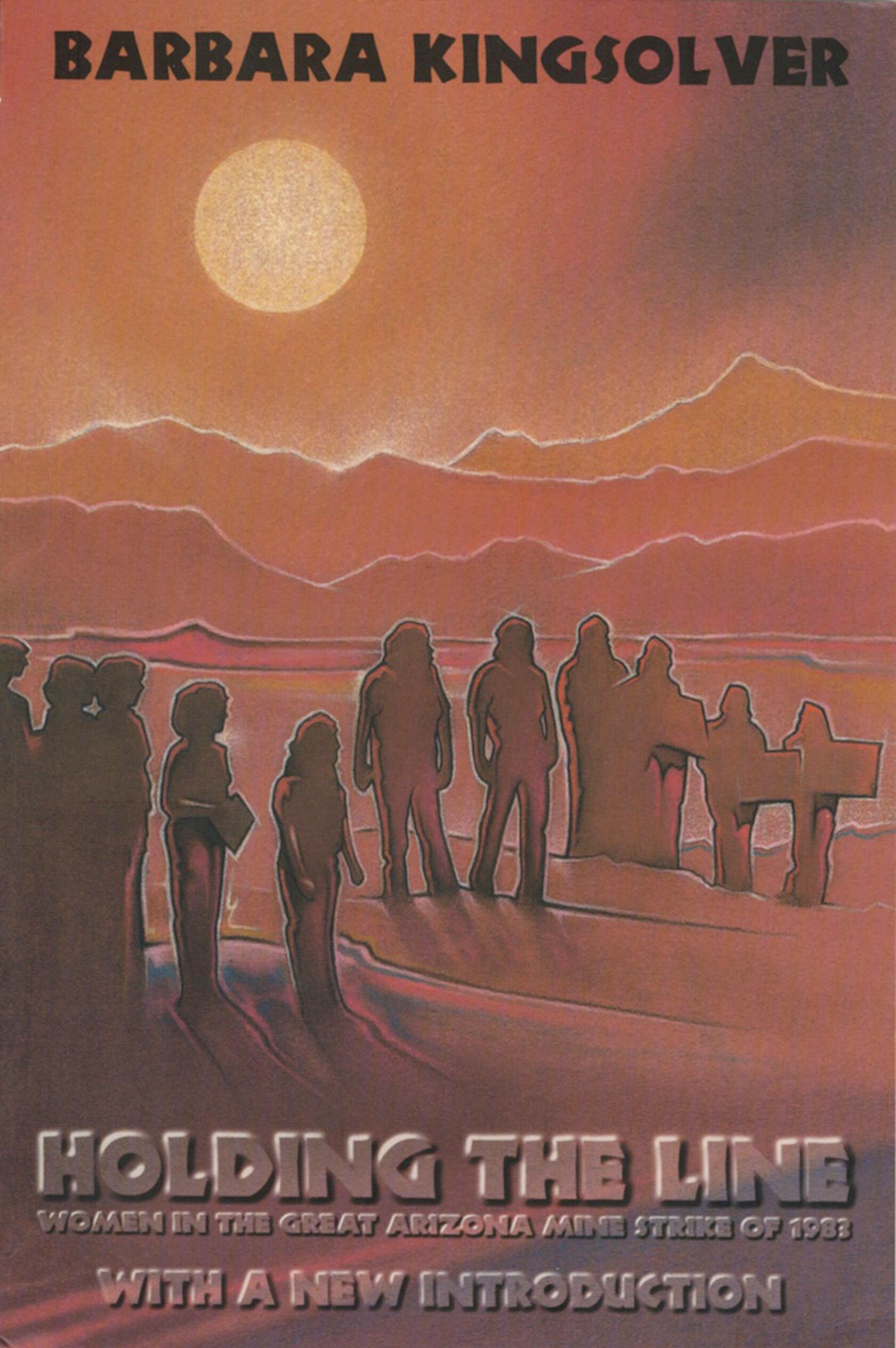
Holding the Line
Holding the Line, Barbara Kingsolver's first non-fiction book, is the story of women's lives transformed by an a signal event. Set in the small mining towns of Arizona, it is part oral history and part social criticism, exploring the process of empowerment which occurs when people work together as a community. Like Kingsolver's award-winning novels,Holding the Lineis a beautifully written book grounded on the strength of its characters.
Hundreds of families held the line in the 1983 strike against Phelps Dodge Copper in Arizona. After more than a year the strikers lost their union certification, but the battle permanently altered the social order in these small, predominantly Hispanic mining towns. At the time the strike began, many women said they couldn't leave the house without their husband's permission. Yet, when injunctions barred union men from picketing, their wives and daughters turned out for the daily picket lines. When the strike dragged on and men left to seek jobs elsewhere, women continued to picket, organize support, and defend their rights even when the towns were occupied by the National Guard. \"Nothing can ever be the same as it was before,\" said Diane McCormick of the Morenci Miners Women's Auxiliary. \"Look at us. At the beginning of this strike, we were just a bunch of ladies.\"
eBook