
Catalogue Search | MBRL


Are you sure you want to remove the book from the shelf?

{{itemTitle}}
69,459
result(s) for
"Community development Planning."
Sort by:

Wealth creation : a new framework for rural economic and community development
\"A new approach to rural development is emerging. Instead of being about attracting companies that might create jobs over which communities have no control, the emerging paradigm is about connecting the unique underutilized assets of place with market opportunity to grow assets that are owned and controlled by and for the benefit of low-wealth people and places. But asset development is about more than bricks and mortar or narrowly defined financial assets. There are many kinds of assets that communities require to thrive - such as social capital, natural capital, political capital, and intellectual capital. The emerging new approach to rural development is, then about broadening the definition of \"wealth,\" engaging underutilized assets, and a key third element: harnessing the power of the market - rather than relying solely on philanthropy and government. Wealth Creation provides a conceptual guide with practical examples for policymakers, practitioners of economic and community development, community organizers, environmentalists, funders, investors, and corporations seeking a values-based framework for identifying self-interests across sectors that can lead to opportunities to transform existing systems for the collective good\"-- Provided by publisher.
Book
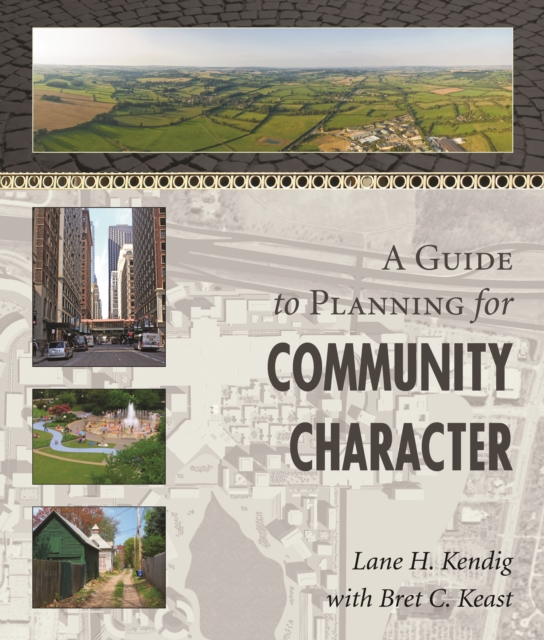
guide to planning for community character
A Guide to Planning for Community Character adds a wealth of practical applications to the framework that Lane Kendig describes in his previous book, Community Character. The purpose of the earlier book is to give citizens and planners a systematic way of thinking about the attributes of their communities and a common language to use for planning and zoning in a consistent and reliable way. This follow-up volume addresses actual design in the three general classes of communities in Kendig's framework-urban, suburban, and rural.
The author's practical approaches enable designers to create communities \"with the character that citizens actually want.\" Kendig also provides a guide for incorporating community character into a comprehensive plan. In addition, this book shows how to use community character in planning and zoning as a way of making communities more sustainable. All examples in the volume are designed to meet real-world challenges. They show how to design a community so that the desired character is actually achieved in the built result. The book also provides useful tools for analyzing or measuring relevant design features.
Together, the books provide a comprehensive treatment of community character, offering both a tested theory of planning based on visual and physical character and practical ways to plan and measure communities. The strength of this comprehensive approach is that it is ultimately less rigid and more adaptable than many recent \"flexible\" zoning codes.
eBook


Community character : principles for design and planning
The book Kendig has written is a comprehensive treatment of community character and how and why this should be a primary consideration when zoning and regulating urban and rural areas. Kendig states that \"community character presents a tested theory of planning based on visual and physical character that offers practical tools to measure and plan communities\". The strength of this book is that it provides tools to measure or analyze design issues. It also differs from the existing books on the topic because it takes a more flexible approach to regulating design. Smart Code has been very popular because it provides specifies on rezoning (or doing overlay zoning) for livability, but it is very rigid. LEED Neighborhood Development is still in its infancy (pilot projects) and is also prescriptive (and flawed).
eBook

Planning from below : a decentralized participatory planning proposal, volumes I and II
In this book, Marta Harnecker, with Spanish economist Josâe Bartolomâe, shares some of her wisdom on how communities everywhere can gain empowerment. For, when impoverished people became involved in the planning process, they no longer feel like beggars demanding solutions from the state; they become the creators of their own destiny. Set out in two parts; this book first demonstrates the importance of community participants working outside a hierarchy, to allow as much decentralization as possible. The second part of the book centers on the methodology of this process: the various tasks taken on by participants and how, in planning processes over years, they are carried out.
Book

Reclaiming Indigenous Planning
Centuries-old community planning practices in Indigenous communities in Canada, the United States, New Zealand, and Australia have, in modern times, been eclipsed by ill-suited western approaches, mostly derived from colonial and neo-colonial traditions. Since planning outcomes have failed to reflect the rights and interests of Indigenous people, attempts to reclaim planning have become a priority for many Indigenous nations throughout the world. In Reclaiming Indigenous Planning, scholars and practitioners connect the past and present to facilitate better planning for the future. With examples from the Canadian Arctic to the Australian desert, and the cities, towns, reserves and reservations in between, contributors engage topics including Indigenous mobilization and resistance, awareness-raising and seven-generations visioning, Indigenous participation in community planning processes, and forms of governance. Relying on case studies and personal narratives, these essays emphasize the critical need for Indigenous communities to reclaim control of the political, socio-cultural, and economic agendas that shape their lives. The first book to bring Indigenous and non-Indigenous authors together across continents, Reclaiming Indigenous Planning shows how urban and rural communities around the world are reformulating planning practices that incorporate traditional knowledge, cultural identity, and stewardship over land and resources. Contributors include Robert Adkins (Community and Economic Development Consultant, USA), Chris Andersen (Alberta), Giovanni Attili (La Sapienza), Aaron Aubin (Dillon Consulting), Shaun Awatere (Landcare Research, New Zealand), Yale Belanger (Lethbridge), Keith Chaulk (Memorial), Stephen Cornell (Arizona), Sherrie Cross (Macquarie), Kim Doohan (Native Title and Resource Claims Consultant, Australia), Kerri Jo Fortier (Simpcw First Nation), Bethany Haalboom (Victoria University, New Zealand), Lisa Hardess (Hardess Planning Inc.), Garth Harmsworth (Landcare Research, New Zealand), Sharon Hausam (Pueblo of Laguna), Michael Hibbard (Oregon), Richard Howitt (Macquarie), Ted Jojola (New Mexico), Tanira Kingi (AgResearch, New Zealand), Marcus Lane (Commonwealth Scientific and Industrial Research Organization, Australia), Rebecca Lawrence (Umea), Gaim Lunkapis (Malaysia Sabah), Laura Mannell (Planning Consultant, Canada), Hirini Matunga (Lincoln University, New Zealand), Deborah McGregor (Toronto), Oscar Montes de Oca (AgResearch, New Zealand), Samantha Muller (Flinders), David Natcher (Saskatchewan), Frank Palermo (Dalhousie), Robert Patrick (Saskatchewan), Craig Pauling (Canterbury Earthquake Recovery Authority, New Zealand), Kurt Peters (Oregon State), Libby Porter (Monash), Andrea Procter (Memorial), Sarah Prout (Combined Universities Centre for Rural Health, Australia), Catherine Robinson (Commonwealth Scientific and Industrial Research Organization, Australia), Shadrach Rolleston (Planning Consultant, New Zealand), Leonie Sandercock (British Columbia), Crispin Smith (Planning Consultant, Canada), Sandie Suchet-Pearson (Macquarie), Siri Veland (Brown), Ryan Walker (Saskatchewan), Liz Wedderburn (AgResearch, New Zealand).
eBook

Collaborative governance for local economic development : lessons from countries around the world
\"Although collaborations for local and regional economic development have been popular in recent years, it is not yet wholly clear when or how such efforts bring successful outcomes. Using an integrative conceptual framework for collaborative governance, this innovative collection provides a systematic and interdisciplinary analysis of real-world collaborative networks for local and regional economic development. Focusing on a wide range collaborative economic development in diverse cities and regions in USA, Canada, Germany, India, Italy, and South Korea, the chapters explore what forces motivate the emergence of collaborative economic development efforts. Each chapter explores the factors which contribute to or hinder collaborative governance efforts for economic development and identifies lessons for overcoming challenges to creating communities that are economically resilient, environmentally sustainable and politically engaged in the era of globalization. By focusing on collaborative governance and its implications for the ability of policies to meet the challenges of the 21st century, it provides lessons for researchers in public management, urban planning/development, public policy, and political science, as well as practitioners interested in promoting local economic development\"-- Provided by publisher.
Book
Community Visioning Programs
Community visioning is key in helping local public officials and community leaders create a flourishing future for their cities, and is essential for the effective planning and implementation of these strategies. Visioning involves collaborative goal setting to motivate actions - of planners, citizens, and officials - in order to design and carry out a strategic planning process for the successful development of the community.
The use of visioning since the 1980s has led to a wealth of information on the productivity of the paths it has taken. The contributors, all with experience working in the area, review the successes and failures of the strategies, and look at new innovations which are pushing the frontiers of community visioning.
This review of the development of visioning focuses on small and medium sized communities in North America. It aims to guide citizens, local leaders and planners on what strategies are best to help them revitalise their communities and ensure a prosperous future.
eBook

Sustainability Planning and Collaboration in Rural Canada
Rural communities, often the first indicators of economic downturns, play an important role in planning for development and sustainability. Increasingly, these communities are compelled to reimagine the paths that lead not only to economic success, but also to the cultural, social, environmental, and institutional pillars of sustainability. As the contributors to this volume demonstrate, there are many examples of such innovation and creativity, and many communities that seek out new ways to build the collaboration, capacity, and autonomy necessary to survive and flourish. Contributors: Don Alexander, Kirstine Baccar, Michael Barr, Mary A. Beckie, Moira J. Calder, Meredith Carter, Yolande E. Chan, Sean Connelly, Jon Corbett, Anthony Davis, Jeff A. Dixon, David J.A. Douglas, Roger Epp, Kelly Green, Lars K. Hallström, Greg Halseth, Casey Hamilton, Karen Houle, Glen T. Hvenegaard, Melanie Irvine, Bernie Jones, Robert Keenan, Rhonda Koster, Ryan Lane, Sean Markey, Shelly McMann, L. Jane McMillan, Morgan E. Moffitt, Karen Morrison, Karsten Mündel, Craig Pollett, Kerry Prosper, Mark Roseland, Laura Ryser, Claire Sanders, Jennifer Sumner, Kelly Vodden, Marc von der Gonna, Shayne Wright.
eBook