
Catalogue Search | MBRL


Are you sure you want to remove the book from the shelf?

{{itemTitle}}
9,444
result(s) for
"Community development United States."
Sort by:


Making Volunteers
Volunteering improves inner character, builds community, cures poverty, and prevents crime. We've all heard this kind of empowerment talk from nonprofit and government-sponsored civic programs. But what do these programs really accomplish? InMaking Volunteers, Nina Eliasoph offers an in-depth, humorous, wrenching, and at times uplifting look inside youth and adult civic programs. She reveals an urgent need for policy reforms in order to improve these organizations and shows that while volunteers learn important lessons, they are not always the lessons that empowerment programs aim to teach.
With short-term funding and a dizzy mix of mandates from multiple sponsors, community programs develop a complex web of intimacy, governance, and civic life. Eliasoph describes the at-risk youth served by such programs, the college-bound volunteers who hope to feel selfless inspiration and plump up their resumés, and what happens when the two groups are expected to bond instantly through short-term projects. She looks at adult \"plug-in\" volunteers who, working in after-school programs and limited by time, hope to become like beloved aunties to youth. Eliasoph indicates that adult volunteers can provide grassroots support but they can also undermine the family-like warmth created by paid organizers. Exploring contradictions between the democratic rhetoric of empowerment programs and the bureaucratic hurdles that volunteers learn to navigate, the book demonstrates that empowerment projects work best with less precarious funding, more careful planning, and mandatory training, reflection, and long-term commitments from volunteers.
Based on participant research inside civic and community organizations,Making Volunteersillustrates what these programs can and cannot achieve, and how to make them more effective.
eBook


Civitas by Design
Since the end of the nineteenth century, city planners have aspired not only to improve the physical living conditions of urban residents but also to strengthen civic ties through better design of built environments. From Ebenezer Howard and his vision for garden cities to today's New Urbanists, these visionaries have sought to deepen civitas, or the shared community of citizens.
InCivitas by Design, historian Howard Gillette, Jr., takes a critical look at this planning tradition, examining a wide range of environmental interventions and their consequences over the course of the twentieth century. As American reform efforts moved from progressive idealism through the era of government urban renewal programs to the rise of faith in markets, planners attempted to cultivate community in places such as Forest Hills Gardens in Queens, New York; Celebration, Florida; and the post-Katrina Gulf Coast. Key figures-including critics Lewis Mumford and Oscar Newman, entrepreneur James Rouse, and housing reformer Catherine Bauer-introduced concepts such as neighborhood units, pedestrian shopping malls, and planned communities that were implemented on a national scale. Many of the buildings, landscapes, and infrastructures that planners envisioned still remain, but frequently these physical designs have proven insufficient to sustain the ideals they represented. Will contemporary urbanists' efforts to join social justice with environmentalism generate better results? Gillette places the work of reformers and designers in the context of their times, providing a careful analysis of the major ideas and trends in urban planning for current and future policy makers.
eBook

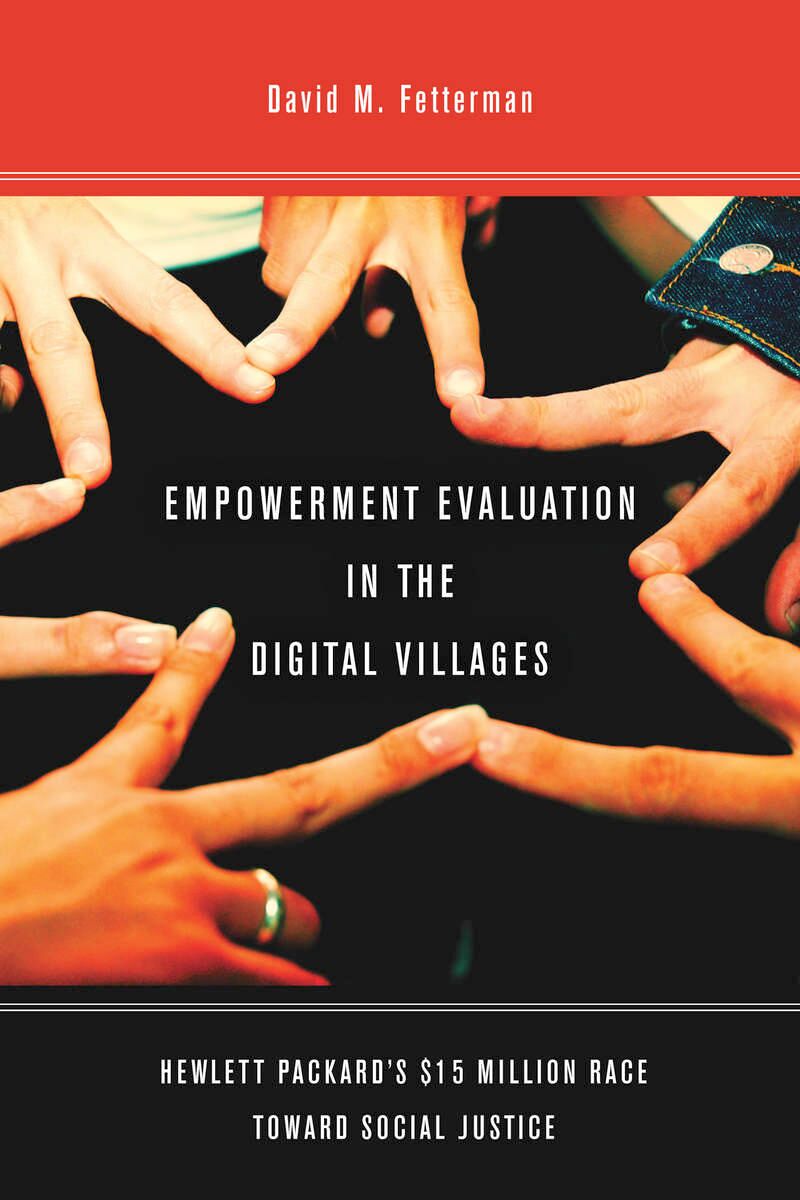
Empowerment evaluation in the digital villages : Hewlett-Packard's $15 million race toward social justice
Empowerment Evaluation in the Digital Villages analyzes a {dollar}15 million community change initiative designed to bridge the digital divide in East Palo Alto, East Baltimore, and San Diego. Involving a partnership between Hewlett-Packard, Stanford University, and three ethnically diverse communities, this initiative enabled its constituencies to build their own technology-oriented businesses, improve their education systems, and improve their economic health. While examining this large-scale, multi-site case, Fetterman highlights the potential for empowerment evaluation to build local capacity and sustain improvements within communities. He provides deep insights into key steps in empowerment evaluation by exploring the way that each of these phases took place in the digital villages. Additionally, the text provides evaluators with real-world stories and practical advice from the front lines. The Digital Village case also demonstrates the social value of combining corporate philanthropy, academic prowess, and community empowerment—highlighting the role of evaluation in this process.
eBook


This Could Be the Start of Something Big
For nearly two decades, progressives have been dismayed by the steady rise of the right in U.S. politics. Often lost in the gloom and doom about American politics is a striking and sometimes underanalyzed phenomenon: the resurgence of progressive politics and movements at a local level. Across the country, urban coalitions, including labor, faith groups, and community-based organizations, have come together to support living wage laws and fight for transit policies that can move the needle on issues of working poverty. Just as striking as the rise of this progressive resurgence has been its reception among unlikely allies. In places as diverse as Chicago, Atlanta, and San Jose, the usual business resistance to pro-equity policies has changed, particularly when it comes to issues like affordable housing and more efficient transportation systems. To see this change and its possibilities requires that we recognize a new thread running through many local efforts: a perspective and politics that emphasizes \"regional equity.\"
Manuel Pastor Jr., Chris Benner, and Martha Matsuoka offer their analysis with an eye toward evaluating what has and has not worked in various campaigns to achieve regional equity. The authors show how momentum is building as new policies addressing regional infrastructure, housing, and workforce development bring together business and community groups who share a common desire to see their city and region succeed. Drawing on a wealth of case studies as well as their own experience in the field, Pastor, Benner, and Matsuoka point out the promise and pitfalls of this new approach, concluding that what they term social movement regionalism might offer an important contribution to the revitalization of progressive politics in America.
eBook


Black, White, and Green
Farmers markets are much more than places to buy produce. According to advocates for sustainable food systems, they are also places to \"vote with your fork\" for environmental protection, vibrant communities, and strong local economies. Farmers markets have become essential to the movement for food-system reform and are a shining example of a growing green economy where consumers can shop their way to social change. Black, White, and Green brings new energy to this topic by exploring dimensions of race and class as they relate to farmers markets and the green economy. With a focus on two Bay Area markets-one in the primarily white neighborhood of North Berkeley, and the other in largely black West Oakland-Alison Hope Alkon investigates the possibilities for social and environmental change embodied by farmers markets and the green economy. Drawing on ethnographic and historical sources, Alkon describes the meanings that farmers market managers, vendors, and consumers attribute to the buying and selling of local organic food, and the ways that those meanings are raced and classed. She mobilizes this research to understand how the green economy fosters visions of social change that are compatible with economic growth while marginalizing those that are not. Black, White, and Green is one of the first books to carefully theorize the green economy, to examine the racial dynamics of food politics, and to approach issues of food access from an environmental-justice perspective. In a practical sense, Alkon offers an empathetic critique of a newly popular strategy for social change, highlighting both its strengths and limitations.
eBook