
Catalogue Search | MBRL


Are you sure you want to remove the book from the shelf?

{{itemTitle}}
63
result(s) for
"Community development-International cooperation"
Sort by:

Contribuciones antropológicas al estudio del desarrollo
¿Qué piensan las poblaciones locales de los proyectos de desarrollo y los cooperantes? ¿A quiénes benefician los programas de cooperación al desarrollo? ¿En qué se fundamenta el modelo alternativo del \"Buen vivir\"? ¿El turismo contribuye a la mejora de las condiciones de vida de los países del sur? ¿Dónde se pueden cursar estudios de antropología del desarrollo en el Estado español? Éstos son algunos de los interrogantes a los que trata de responder este libro. Los ocho capítulos que integran este volumen son una muestra del alcance de la investigación antropológica sobre la cooperación internacional al desarrollo en el Estado español. Todos ellos son fruto de la consolidación de estudios -críticos u orientadores- con base etnográfica, en países como Ecuador, Guatemala, Panamá y Sudáfrica. Se trata de contribuciones antropológicas que conciben de forma distinta el quehacer del desarrollo, y que muestran la necesidad de superar la dicotomía práctica vs. crítica.
eBook


Global Monitoring Report, 2009: A Development Emergency
A Development Emergency: the title of this year's Global Monitoring Report, the sixth in an annual series, could not be more apt. The global economic crisis, the most severe since the Great Depression, is rapidly turning into a human and development crisis. No region is immune. The poor countries are especially vulnerable, as they have the least cushion to withstand events. The crisis, coming on the heels of the food and fuel crises, poses serious threats to their hard-won gains in boosting economic growth and reducing poverty. It is pushing millions back into poverty and putting at risk the very survival of many. The prospect of reaching the Millennium Development Goals (MDGs) by 2015, already a cause for serious concern, now looks even more distant. A global crisis must be met with a global response. The crisis began in the financial markets of developed countries, so the first order of business must be to stabilize these markets and counter the recession that the financial turmoil has triggered. At the same time, strong and urgent actions are needed to counter the impact of the crisis on developing countries and help them restore strong growth while protecting the poor. Global Monitoring Report 2009, prepared jointly by the staff of the World Bank and the International Monetary Fund, provides a development perspective on the global economic crisis. It assesses the impact on developing countries, their growth, poverty reduction, and other MDGs. And it sets out priorities for policy response, both by developing countries themselves and by the international community. This report also focuses on the ways in which the private sector can be better mobilized in support of development goals, especially in the aftermath of the crisis.
eBook

Peace and Democratic Society
Recent acts of terrorism and the current unrest in the Middle East remind us how important it is to understand the relationship between violence, peace and democracy. In a challenging and insightful essay, Amartya Sen explores ideas around 'organised violence' (such as war, genocide and terrorism) and violence against the individual. Highlighting the inadequacies of some of the widely accepted explanations for violenceâ  including the idea that the world is experiencing a 'clash of civilisations'â  Sen makes a plea for a global, multilateral debate on the causes of conflict, and an understanding of the multiple identities of the individuals involved. The introductory essay draws on the findings of the Commonwealth Commission on Respect and Understanding, which was chaired by Sen, and established to promote mutual communication and understanding among all faiths and communities in the Commonwealth. Its timely report, \"Civil Paths to Peace\", suggests that governments, media and educatorsâ  indeed, everyoneâ  must take the time to understand the complexities around violent behaviour and its causes, without prejudging what these might be.
eBook
Differentiating development
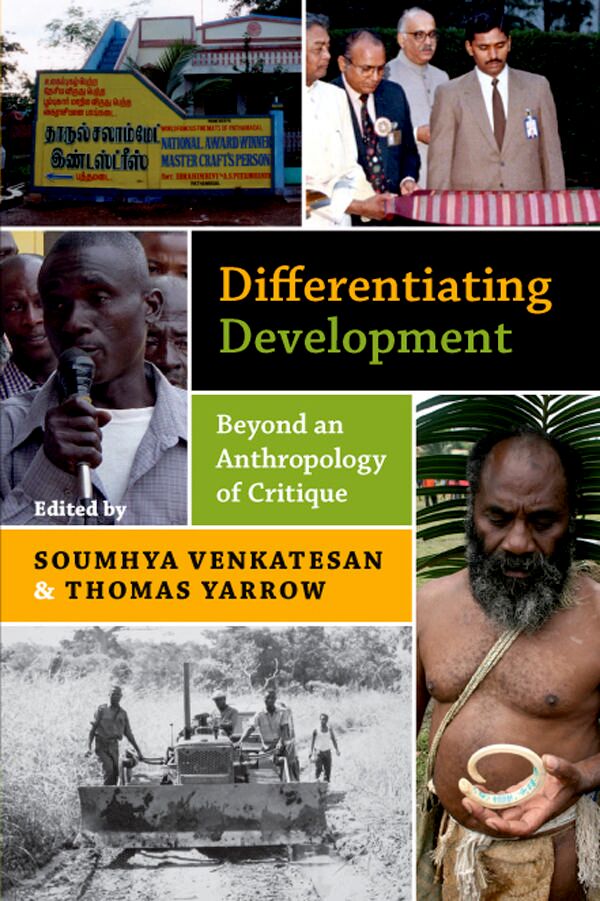
Over the last two decades, anthropological studies have highlighted the problems of 'development' as a discursive regime, arguing that such initiatives are paradoxically used to consolidate inequality and perpetuate poverty. This volume constitutes a timely intervention in anthropological debates about development, moving beyond the critical stance to focus on development as a mode of engagement that, like anthropology, attempts to understand, represent and work within a complex world. By setting out to elucidate both the similarities and differences between these epistemological endeavors, the book demonstrates how the ethnographic study of development challenges anthropology to rethink its own assumptions and methods. In particular, contributors focus on the important but often overlooked relationship between acting and understanding, in ways that speak to debates about the role of anthropologists and academics in the wider world. The case studies presented are from a diverse range of geographical and ethnographic contexts, from Melanesia to Africa and Latin America, and ethnographic research is combined with commentary and reflection from the foremost scholars in the field.
eBook

The dark sides of virtue
In this provocative and timely book, David Kennedy explores what can go awry when we put our humanitarian yearnings into action on a global scale--and what we can do in response.
Rooted in Kennedy's own experience in numerous humanitarian efforts, the book examines campaigns for human rights, refugee protection, economic development, and for humanitarian limits to the conduct of war. It takes us from the jails of Uruguay to the corridors of the United Nations, from the founding of a non-governmental organization dedicated to the liberation of East Timor to work aboard an aircraft carrier in the Persian Gulf.
Kennedy shares the satisfactions of international humanitarian engagement--but also the disappointments of a faith betrayed. With humanitarianism's new power comes knowledge that even the most well-intentioned projects can create as many problems as they solve. Kennedy develops a checklist of the unforeseen consequences, blind spots, and biases of humanitarian work--from focusing too much on rules and too little on results to the ambiguities of waging war in the name of human rights. He explores the mix of altruism, self-doubt, self-congratulation, and simple disorientation that accompany efforts to bring humanitarian commitments to foreign settings.
Writing for all those who wish that \"globalization\" could be more humane, Kennedy urges us to think and work more pragmatically.
A work of unusual verve, honesty, and insight, this insider's account urges us to embrace the freedom and the responsibility that come with a deeper awareness of the dark sides of humanitarian governance.
eBook

Green Governance
The vast majority of the world's scientists agree: we have reached a point in history where we are in grave danger of destroying Earth's life-sustaining capacity. But our attempts to protect natural ecosystems are increasingly ineffective because our very conception of the problem is limited; we treat 'the environment' as its own separate realm, taking for granted prevailing but outmoded conceptions of economics, national sovereignty and international law. Green Governance is a direct response to the mounting calls for a paradigm shift in the way humans relate to the natural environment. It opens the door to a new set of solutions by proposing a compelling new synthesis of environmental protection based on broader notions of economics and human rights and on commons-based governance. Going beyond speculative abstractions, the book proposes a new architecture of environmental law and public policy that is as practical as it is theoretically sound.
eBook
NGOization
The growth and spread of non-governmental organizations (NGOs) at local and international levels has attracted considerable interest and attention from policy-makers, development practitioners, academics and activists around the world. But how has this phenomenon impacted on struggles for social and environmental justice? How has it challenged - or reinforced - the forces of capitalism and colonialism? And what political, economic, social and cultural interests does this serve? NGOization - the professionalization and institutionalization of social action - has long been a hotly contested issue in grassroots social movements and communities of resistance. This book pulls together for the first time unique perspectives of social struggles and critically engaged scholars from a wide range of geographical and political contexts to offer insights into the tensions and challenges of the NGO model, while considering the feasibility of alternatives.
eBook

Launching Europe
In this first ethnographic study of the European Space Agency, Stacia Zabusky explores the complex processes involved in cooperation on space science missions in the contemporary context of European integration. Zabusky argues that the practice of cooperation does not depend on a homogenizing of interests in a bland unity. Instead, it consists of ongoing negotiation of and conflict over often irreconcilable differences. In this case, those differences are put into play by both technical and political divisions of labor (in particular, those of big science and of European integration).
Zabusky shows how participants on space science missions make use of these differences, particularly those manifest in identities of work and of nationality, as they struggle together not only to produce space satellites but also to create European integration. She argues that the dialectical processes of production include and depend on conflict and contradiction to maintain energy and excitement and thus to be successful. Participants in these processes are not, however, working only to produce tangible success. In her epilogue, Zabusky argues that European space science missions can be interpreted as sacred journeys undertaken collectively, and that these journeys are part of a fundamental cultural project of modernity: the legitimation of and aspiration for purity. She suggests, finally, that this project characterizes not only the institution of technoscience but those of bureaucracy and nationalism as well.
eBook