
Catalogue Search | MBRL


Are you sure you want to remove the book from the shelf?

{{itemTitle}}
11,524
result(s) for
"Community organization United States."
Sort by:


This Could Be the Start of Something Big
For nearly two decades, progressives have been dismayed by the steady rise of the right in U.S. politics. Often lost in the gloom and doom about American politics is a striking and sometimes underanalyzed phenomenon: the resurgence of progressive politics and movements at a local level. Across the country, urban coalitions, including labor, faith groups, and community-based organizations, have come together to support living wage laws and fight for transit policies that can move the needle on issues of working poverty. Just as striking as the rise of this progressive resurgence has been its reception among unlikely allies. In places as diverse as Chicago, Atlanta, and San Jose, the usual business resistance to pro-equity policies has changed, particularly when it comes to issues like affordable housing and more efficient transportation systems. To see this change and its possibilities requires that we recognize a new thread running through many local efforts: a perspective and politics that emphasizes \"regional equity.\"
Manuel Pastor Jr., Chris Benner, and Martha Matsuoka offer their analysis with an eye toward evaluating what has and has not worked in various campaigns to achieve regional equity. The authors show how momentum is building as new policies addressing regional infrastructure, housing, and workforce development bring together business and community groups who share a common desire to see their city and region succeed. Drawing on a wealth of case studies as well as their own experience in the field, Pastor, Benner, and Matsuoka point out the promise and pitfalls of this new approach, concluding that what they term social movement regionalism might offer an important contribution to the revitalization of progressive politics in America.
eBook


Immigrants and Electoral Politics
InImmigrants and Electoral Politics, Heath Brown shows why nonprofit electoral participation has emerged in relationship to new threats to immigrants, on one hand, and immigrant integration into U.S. society during a time of demographic change, on the other. Immigrants across the United States tend to register and vote at low rates, thereby limiting the political power of many of their communities. In an attempt to boost electoral participation through mobilization, some nonprofits adopt multifaceted political strategies including registering new voters, holding candidate forums, and phone banking to increase immigrant voter turnout. Other nonprofits opt to barely participate at all in electoral politics, preferring to advance the immigrant community by providing exclusively social services.
Brown interviewed dozens of nonprofit leaders and surveyed hundreds of organizations. To capture the breadth of the immigrant experience, Brown selected organizations operating in traditional centers of immigration as well as new gateways for immigrants across the South: Florida, Illinois, Michigan, New Jersey, New York, and, North Carolina. The stories that emerge from his research include incredible successes in mobilizing immigrant communities, including organizations that registered sixty thousand new immigrant voters in New York. They also reveal efforts to suppress nonprofit voter mobilization in Florida and describe the organizational response to hate crimes directed at immigrants in Illinois.
eBook

Grassroots library advocacy
Library issues are community issues-it's not enough to simply marshal internal library resources to fight cutbacks. When properly harnessed, public engagement can be the most powerful force of all for library advocacy. But rounding up advocates from the wider community and conducting a grassroots effort demands careful planning and commitment. This ALA Editions Special Report cuts through the rhetoric and gets straight to modeling a plan of action, for libraries big and small, byDetailing the lessons learned during the authors' successful campaign to save New York City librariesInstructing readers how to clarify the message, manage volunteers, and plan eventsOffering public relations strategies, including advice for dealing with political leaders and the mediaThis indispensable report goes beyond the \"what-to-do\" of library advocacy and explains how to do it right
eBook


City Making
American metropolitan areas today are divided into neighborhoods of privilege and poverty, often along lines of ethnicity and race. City residents traveling through these neighborhoods move from feeling at home to feeling like tourists to feeling so out of place they fear for their security. As Gerald Frug shows, this divided and inhospitable urban landscape is not simply the result of individual choices about where to live or start a business. It is the product of government policies--and, in particular, the policies embedded in legal rules. A Harvard law professor and leading expert on urban affairs, Frug presents the first-ever analysis of how legal rules shape modern cities and outlines a set of alternatives to bring down the walls that now keep city dwellers apart.
eBook

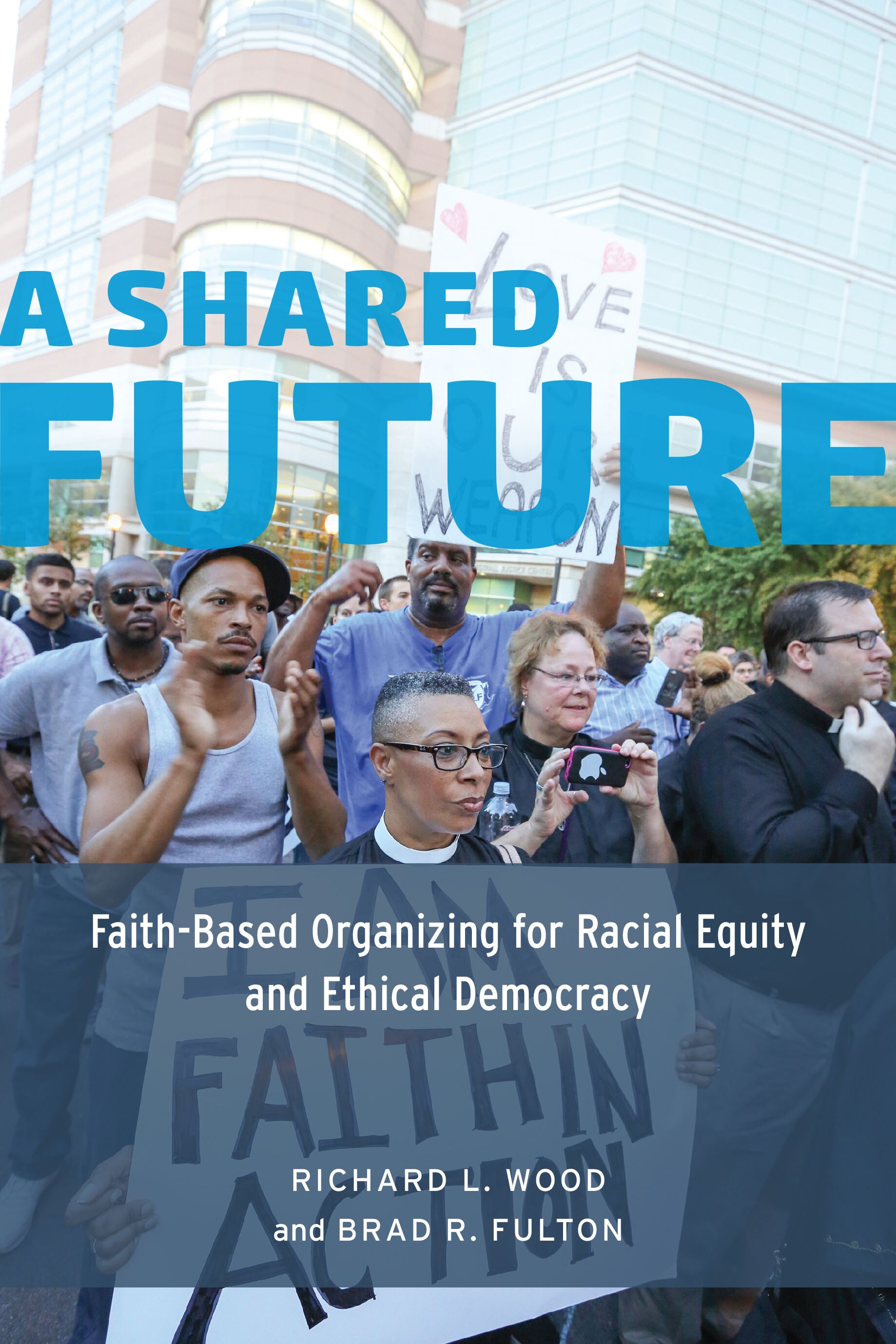
A shared future : faith-based organizing for racial equity and ethical democracy
Faith-based community organizers have spent decades working for greater equality in American society, and more recently have become significant players in shaping health care, finance, and immigration reform at the highest levels of government.
In A Shared Future, Richard L. Wood and Brad R. Fulton draw on a new national study of community organizing coalitions and in-depth interviews of key leaders in this field to show how faith-based organizing is creatively navigating the competing aspirations of America's universalist and multiculturalist democratic ideals, even as it confronts three demons bedeviling American politics: economic inequality, federal policy paralysis, and racial inequity. With a broad view of the entire field and a distinct empirical focus on the PICO National Network, Wood and Fulton's analysis illuminates the tensions, struggles, and deep rewards that come with pursuing racial equity within a social change organization and in society. Ultimately, A Shared Future offers a vision for how we might build a future that embodies the ethical democracy of the best American dreams.
An interview of the authors on the subject of faith leaders organizing for justice (Peace Talks Radio, copyright Good Radio Shows, Inc.) can be heard at this link: https://beta.prx.org/stories/190030 [https://beta.prx.org/stories/190030]
eBook