
Catalogue Search | MBRL


Are you sure you want to remove the book from the shelf?

{{itemTitle}}
12,286
result(s) for
"Community radio"
Sort by:


Low Power to the People
The United States ushered in a new era of small-scale broadcasting in 2000 when it began issuing low-power FM (LPFM) licenses for noncommercial radio stations around the country. Over the next decade, several hundred of these newly created low-wattage stations took to the airwaves. InLow Power to the People, Christina Dunbar-Hester describes the practices of an activist organization focused on LPFM during this era. Despite its origins as a pirate broadcasting collective, the group eventually shifted toward building and expanding regulatory access to new, licensed stations. These radio activists consciously cast radio as an alternative to digital utopianism, promoting an understanding of electronic media that emphasizes the local community rather than a global audience of Internet users.Dunbar-Hester focuses on how these radio activists impute emancipatory politics to the \"old\" medium of radio technology by promoting the idea that \"microradio\" broadcasting holds the potential to empower ordinary people at the local community level. The group's methods combine political advocacy with a rare commitment to hands-on technical work with radio hardware, although the activists' hands-on, inclusive ethos was hampered by persistent issues of race, class, and gender. Dunbar-Hester's study of activism around an \"old\" medium offers broader lessons about how political beliefs are expressed through engagement with specific technologies. It also offers insight into contemporary issues in media policy that is particularly timely as the FCC issues a new round of LPFM licenses.
eBook

Feminista frequencies : community building through radio in the Yakima Valley
\"Beginning in the 1970s Chicana and Chicano organizers turned to community radio broadcasting to educate, entertain, and uplift Mexican American listeners across the United States. In rural areas, radio emerged as the most effective medium for reaching relatively isolated communities such as migrant farmworkers. And in Washington's Yakima Valley, where the media landscape was dominated by perspectives favorable to agribusiness, community radio for and about farmworkers became a life-sustaining tool. Feminista Frequencies unearths the remarkable history of one of the United States' first full-time Spanish-language community radio stations, Radio KDNA, which began broadcasting in the Yakima Valley in 1979. Extensive interviews reveal the work of Chicana and Chicano producers, on-air announcers, station managers, technical directors, and listeners who contributed to the station's success. Monica De La Torre weaves these oral histories together with a range of visual and audio artifacts, including radio programs, program guides, and photographs to situate KDNA within the larger network of Chicano community-based broadcasting and social movement activism. Feminista Frequencies highlights the development of a public broadcasting model that centered Chicana radio producers and documents the central role of women in developing this infrastructure in the Yakima Valley. De La Torre shows how KDNA revolutionized community radio programming, adding new depth to the history of the Chicano movement, women's activism, and media histories\"-- Provided by publisher.
BOOK

Working-Class Writing and Publishing in the Late Twentieth Century
From the early 1970s, working class writing and publishing in local communities rapidly proliferated into a national movement. This book is the first full evaluation of these developments and opens up new perspectives on literature, culture, class and identity over the past 50 years.
eBook
Developing dialogues
Developing Dialogues offers a new perspective on Australian community broadcasting and presents evidence of global trends in the media industry. Based on firsthand research of radio and television audiences in Australia, the authors argue that community radio and television worldwide perform an essential service for indigenous and ethnic audiences.
eBook
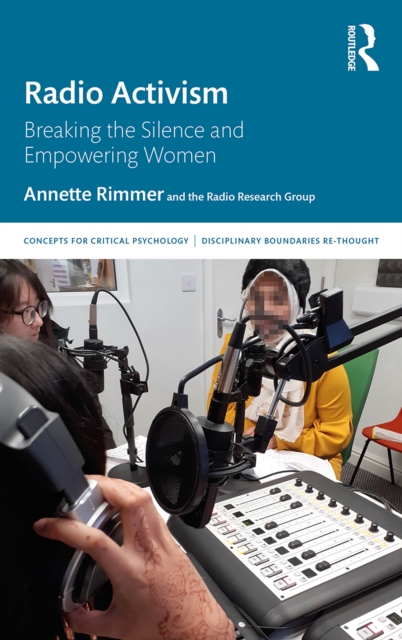
Radio Activism
This unique book draws on the narratives of women participants in community radio, using intersectionality, feminist, critical psychological and community development frameworks to explore how this highly symbolic, creative dimension of activism can unmute marginalised women and enrich corporate media.
Over a period of four years, twelve female radio project volunteers offer their experiences which they analyse, together as part of the RRG (Radio Research Group), alongside a conceptual and contextual framework to produce insights on the gendered nature of silence, voice and empowerment, and the wider potential of radio activism. Employing literature from a variety of fields, from bell hooks to Stuart Hall, the book foregrounds evidence from the majority world to argue the empowerment potential of community radio and the barriers to radio participation. Through this analysis, community radio emerges as a site of development, from which diverse identities transpire through laughter, dialogue, raised consciousness and solidarity, but it also exposes the conflicts of empowerment by recognising inherent tensions in womanhood and in communities.
Centring on the global, hegemonic challenge of empowering women, and relevant across multiple disciplines and professions, this is fascinating reading for academics, students and professionals in psychology, gender studies, media studies, development and related areas.
eBook

Exploring the Subaltern Voices: A Study of Community Radio Reporters (CRR's) in Rural India
Despite India’s remarkable communication media revolution the rural subalterns remained uninformed, unheard and voiceless, who asks the question: Whose Media, Whose Voice? This created a space for community radio (CR) because it is of, for, and by the community. However, in spite of the alternative, counter-hegemonic, and participatory communication ethos, the contribution of CR’s and CRR’s lingered unexplored and unacknowledged. To bridge this gap, within the theoretical framework of alternative-media-theory this study has been undertaken. Based on case studies of India’s pioneer CR’s (Sangam Radio and Radio Bundelkhand) using media ethnography tools a qualitative inquiry was carried out. Findings suggest that CR’s can be seen as means of developing capabilities among the subalterns through equitable inclusion not merely as participants but as active producers, partners and managers. The dialectical, dynamic, non-hierarchical and citizen controlled journalism of CRR’s reflects antagonisms of reality and high level of community belongingness and responsibility that created fundamental distinctiveness-challenges to mainstream media. Finally, providing platform for expression enlarges the voices of the subalterns which will ultimately facilitate community dialogs and deliberations around local issues and helps to redefine their community identity in their own way and might lead to positive social change.
Journal Article

Radio of Flesh and Bone: Community Radio in the Authoritarian and Patriarchal Context of Today’s Nicaragua
In
José Ignacio López Vigil asserts that community radio “is (made) of flesh and bone” (2015, p. 25). In the context of authoritarianism and patriarchy in today’s Nicaragua these words suggest at least three meanings. One recalls threats to the lives and livelihoods of Nicaraguans that work for Nicaragua’s surviving independent media, including community radio, particularly following the political and humanitarian crisis that began in April 2018. Community radio as “flesh and bone” also relates to the bodies of its listening public and is examined in this paper through the prism of the feminist community radio station, Radio Vos (Radio You 101.7 FM). Radio as “flesh and bone” also serves as a metaphor for community radio’s material and operational existence, a body that functions via multiple interworking parts and systems. In discussing the challenges facing community radio in Nicaragua, this essay incorporates excerpts from an interview with Argentina Olivas, the director of
Journal Article


Community Radio, Power, and Social Change: Navigating Participation and Transformation in Khwezi Community Radio, South Africa
This article examines the transformative potential of community radio (CR) in facilitating social change. Using a case study of Khwezi Community Radio (KR) in South Africa (SA), the study draws on vignette-based analysis informed by content analysis of KR programming, supported by excerpts from interviews and focus groups with community members and radio staff from the broader doctoral study. It advances a nuanced analysis of power that goes beyond its hierarchical and oppressive dimensions, exploring it as relational, negotiated, and potentially transformative. The study interrogates how communities engage with power through KR, particularly in relation to leadership structures, as exemplified in the KR mayoral show, where decision-making power remains contested. Findings highlight how communities cultivate collective agency through the Masibumbane Listeners Club (MLC), reinforcing a shared sense of community and participatory engagement. However, the study problematises static conceptualisations of participatory spaces by demonstrating how power asymmetries persist and are continuously negotiated within CR-facilitated interactions embedded in broader socio-political and economic structures. The study argues that understanding the extent to which CRs contribute to social change requires a critical power lens, revealing the constraints of transformative power when community leaders act as gatekeepers, thereby impeding ser-vice delivery and obstructing participatory governance. Furthermore, the study challenges the assumption that power asymmetries exist solely in external structures, highlighting subtler forms of power embedded within collaborative spaces such as the MLC.
Journal Article