
Catalogue Search | MBRL


Are you sure you want to remove the book from the shelf?

{{itemTitle}}
537,087
result(s) for
"Comparative"
Sort by:


Memorization and the Compound-Phrase Distinction
Over the last decades, it has been hotly debated whether and how compounds, i.e.word-formations, and phrases differ from each other.The book discusses this issue by investigating compounds and phrases from a structural, semantic-functional and, crucially, cognitive perspective.
eBook


Localism versus Globalism in Morphology and Phonology
An argument that patterns of allomorphy reveal that morphology and phonology behave in a way that provides evidence for a Localist theory of grammar.
In Localism versus Globalism in Morphology and Phonology, David Embick offers the first detailed examination of morphology and phonology from a phase-cyclic point of view (that is, one that takes into account recent developments in Distributed Morphology and the Minimalist program) and the only recent detailed treatment of allomorphy, a phenomenon that is central to understanding how the grammar of human language works. In addition to making new theoretical proposals about morphology and phonology in terms of a cyclic theory, Embick addresses a schism in the field between phonological theories such as Optimality Theory and other (mostly syntactic) theories such as those associated with the Minimalist program. He presents sustained empirical arguments that the Localist view of grammar associated with the Minimalist program (and Distributed Morphology in particular) is correct, and that the Globalism espoused by many forms of Optimality Theory is incorrect. In the “derivational versus nonderivational” debate in linguistic theory, Embick's arguments come down squarely on the derivational side.
Determining how to make empirical comparisons between such large positions, and the different frameworks that embody them, is at the heart of the book. Embick argues that patterns of allomorphy implicate general questions about locality and specific questions about the manner in which (morpho)syntax relates to (morpho)phonology. Allomorphy thus provides a crucial test case for comparing Localist and Globalist approaches to grammar.
eBook


Social Learning
Many animals, including humans, acquire valuable skills and knowledge by copying others. Scientists refer to this as social learning. It is one of the most exciting and rapidly developing areas of behavioral research and sits at the interface of many academic disciplines, including biology, experimental psychology, economics, and cognitive neuroscience.Social Learningprovides a comprehensive, practical guide to the research methods of this important emerging field. William Hoppitt and Kevin Laland define the mechanisms thought to underlie social learning and demonstrate how to distinguish them experimentally in the laboratory. They present techniques for detecting and quantifying social learning in nature, including statistical modeling of the spatial distribution of behavior traits. They also describe the latest theory and empirical findings on social learning strategies, and introduce readers to mathematical methods and models used in the study of cultural evolution. This book is an indispensable tool for researchers and an essential primer for students.
Provides a comprehensive, practical guide to social learning researchCombines theoretical and empirical approachesDescribes techniques for the laboratory and the fieldCovers social learning mechanisms and strategies, statistical modeling techniques for field data, mathematical modeling of cultural evolution, and more
eBook

The Cambridge companion to comparative constitutional law
\"What is the purpose of comparative constitutional law? Comparing constitutions allows us to consider the similarities and differences in forms of government, and the normative philosophies behind constitutional choices. Constitutional comparisons offer \"hermeneutic\" help: they enable us to see \"our\" own constitution with different eyes and to locate its structural and normative choices by references to alternatives evident in other constitutional orders\"-- Provided by publisher.
Book
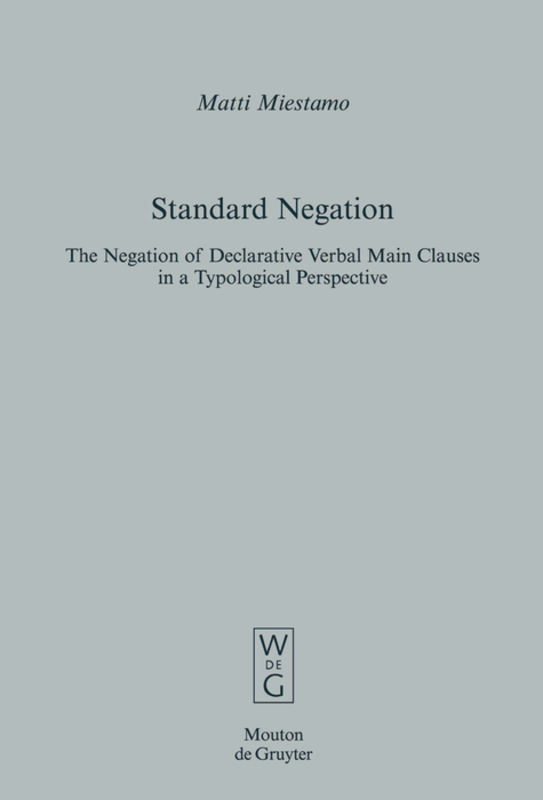
Standard Negation
This book is the first cross-linguistic study of clausal negation based on an extensive and systematic language sample. Methodological issues, especially sampling, are discussed at length. Standard negation – the basic structural means languages have for negating declarative verbal main clauses – is typologized from a new perspective, paying attention to structural differences between affirmatives and negatives. In symmetric negation affirmative and negative structures show no differences except for the presence of the negative marker(s), whereas in asymmetric negation there are further structural differences, i.e. asymmetries. A distinction is made between constructional and paradigmatic asymmetry; in the former the addition of the negative marker(s) is accompanied by further structural differences in comparison to the corresponding affirmative, and in the latter the correspondences between the members of (verbal etc.) paradigms used in affirmatives and negatives are not one-to-one. Cross-cutting the constructional-paradigmatic distinction, asymmetric negation can be further divided into subtypes according to the nature of the asymmetry. Standard negation structures found in the 297 sample languages are exemplified and discussed in detail. The frequencies of the different types and some typological correlations are also examined. Functional motivations are proposed for the structural types – symmetric negatives are language-internally analogous to the linguistic structure of the affirmative and asymmetric negatives are language-externally analogous to different asymmetries between affirmation and negation on the functional level. Relevant diachronic issues are also discussed. The book is of interest to language typologists, descriptive linguists and to all linguists interested in negation.
eBook


Registry-based randomized controlled trials- what are the advantages, challenges, and areas for future research?
Registry-based randomized controlled trials are defined as pragmatic trials that use registries as a platform for case records, data collection, randomization, and follow-up. Recently, the application of registry-based randomized controlled trials has attracted increasing attention in health research to address comparative effectiveness research questions in real-world settings, mainly due to their low cost, enhanced generalizability of findings, rapid consecutive enrollment, and the potential completeness of follow-up for the reference population, when compared with conventional randomized effectiveness trials. However several challenges of registry-based randomized controlled trials have to be taken into consideration, including registry data quality, ethical issues, and methodological challenges. In this article, we summarize the advantages, challenges, and areas for future research related to registry-based randomized controlled trials.
Journal Article