
Catalogue Search | MBRL


Are you sure you want to remove the book from the shelf?

{{itemTitle}}
5
result(s) for
"Comparative education Cross-cultural studies Congresses."
Sort by:

Educational studies in Europe
Reflecting the growing integration of the European Union, this volume presents one of the results of an increasing cooperation between the education departments of Berlin, Amsterdam and London universities. The aim is to achieve a better understanding of the cultural and socio-political differences of the educational sciences and, more generally, the educational consequences and possibilities of both globalizing and pluralist developments in European countries. The areas covered include theoretical discussions of educational developments in contemporary society, education organization and policy, intercultural and integration pedagogics, education for young children as well as higher education.
eBook

A tribute to David N. Wilson : clamouring for a better world
\"This volume was commissioned by the World Council of Comparative Education Societies, in memory of their Past President, David N. Wilson, who died on December 8, 2006. Professor Wilson was also President of the Comparative and International Education Society of Canada, the Comparative and International Education Society (US) and the International Society for Educational Planning. A call for papers was sent out to his colleagues worldwide, and many of his colleagues, friends and former students contributed chapters to this book. David N. Wilson was educated at Syracuse University as an educational planner, and he had a lifelong career at the Ontario Institute for Studies in Education at the University of Toronto. His main interests are reflected in the five major themes in this book: Africa and Development, Technical and Vocational Education and Training, Cross-Cultural Issues, Policy Development, and Comparative Education. Each author places his or her work firmly within these areas of interest and explains how their work or life experiences were influenced by him. Several of his children also contributed to the Introduction, and Crain Soudien, the 2007-2010 President of the WCCES, wrote the Preface. Together, all of the chapters provide a fitting tribute to a man whose heart, in the words of his former student Suwanda Sugunasiri, was always \"clamouring for a better world\". This work was supported financially by the Comparative, International and Development Education Centre at OISE/University of Toronto and morally by his colleagues in every part of the world.\"--Publisher's website.
Book
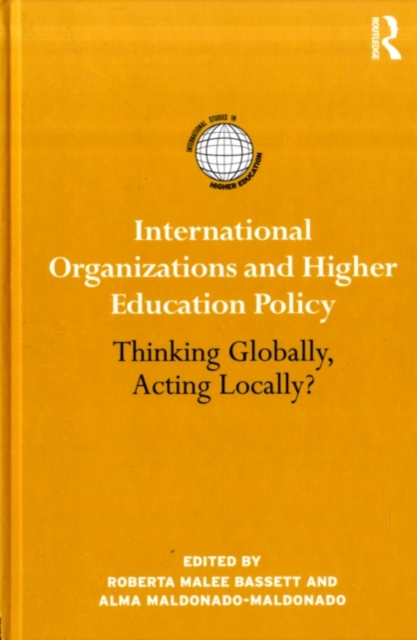
International Organizations and Higher Education Policy
Higher Education operates in an increasingly global context, and yet the examination of what drives and moves the field has remained largely focused on domestic campus leaders, national governments and institutional actors. International Organizations and Higher Education Policy expands the analysis to include the global drivers behind higher education policy, including a full array of influential organizations such as the World Bank, UNESCO, OECD, WTO, bilateral aid agencies and major private foundations. The significance of these organizations is especially pronounced in the developing world, where the expansion of higher education is happening in conjunction with the broadening influence of globalization.
International Organizations and Higher Education Policy critically analyses the impact that these influential organizations have at different levels of policy development and implementation around the world. It examines their role in higher education institutions, examines the strength of these relationships, and exposes both the positive and negative implications.
This edited volume is composed of scholars and members of these organizations from around the world. They address:
How international organizations represent the interests of the developed world and subsequently have an impact on the developing world.
How these organizations drive and shape the global agenda for higher education
How higher education as an international industry is subject to a myriad of influences, from the international to the regional level
What ethical issues emerge when international organizations intervene in national policy-making processes.
Section 1: Introduction: The history and influence of multinational/regional organizations and regimes (all terms will be explained and defined) on higher education
Section 2: Multilateral Organizations/Regimes:
Chapter 1: UNESCO: Worldwide and regional scopes
(Potential author: Stamenka Uvalic-Trumbic, UNESCO)
Chapter 2: UNESCO: A critical revision on its influence in higher education (potential author Alma Maldonado-Maldonado, Univ. of Arizona)
Chapter 3: OECD: Programmes, Centres, and other bodies investigating issues related to higher education
(potential author Stephan Vincent-Lancrin, OECD)
Chapter 4: OECD: Mechanisms of influence and critical analysis of its impact in higher education
(Potential author: Miriam Henry, Queensland University of Technology, Red Hill, Australia)
Chapter 5: The World Bank: Its role in higher education since 1944
(Likely authors: Jamil Salmi & Rick Hopper, The World Bank)
Chapter 6 The World Bank and its higher education initiatives: A critical view
(Potential author: Joel Samoff, Stanford University)
Chapter 7: The WTO: Higher education possibilities
(Potential author: Jane Knight, OISE, Toronto)
Chapter 8: The GATS: Current debate and situation
(Likely author: Roberta Malee Bassett)
Chapter 9: International organizations and bilateral aid: National interests and transnational agendas (Likely authors: Brendan Cantwell and Alma Maldonado-Maldonado, University of Arizona,)
Section 3: Regional Actors:
Chapter 10: Asia/Oceana
(Potential author: Simon Marginson, University of Melbourne)
Chapter 11: Europe
(Potential author: Pedro Lourtie, Instituto Superior—Lisbon)
Chapter 12: Latin America
(Potential author: Carmen García-Guadilla, Center for Development Studies, Central University of Venezuela)
Chapter 13: Africa
(Likely author: Damtew Teferra, The Ford Foundation and The Journal of Higher Education in Africa)
Chapter 14: Inter-American/Asian/African Development Bank
(Potential author: Suganya Hutaserani, Asian Development Bank)
Chapter 15: Regional Banks in the shadow of the World Bank: A critical examination
Chapter 16: Regional initiatives: Balancing local priorities or legitimizing global influences?
Section 4: Internationally/Regionally Active Foundations:
Chapter 17: Foundations sponsoring higher education initiatives and individuals
(Potential author, Daniel Levy, SUNY Albany)
Chapter 18: Altruism, interventionism or cooperation? Analytical discussion on Foundations supporting higher education
Section 5: Conclusions: Between the NGO’s, international organizations and corporations, where are the Nation-States?
Roberta Malee Bassett is currently serving as a higher education specialist with the World Bank, in Washington, DC.
Alma Maldonado-Maldonado is assistant professor at the Center for the Study of Higher Education at the University of Arizona.
\"The editors of this volume have given the international higher education community a valuable resource as we enter the second decade of the 21st century. This book has the potential to serve as a tool for nation states, regional consortiums, and international organizations as they consider their roles in the regulation, direction, and funding of higher education. I highly recommend it as a text in graduate-level courses in higher education and international education and could make the case that international organizations use the book as a resource to better navigate the sometimes difficult landscape of working with and understanding higher education on the national, regional, and global levels.\"-- The Review of Higher Education , Volume 33, Number 4, Summer 2010, pp. 604-606
eBook

Translation, globalization and translocation : the classroom and beyond
This book examines the spaces where translation and globalization intersect, whether they be classrooms, communities, or cultural texts. It foregrounds the connections between cultural analysis, literary critique, pedagogy and practice, uniting the disparate fields that operate within translation studies. In doing so, it offers fresh perspectives that will encourage the reader to reappraise translation studies as a field, reaffirming the directions that the subject has taken over the last twenty years. Offering a comprehensive analysis of the links between translation and globalization, this ambitious edited collection will appeal to students and scholars who work in any area of translation studies.
eBook