
Catalogue Search | MBRL


Are you sure you want to remove the book from the shelf?

{{itemTitle}}
36,025
result(s) for
"Comparative history"
Sort by:


Grammar and Christianity in the Late Roman World
Between the years 350 and 500 a large body of Latinartes grammaticaeemerged, educational texts outlining the study of Latin grammar and attempting a systematic discussion of correct Latin usage. These texts-the most complete of which are attributed to Donatus, Charisius, Servius, Diomedes, Pompeius, and Priscian-have long been studied as documents in the history of linguistic theory and literary scholarship. InGrammar and Christianity in the Late Roman World, Catherine Chin instead finds within them an opportunity to probe the connections between religious ideology and literary culture in the later Roman Empire. To Chin, the production and use of these texts played a decisive role both in the construction of a pre-Christian classical culture and in the construction of Christianity as a religious entity bound to a religious text. In exploring themes of utopian writing, pedagogical violence, and the narration of the self, the book describes the multiple ways literary education contributed to the idea that the Roman Empire and its inhabitants were capable of converting from one culture to another, from classical to Christian. The study thus reexamines the tensions between these two idealized cultures in antiquity by suggesting that, on a literary level, they were produced simultaneously through reading and writing techniques that were common across the empire. In bringing together and reevaluating fundamental topics from the fields of religious studies, classics, education, and literary criticism,Grammar and Christianity in the Late Roman Worldoffers readers from these disciplines the opportunity to reconsider the basic conditions under which religions and cultures interact.
eBook

Comparative and international education : survey of an infinite field
This book explores the evolution and current state of the scholarly field of comparative and international education over 200 years of development. Experts in the field explore comparative and international education in each of the major world regions.
Book

The Politics of Veteran Benefits in the Twentieth Century
What happened to veterans of the nations involved in the world
wars? How did they fare when they returned home and needed
benefits? How were they recognized-or not-by their governments and
fellow citizens? Where and under what circumstances did they obtain
an elevated postwar status?
In this sophisticated comparative history of government policies
regarding veterans, Martin Crotty, Neil J. Diamant, and Mark Edele
examine veterans' struggles for entitlements and benefits in the
United States, the United Kingdom, Japan, Taiwan, the Soviet Union,
China, Germany, and Australia after both global conflicts. They
illuminate how veterans' success or failure in winning benefits
were affected by a range of factors that shaped their ability to
exert political influence. Some veterans' groups fought politicians
for improvements to their postwar lives; this lobbying, the authors
show, could set the foundation for beneficial veteran treatment
regimes or weaken the political forces proposing unfavorable
policies.
The authors highlight cases of veterans who secured (and in some
cases failed to secure) benefits and status after wars both won and
lost; within both democratic and authoritarian polities; under
liberal, conservative, and even Leninist governments; after wars
fought by volunteers or conscripts, at home or abroad, and for
legitimate or subsequently discredited causes. Veterans who
succeeded did so, for the most part, by forcing their agendas
through lobbying, protesting, and mobilizing public support.
The Politics of Veteran Benefits in the Twentieth Century
provides a large-scale map for a research field with a future:
comparative veteran studies.
eBook


The Politics of Veteran Benefits in the Twentieth Century
What happened to veterans of the nations involved in the world
wars? How did they fare when they returned home and needed
benefits? How were they recognized-or not-by their governments and
fellow citizens? Where and under what circumstances did they obtain
an elevated postwar status?
In this sophisticated comparative history of government policies
regarding veterans, Martin Crotty, Neil J. Diamant, and Mark Edele
examine veterans' struggles for entitlements and benefits in the
United States, the United Kingdom, Japan, Taiwan, the Soviet Union,
China, Germany, and Australia after both global conflicts. They
illuminate how veterans' success or failure in winning benefits
were affected by a range of factors that shaped their ability to
exert political influence. Some veterans' groups fought politicians
for improvements to their postwar lives; this lobbying, the authors
show, could set the foundation for beneficial veteran treatment
regimes or weaken the political forces proposing unfavorable
policies.
The authors highlight cases of veterans who secured (and in some
cases failed to secure) benefits and status after wars both won and
lost; within both democratic and authoritarian polities; under
liberal, conservative, and even Leninist governments; after wars
fought by volunteers or conscripts, at home or abroad, and for
legitimate or subsequently discredited causes. Veterans who
succeeded did so, for the most part, by forcing their agendas
through lobbying, protesting, and mobilizing public support.
The Politics of Veteran Benefits in the Twentieth Century
provides a large-scale map for a research field with a future:
comparative veteran studies.
eBook


Quantitative historical analysis uncovers a single dimension of complexity that structures global variation in human social organization
Do human societies from around the world exhibit similarities in the way that they are structured, and show commonalities in the ways that they have evolved? These are long-standing questions that have proven difficult to answer. To test between competing hypotheses, we constructed a massive repository of historical and archaeological information known as “Seshat: Global History Databank.” We systematically coded data on 414 societies from 30 regions around the world spanning the last 10,000 years. We were able to capture information on 51 variables reflecting nine characteristics of human societies, such as social scale, economy, features of governance, and information systems. Our analyses revealed that these different characteristics show strong relationships with each other and that a single principal component captures around three-quarters of the observed variation. Furthermore, we found that different characteristics of social complexity are highly predictable across different world regions. These results suggest that key aspects of social organization are functionally related and do indeed coevolve in predictable ways. Our findings highlight the power of the sciences and humanities working together to rigorously test hypotheses about general rules that may have shaped human history.
Journal Article

Founding moments in constitutionalism
\"Conventionally, founding moments are landmark events that break ties with the ancient regime and lay the foundation for the establishment of new constitutional order. They are often depicted as occurring radically, and are best exemplified by revolution. Founding moments shape national law, influence surrounding countries, establish future power structures and reinforce political institutions established by the constitution. This edited collection brings together leading scholars to consider how much we know about the idea of a founding moment. Divided into three main parts, the first part on 'theory' explores founding moments as a concept. In approaching the phenomenon in a theoretical way, this part establishes some basic ideas that can lead to a general understanding of what exactly founding moments are. The second part focuses on 'history', the chapters take a distinctly historical approach to the idea of a founding moment, whether by closely reconsidering a founding moment in a regime or by engaging in a historical archival research. The third part, on 'application', looks at the founding moments of specific states. Many of these are cases which differ from the conventional model of founding moments\"-- Provided by publisher.
Book
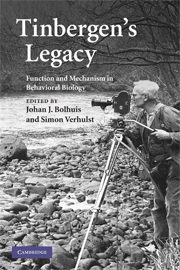
Tinbergen's Legacy
Nobel laureate Niko Tinbergen laid the foundations for the scientific study of animal behaviour with his work on causation, development, function and evolution. In this book, an international cast of leading animal biologists reflect on the enduring significance of Tinbergen's groundbreaking proposals for modern behavioural biology. It includes a reprint of Tinbergen's original article on the famous 'four whys' and a contemporary introduction, after which each of the four questions are discussed in the light of contemporary evidence. There is also a discussion of the wider significance of recent trends in evolutionary psychology and neuroecology to integrate the 'four whys'. With a foreword by one of Tinbergen's most prominent pupils, Aubrey Manning, this wide-ranging book demonstrates that Tinbergen's views on animal behaviour are crucial for modern behavioural biology. It will appeal to graduate students and researchers in animal behaviour, behavioural ecology and evolutionary biology.
eBook