
Catalogue Search | MBRL


Are you sure you want to remove the book from the shelf?

{{itemTitle}}
2,042
result(s) for
"Comparative literature -- American and Latin American"
Sort by:


Ghost-Watching American Modernity:Haunting, Landscape, and the Hemispheric Imagination
In Ghost-Watching American Modernity, Maria del Pilar Blanco revisits nineteenth- and twentieth-century texts from Spanish America and the United States to ask how different landscapes are represented as haunted sites. Moving from foundational fictions to Westerns, Blanco explores the diverse ways in which ghosts and haunting emerge across the American hemisphere for authors who are preoccupied with evoking the experience of geographical transformations during a period of unprecedented development. The book offers an innovative approach that seeks to understand ghosts in their local specificity, rather than as products of generic conventions or as allegories of hidden desires. Its chapters pursue formally attentive readings of texts by Domingo Sarmiento, Henry James, Jose Marti, W. E. B. Du Bois, Juan Rulfo, Felisberto Hernandez, and Clint Eastwood. In an intervention that will reconfigure the critical uses of spectrality for scholars in U.S./Latin American Studies, narrative theory, and comparative literature, Blanco advances ghost-watching as a method for rediscovering haunting on its own terms.
eBook

Literary and cultural relations between Brazil and Mexico : deep undercurrents
\"Literary and Cultural Relations Between Brazil and Mexico: Deep Undercurrents proposes an innovative assessment of cultural relations in Latin America in a context of enormous diversity. Its main focus is on a series of imaginative encounters involving extraordinary writers, artists, filmmakers, and thinkers from Brazil and Mexico. These encounters originated noteworthy essays, poems, novels, films, sculptures, and even graphic novels that represent the amazing potential of intercultural contacts within Latin America. They are carefully contextualized and thoroughly examined in a set of dense and yet clear analyses. Ultimately, these encounters serve as the basis for setting up an important discussion about the reconfiguration of the idea of Latin America and the productive cultural relationship between Latin American identities\"-- Provided by publisher.
Book

Segregated Miscegenation
First Published in 2003. Routledge is an imprint of Taylor & Francis, an informa company.
Carlos Hiraldo earned his Ph.D. from SUNY at Stony Brook and is currently an Assistant Professor of English at LaGuardia Community College.
eBook
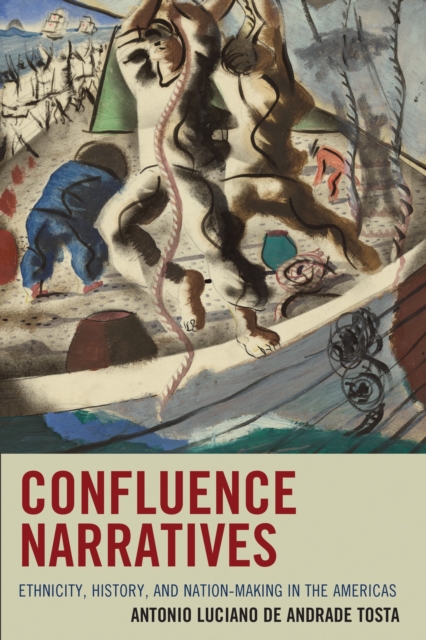
Confluence narratives
Confluence Narratives: Ethnicity, History and Nation-Making in the Americas explores how a collection of contemporary novels calls attention to the impact of ethnicity on national identities in the Americas. These historical narratives portray the cultural encounters—the conflicts and alliances, peaceful borrowings and violent seizures—that have characterized the history of the American continents since the colonial period. In the second half of the twentieth century, North and South American readers have witnessed a steady output of novels that revisit moments of cultural confluence as a means of revising national histories. Confluence Narratives proposes that these historical novels, published in such places as Brazil, Argentina, Mexico, the United States, and Canada, make up a key literary genre in the Americas. The genre links the various parts of the hemisphere together through three common historical experiences: colonization, slavery, and immigration. Luciano Tosta demonstrates how numerous texts from the United States, Canada, Spanish America, the Caribbean, and Brazil fall into the genre. The book focuses on four case studies from ethnic groups in the Americas: Amerindians, Afro-descendants, Jewish Americans, and Japanese Americans. Tosta uses the experience of the American nations as a springboard to problematize the concept of the contemporary nation, an identity marked by border-crossings and other experiences of deterritorialization. Based on the exploration of \"confluence narratives,\" Tosta argues that the \"contemporary\" nation is not as contemporary as one may think. Informed by postcolonial theory and transnational and ethnic studies, this book offers an important comparative study for and of inter-American literature. Its analysis of the representation of cultural encounters within distinctive national histories underscores the complex nature of 'otherness' in the Americas, as well as the inherently transcultural aspect of a trans-continental American identity.
eBook
Segregated Miscegenation
First Published in 2003. Routledge is an imprint of Taylor & Francis, an informa company.
eBook

Challenging the Black Atlantic
The historical novels of Manuel Zapata Olivella and Ana Maria Gonçalves map black journeys from Africa to the Americas in a way that challenges the Black Atlantic paradigm that has become synonymous with cosmopolitan African diaspora studies. Unlike Paul Gilroy, who coined the term and based it on W.E.B. DuBois’s double consciousness, Zapata, in Changó el gran putas (1983), creates an empowering mythology that reframes black resistance in Colombia, Haiti, Mexico, Brazil, and the United States. In Um defeito de cor (2006), Gonçalves imagines the survival strategies of a legendary woman said to be the mother of black abolitionist poet Luís Gama and a conspirator in an African Muslim–led revolt in Brazil’s “Black Rome.” These novels show differing visions of revolution, black community, femininity, sexuality, and captivity. They skillfully reveal how events preceding the UNESCO Decade of Afro-Descent (2015–2024) alter our understanding of Afro-Latin America as it gains increased visibility.
Published by Bucknell University Press. Distributed worldwide by Rutgers University Press.
eBook

Para Romper con el Insularismo
Para romper con el insularismo que ha venido caracterizando la literatura puertorriqueña nueve destacados especialistas proponen estudios desde una perspectiva comparatista. Quíntuples de Luis Rafael Sánchez entra en diálogo con The Last Carnival de Derek Walcott. Los planteamientos (afro)antillanos de Palés Matos son revisitados en relación con los de Guillén. Los ensayos de José Luis González son puestos en relación con el ideario del pensador dominicano Silvio Torres-Saillant. El cuento 'Cuatro selecciones por una peseta' de Ana Lydia Vega y Carmen Lugo Filippi engendra reflexiones sobre clichés caribeños al cotejarlo con 'Vellonera de sueños' del dominicano Luis Martín Gómez. Un ensayo de Juan Bosch sobre Emilio Belaval arroja otra luz sobre ambos escritores. Pero los interlocutores no provienen únicamente del área caribeña. Sol de medianoche de Edgardo Rodríguez Juliá es relacionado con 'Deutsches Requiem' de Borges y sus crónicas suscitan ecos desde Chile con Lemebel. El laberinto de la soledad de Octavio Paz es acercado a los ensayos de Emilio Belaval. Hasta se tienden puentes entre el bertso vasco y la décima puertorriqueña. Estas aproximaciones innovadoras amplían el contexto cultural e intelectual de las letras puertorriqueñas.
eBook

Mayaya Rising
Who are the Black heroines of Latin America and the Caribbean? Where do we turn for models of transcendence among women of African ancestry in the region? In answer to the historical dearth of such exemplars, Mayaya Rising explores and celebrates the work of writers who intentionally center powerful female cultural archetypes. In this inventive analysis, Duke proposes three case studies and a corresponding womanist methodology through which to study and rediscover these figures. The musical Cuban-Dominican sisters and former slaves Teodora and Micaela Ginés inspired Aida Cartagena Portalatin's epic poem Yania tierra; the Nicaraguan matriarch of the May Pole, \"Miss Lizzie,\" figures prominently in four anthologies from the country's Bluefields region; and the iconic palenqueras of Cartagena, Colombia are magnified in the work of poets María Teresa Ramírez Neiva and Mirian Díaz Pérez. In elevating these figures and foregrounding these works, Duke restores and repairs the scholarly record.
eBook

A companion to Latin American literature and culture
Cutting-edge and insightful discussions of Latin American literature and culture In the newly revised second edition of A Companion to Latin American Literature and Culture, Sara Castro-Klaren delivers an eclectic and revealing set of discussions on Latin American culture and literature by scholars at the cutting edge of their respective fields.
eBook