
Catalogue Search | MBRL


Are you sure you want to remove the book from the shelf?

{{itemTitle}}
5
result(s) for
"Composition (Language arts) Therapeutic use."
Sort by:

A guide to writing social stories : step-by-step guidelines for parents and professionals
\"Developed with the input of parents and professionals, and informed by new Social Stories research, this is a comprehensive, clear step-by-step guide to writing personalised Social Stories that gives children social information, creating many benefits for them\"--Back cover.
Book

Enticing Hard-To-Reach Writers
In her moving and personal book Enticing Hard-to-Reach Writers. Ruth Ayres weaves together her experience as a mother, teacher, and writer. She explores the power of stories to heal children from troubled backgrounds and offers up strategies for helping students discover and write about their own stories of strength and survival. She shares her own struggles and triumphs and hard-earned lessons from raising a family of four adopted children. Her experience is invaluable to any teacher whose has met children living in poverty, in unstable households, or in fear of abuse. Ayres explores brain research and the ways trauma can change the brain and how encouraging all students to write can help offset some of these effects. She believes that all students benefit from revealing their stories, by communicating information and opinion that allows darkness to turn to light in the lives of children. In the last part of her book she offers up practical suggestions for enticing all writers, regardless of their struggles. Enticing Hard-to-Reach Writers invites you on a journey to become a teacher who refuses to give up on any student, who helps children believe that they can have a positive impact on the world, and who-in some cases becomes the last hope for a child to heal.
eBook

Signifying Pain
A deeply personal yet universal work, Signifying Pain applies the principles of therapeutic writing to such painful life experiences as mental illness, suicide, racism, domestic abuse, and even genocide. Probing deep into the bedrock of literary imagination, Judith Harris traces the odyssey of a diverse group of writers—John Keats, Derek Walcott, Jane Kenyon, Michael S. Harper, Robert Lowell, and Ai, as well as student writers—who have used their writing to work through and past such personal traumas. Drawing on her own experience as a poet and teacher, Harris shows how the process can be long and arduous, but that when exercised within the spirit of one's own personal compassion, the results can be limitless. Signifying Pain will be of interest not only to teachers of creative and therapeutic writing, but also to those with a critical interest in autobiographical or confessional writing more generally.
eBook

Therapeutic Storywriting
Literacy work can provide a therapeutic context in which to support children with emotional and behavioural difficulties in mainstream schools. This text provides a clear theoretical rationale for therapeutic storywriting.
eBook
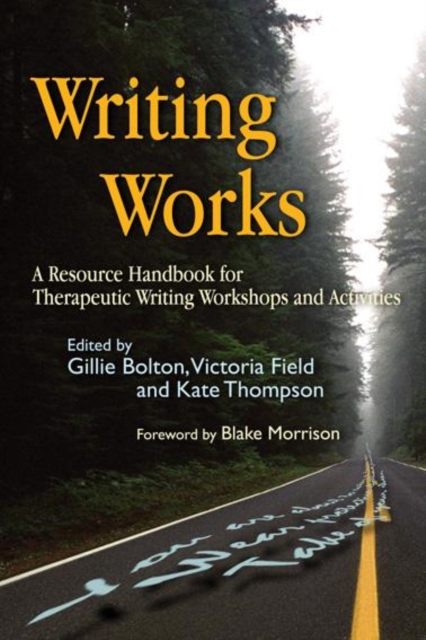
Writing works : a resource handbook for therapeutic writing workshops and activities
The use of creative writing as a route to personal development is a powerful therapeutic tool - a fact that is recognized in the growing numbers of workshops and writing groups within professional contexts, including clinical, health and criminal justice settings.
Writing Works is a guide for writers or therapists working with groups or individuals and is full of practical advice on everything from the equipment needed to run a session to ideas for themes, all backed up by the theory that underpins the methods explained. Experienced practitioners in the field contribute detailed illuminating accounts of organizing writing workshops for a wide range of different clients, together with examples of their outcomes.
This book will be an invaluable start-up reference for arts therapists and professionals working across the health, social care and caring professions, and one that will be referred to again and again.
eBook