
Catalogue Search | MBRL


Are you sure you want to remove the book from the shelf?

{{itemTitle}}
526
result(s) for
"Composition (Musique)"
Sort by:


Medieval music and the art of memory
This bold challenge to conventional notions about medieval music disputes the assumption of pure literacy and replaces it with a more complex picture of a world in which literacy and orality interacted. Asking such fundamental questions as how singers managed to memorize such an enormous amount of music and how music composed in the mind rather than in writing affected musical style, Anna Maria Busse Berger explores the impact of the art of memory on the composition and transmission of medieval music. Her fresh, innovative study shows that although writing allowed composers to work out pieces in the mind, it did not make memorization redundant but allowed for new ways to commit material to memory.
eBook

Algorithmic composition
Composers have used formalized procedures to create music throughout history. With the advent of the computer, algorithmic composition allows composers not only to create and experiment with different formalisms, but to hear and evaluate results quickly. Often in algorithmic composition, the composer has only a vague idea how the output will sound, but because the input is highly automated, the composer can make adjustments to take advantage of happy accidents, program bugs, and other creative sources of sound. Algorithmic Composition: A Guide to Composing Music with Nyquist provides an overview of procedural approaches to music generation. It introduces programming concepts through many examples written using the Nyquist system for music composition and sound synthesis. Nyquist is freely available software, and over 100 program examples from this book are available in electronic form. Readers will be well equipped to develop their own algorithms for composition. Music students who are learning about computer music and electronic music will all be interested in this innovative book, as generative music becomes an important part of the future of the discipline. Students and scholars in computer science will also find much to interest them, in a straightforward and fun way.
eBook
Economist video. Behind the data : music by numbers
With 25 Billboard Hot 100 number one hits to his name, Max Martin is effectively the king of pop music. We wanted to find the key to his success — with a little help from a lot of data.
Streaming Video

Steal This Music
Is music property? Under what circumstances can music be stolen? Such questions lie at the heart of Joanna Demers's timely look at how overzealous intellectual property (IP) litigation both stifles and stimulates musical creativity. A musicologist, industry consultant, and musician, Demers dissects works that have brought IP issues into the mainstream culture, such as DJ Danger Mouse's \"Grey Album\" and Mike Batt's homage-gone-wrong to John Cage's silent composition \"4'33.\" Demers also discusses such artists as Ice Cube, DJ Spooky, and John Oswald, whose creativity is sparked by their defiant circumvention of licensing and copyright issues. Demers is concerned about the fate of transformative appropriation-the creative process by which artists and composers borrow from, and respond to, other musical works. In the United States, only two elements of music are eligible for copyright protection: the master recording and the composition (lyrics and melody) itself. Harmony, rhythm, timbre, and other qualities that make a piece distinctive are virtually unregulated. This two-tiered system had long facilitated transformative appropriation while prohibiting blatant forms of theft. The advent of digital file sharing and the specter of global piracy changed everything, says Demers. Now, record labels and publishers are broadening the scope of IP \"infringement\" to include allusive borrowing in all forms: sampling, celebrity impersonation-even Girl Scout campfire sing-alongs. Paying exorbitant licensing fees or risking even harsher penalties for unauthorized borrowing have become the only options for some musicians. Others, however, creatively sidestep not only the law but also the very infrastructure of the music industry. Moving easily between techno and classical, between corporate boardrooms and basement recording studios, Demers gives us new ways to look at the tension between IP law, musical meaning and appropriation, and artistic freedom.
eBook
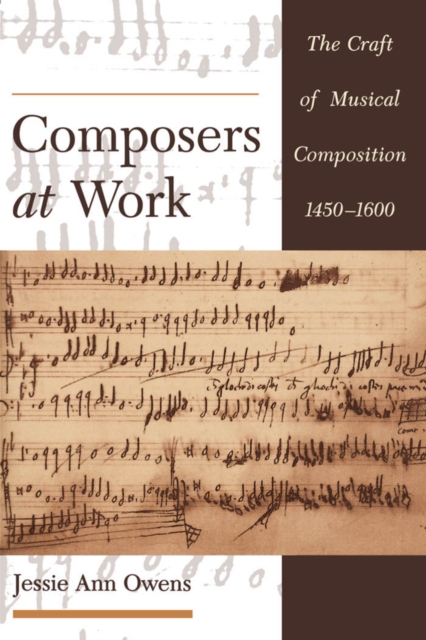
Composers at work : the craft of musical composition 1450-1600
How did Renaissance composers write their music? In this revolutionary look at a subject that has fascinated scholars for years, musicologist Jessie Ann Owens offers new and striking evidence that contrary to accepted theory, sixteenth-century composers did not use scores to compose--even to write complex vocal polyphony.L L Drawing on sources that include contemporary theoretical treatises, documents and letters, iconographical evidence, actual fragments of composing slates, and numerous sketches, drafts, and corrected autograph manuscripts, Owens carefully reconstructs the step-by-step process by which composers between 1450 and 1600 composed their music. The manuscript evidence--autographs of more than thirty composers--shows the stages of work on a wide variety of music--instrumental and vocal, sacred and secular--from across most of Renaissance Europe. Her research demonstrates that instead of working in full score, Renaissance composers fashioned the music in parts, often working with brief segments, according to a linear conception. The importance of this discovery on editorial interpretation and on performance cannot be overstated.L Lhe book opens with a broad picture of what has been known about Renaissance composition. From there, Owens examines the teaching of composition and the ways in which musicians and composers both read and wrote music. She also considers evidence for composition that occurred independent of writing, such as composing “in the mind “ or composing with instruments. In chapters on the manuscript evidence, she establishes a typology both of the sources themselves and of their contents (sketches, drafts, fair copies). She concludes with case studies detailing the working methods of Francesco Corteccia, Henricus Isaac, Cipriano de Rore, and Giovanni Pierluigi da Palestrina.L L This book will change the way we analyze and understand early music. Clear, provocative, and painstakingly researched, Composers at Work: The Craft of Musical Composition 1450-1600 makes essential reading for scholars of Renaissance music as well as those working in related fields such as sketch studies and music theory.
eBook

Collaborative creative thought and practice in music
The notion of the individual creator, a product in part of the Western romantic ideal, is now troubled by accounts and explanations of creativity as a social construct. While in collectivist cultures the assimilation (but not the denial) of individual authorship into the complexities of group production and benefit has been a feature, the notion of the lone individual creator has been persistent. Systems theories acknowledge the role of others, yet at heart these are still individual views of creativity - focusing on the creative individual drawing upon the work of others rather than recognizing the mutually constitutive elements of social interactions across time and space. Focusing on the domain of music, the approach taken in this book falls into three sections: investigations of the people, processes, products, and places of collaborative creativity in compositional thought and practice; explorations of the ways in which creative collaboration provides a means of crossing boundaries between disciplines such as music performance and musicology; and studies of the emergence of creative thought and practice in educational contexts including that of the composer and the classroom. The volume concludes with an extended chapter that reflects on the ways in which the studies reported advance understandings of creative thought and practice. The book provides new perspectives to our understandings of the role of collaborative thought and processes in creative work across the domain of music including: composition, musicology, performance, music education and music psychology.
eBook
Composing Ambiguity
American composer Morton Feldman is increasingly seen to have been one of the key figures in late-twentieth-century music, with his work exerting a powerful influence into the twenty-first century. At the same time, much about his music remains enigmatic, largely due to long-standing myths about supposedly intuitive or aleatoric working practices. In Composing Ambiguity, Alistair Noble reveals key aspects of Feldman's musical language as it developed during a crucial period in the early 1950s. Drawing models from primary sources, including Feldman's musical sketches, he shows that Feldman worked deliberately within a two-dimensional frame, allowing a focus upon the fundamental materials of sounding pitch in time. Beyond this, Feldman's work is revealed to be essentially concerned with the 12-tone chromatic field, and with the delineation of complexes of simple proportions in 'crystalline' forms. Through close reading of several important works from the early 1950s, Noble shows that there is a remarkable consistency of compositional method, despite the varied experimental notations used by Feldman at this time. Not only are there direct relations to be found between staff-notated works and grid scores, but much of the language developed by Feldman in this period was still in use even in his late works of the 1980s.
eBook
On the Track
On the Track offers a comprehensive guide to scoring for film and television. Covering all styles and genres, the authors, both noted film composers, cover everything from the nuts-and-bolts of timing, cuing, and recording through balancing the composer's aesthetic vision with the needs of the film itself. Unlike other books that are aimed at the person \"dreaming\" of a career, this is truly a guide that can be used by everyone from students to technically sophisticated professionals. It contains over 100 interviews with noted composers, illustrating the many technical points made through the text.
eBook

Musical Creativity in Restoration England
Musical Creativity in Restoration England is the first comprehensive investigation of approaches to creating music in late seventeenth-century England. Understanding creativity during this period is particularly challenging because many of our basic assumptions about composition – such as concepts of originality, inspiration and genius – were not yet fully developed. In adopting a new methodology that takes into account the historical contexts in which sources were produced, Rebecca Herissone challenges current assumptions about compositional processes and offers new interpretations of the relationships between notation, performance, improvisation and musical memory. She uncovers a creative culture that was predominantly communal, and reveals several distinct approaches to composition, determined not by individuals, but by the practical function of the music. Herissone's new and original interpretations pose a fundamental challenge to our preconceptions about what it meant to be a composer in the seventeenth century and raise broader questions about the interpretation of early modern notation.
eBook