
Catalogue Search | MBRL


Are you sure you want to remove the book from the shelf?

{{itemTitle}}
14,977
result(s) for
"Computer capacity"
Sort by:

The art of capacity planning : scaling web resources in the cloud
In their early days, Twitter, Flickr, Etsy, and many other companies experienced sudden spikes in activity that took their web services down in minutes. Today, determining how much capacity you need for handling traffic surges is still a common frustration of operations engineers and software developers. This hands-on guide provides the knowledge and tools you need to measure, deploy, and manage your web application infrastructure before you experience explosive growth.
Book


Reconceptualizing System Usage: An Approach and Empirical Test
Although DeLone, McLean, and others insist that system usage is a key variable in information systems research, the system usage construct has received little theoretical scrutiny, boasts no widely accepted definition, and has been operationalized by a diverse set of unsystematized measures. In this article, we present a systematic approach for reconceptualizing the system usage construct in particular nomological contexts. Comprising two stages, definition and selection, the approach enables researchers to develop clear and valid measures of system usage for a given theoretical and substantive context. The definition stage requires that researchers define system usage and explicate its underlying assumptions. In the selection stage, we suggest that system usage be conceptualized in terms of its structure and function. The structure of system usage is tripartite, comprising a user, system, and task, and researchers need to justify which elements of usage are most relevant for their study. In terms of function, researchers should choose measures for each element (i.e., user, system, and/or task) that tie closely to the other constructs in the researcher's nomological network.
To provide evidence of the viability of the approach, we undertook an empirical investigation of the relationship between system usage and short-run task performance in cognitively engaging tasks. The results support the benefits of the approach and show how an inappropriate choice of usage measures can lead researchers to draw opposite conclusions in an empirical study. Together, the approach and the results of the empirical investigation suggest new directions for research into the nature of system usage, its antecedents, and its consequences.
Journal Article
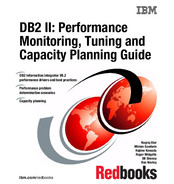
DB2 II
This IBM Redbooks publication provides an overview of DB2
Information Integrator V8.2 key performance drivers; best practices
to achieve optimal performance; and guidelines for monitoring a DB2
Information Integrator environment for capacity planning, problem
diagnosis, and problem resolution.This publication documents procedures for monitoring existing
DB2 II implementations for the purposes of capacity planning. It
also documents a methodology for routine and exception monitoring
of a DB2 II environment for performance problem determination; and
describes some commonly encountered performance problem scenarios
and the step-by-step approach used in problem determination and
resolution.
eBook

File System Performance Comparison in Full Hardware Virtualization with ESXi, KVM, Hyper-V and Xen Hypervisors
This paper focus is the mathematical modeling of the file system performance in virtual environment when using type-1 hypervisors. The modeling provides a set of hypotheses related to the expected behavior. The presented model is validated based on the analysis of a collection of the results obtained for a specific case study. Our case study includes the file system performance comparison, in full hardware virtualization, when examining four dominant type-1 hypervisors: ESXi, KVM, Hyper-V, and Xen. We chose Filebench as a benchmark tool, which guarantees comprehensive and versatile testing of file system performance, whereas for all tested hypervisors we have provided an equivalent environment and testing conditions. For all the examined hypervisors, we have tested the cases with one, two, and three virtual machines that are running simultaneously, whereas CentOS 6.3 Linux is used as the guest operating system. We have further validated the mathematical model and defined hypotheses by the means of the case study benchmark results.
Journal Article

Methodology for Automating and Orchestrating Performance Evaluation of Kubernetes Container Network Interfaces
Maintaining a fast, low-latency network must be balanced in the demanding world of High-Performance Computing (HPC). Any compromise in network performance can severely affect distributed HPC applications, leading to bottlenecks that undermine the entire system’s efficiency. This paper highlights the critical need for precise and consistent evaluation of Kubernetes Container Network Interfaces (CNIs) to ensure that HPC workloads can operate at their full potential. Traditional manual methods for evaluating network bandwidth and latency are time-consuming and prone to errors, making them inadequate for the rigorous demands of HPC environments. To address this, we introduce a novel approach that leverages Ansible to automate and standardize the evaluation process across diverse CNIs, performance profiles, and configurations. By eliminating human error and ensuring replicability, this method significantly enhances the reliability of performance assessments. The Ansible playbooks we developed enable the efficient deployment, configuration, and execution of CNIs and evaluations, providing a robust framework for ensuring that Kubernetes-based infrastructures can meet the stringent performance requirements of HPC applications. This approach is vital for safeguarding the performance integrity of HPC workloads, ensuring that inadequate network configurations do not cripple them.
Journal Article

Empirical Performance Analysis of Collective Communication for Distributed Deep Learning in a Many-Core CPU Environment
To accommodate lots of training data and complex training models, “distributed” deep learning training has become employed more and more frequently. However, communication bottlenecks between distributed systems lead to poor performance of distributed deep learning training. In this study, we proposed a new collective communication method in a Python environment by utilizing Multi-Channel Dynamic Random Access Memory (MCDRAM) in Intel Xeon Phi Knights Landing processors. Major deep learning software platforms, such as TensorFlow and PyTorch, offer Python as a main development language, so we developed an efficient communication library by adapting Memkind library, which is a C-based library to utilize high-performance memory MCDRAM. For performance evaluation, we tested the popular collective communication methods in distributed deep learning, such as Broadcast, Gather, and AllReduce. We conducted experiments to analyze the effect of high-performance memory and processor location on communication performance. In addition, we analyze performance in a Docker environment for further relevance given the recent major trend of Cloud computing. By extensive experiments in our testbed, we confirmed that the communication in our proposed method showed performance improvement by up to 487%.
Journal Article
The Strategic Value of Information Technology in Setting Productive Capacity
Capacity is the maximum short-run output with capital in place under normal operations, and capital investment increases capacity. Excess capacity can be used as entry deterrence by lowering average costs over a greater range of output, and as an operations strategy by providing value through flexibility to manage demand fluctuations and production disturbances. We study the way that information technology (IT) can contribute to a strategy of holding excess capacity by comparing the relationship between IT capital and capacity with that of non-IT capital and capacity. We find that increases in IT capital yield almost fourfold greater expansion in capacity than do increases in non-IT capital. Thus, as both types of capital are constraints on capacity, for a strategy of holding excess capacity, IT capital is a more valuable constraint to relax than non-IT capital. In addition, since the late 1990s, IT capital and, to a lesser extent, non-IT capital have reduced capacity utilization (output divided by capacity), meaning increasing levels of excess capacity are being held across manufacturing industries and utilities across the economy.
Capacity is the maximum short-run output with capital in place under normal operations, and capital investment increases capacity. Excess capacity can be used as an economic strategy for entry deterrence by lowering average costs over a greater range of output, and as an operations strategy by providing value through flexibility to manage demand fluctuations and production disturbances. Our primary focus is to study the way that information technology (IT) can contribute to a strategy of holding excess capacity by comparing the relationship between IT capital and capacity with that of non-IT capital and capacity. Using production theory–based empirical analyses, we find that increases in IT capital yield almost fourfold greater expansion in capacity than do increases in non-IT capital. Thus, as both types of capital are constraints on capacity, for a strategy of holding excess capacity IT capital is a more valuable constraint to relax than non-IT capital. In addition, since the late 1990s, IT capital, and to a lesser extent, non-IT capital, has reduced capacity utilization (output/capacity), meaning increasing levels of excess capacity are being held across manufacturing industries and utilities across the economy.
Journal Article

On Consensus of Star-Composed Networks with an Application of Laplacian Spectrum
In this paper, we mainly study the performance of star-composed networks which can achieve consensus. Specifically, we investigate the convergence speed and robustness of the consensus of the networks, which can be measured by the smallest nonzero eigenvalue λ2 of the Laplacian matrix and the H2 norm of the graph, respectively. In particular, we introduce the notion of the corona of two graphs to construct star-composed networks and apply the Laplacian spectrum to discuss the convergence speed and robustness for the communication network. Finally, the performances of the star-composed networks have been compared, and we find that the network in which the centers construct a balanced complete bipartite graph has the most advantages of performance. Our research would provide a new insight into the combination between the field of consensus study and the theory of graph spectra.
Journal Article