
Catalogue Search | MBRL


Are you sure you want to remove the book from the shelf?

{{itemTitle}}
13,114
result(s) for
"Computer composition."
Sort by:


Technology and the Gendering of Music Education
Critical of technologically determinist assumptions underpinning current educational policy, Victoria Armstrong argues that this growing technicism has grave implications for the music classroom where composition is often synonymous with the music technology suite. The use of computers and associated compositional software in music education is frequently decontextualized from cultural and social relationships, thereby ignoring the fact that new technologies are used and developed within existing social spaces that are always already delineated along gender lines. Armstrong suggests these gender-technology relations have a profound effect on the ways adolescents compose music as well as how gendered identities in the technologized music classroom are constructed. Drawing together perspectives from the sociology of science and technology studies (STS) and the sociology of music, Armstrong examines the gendered processes and practices that contribute to how students learn about technology, the repertoire of teacher and student talk, its effect on student confidence and the issue of male control of technological knowledge. Even though girls and female teachers have technological knowledge and skill, the continuing material and symbolic associations of technology with men and masculinity contribute to the perception of women as less able and less interested in all things technological. In light of the fact that music technology is now central to many music-making practices across all sectors of education from primary, secondary through to higher education, this book provides a timely critical analysis that powerfully demonstrates why the relationship between gender and music technology should remain an important empirical consideration.
eBook


Interactive composition : strategies using Ableton Live and Max for Live
Interactive Composition empowers readers with the skills and insight needed to compose and perform electronic popular music in a variety of popular styles. This book focuses on the implementation of compositional and production concepts with each chapter culminating in a newly composed piece created by the reader using these concepts.
eBook

Deep and shallow : machine learning in music and audio
\"Providing an essential and unique bridge between the theories of signal processing, machine learning and artificial intelligence (AI) in music, this book provides a holistic overview of foundational ideas in music, from the physical and mathematical properties of sound to symbolic representations. Combining signals and language models in one place, this book explores how sound may be represented and manipulated by computer systems, and how our devices may come to recognize particular sonic patterns as musically meaningful or creative through the lens of information theory. Introducing popular fundamental ideas in AI at a comfortable pace, more complex discussions around implementations and implications in musical creativity are gradually incorporated as the book progresses. Each chapter is accompanied by guided programming activities designed to familiarise readers with practical implications of discussed theory, without the frustrations of free-form coding. Surveying state of the art methods in applications of deep neural networks to audio and sound computing, as well as offering a research perspective that suggests future challenges in music and AI research, this book appeals to both students of AI and music, as well as industry professionals in the fields of machine learning, music and AI\"-- Provided by publisher.
Book

Algorithmic composition
Composers have used formalized procedures to create music throughout history. With the advent of the computer, algorithmic composition allows composers not only to create and experiment with different formalisms, but to hear and evaluate results quickly. Often in algorithmic composition, the composer has only a vague idea how the output will sound, but because the input is highly automated, the composer can make adjustments to take advantage of happy accidents, program bugs, and other creative sources of sound. Algorithmic Composition: A Guide to Composing Music with Nyquist provides an overview of procedural approaches to music generation. It introduces programming concepts through many examples written using the Nyquist system for music composition and sound synthesis. Nyquist is freely available software, and over 100 program examples from this book are available in electronic form. Readers will be well equipped to develop their own algorithms for composition. Music students who are learning about computer music and electronic music will all be interested in this innovative book, as generative music becomes an important part of the future of the discipline. Students and scholars in computer science will also find much to interest them, in a straightforward and fun way.
eBook

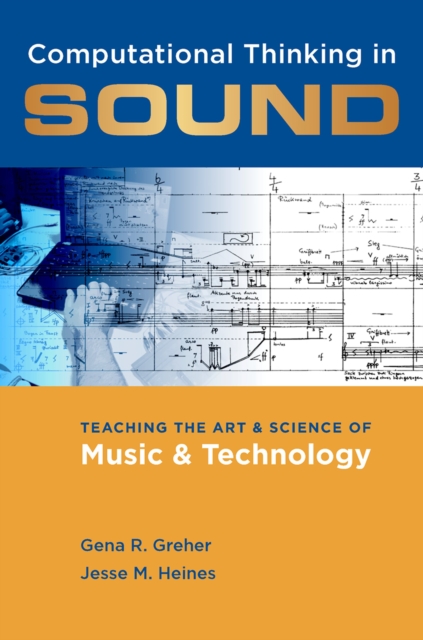
Computational Thinking in Sound
Computational Thinking in Sound is the first book for music fundamentals educators which is devoted specifically to music, sound, and technology. The book offers practical guidance on creating an interdisciplinary classroom program, and includes numerous student activities at the intersection of computing and music complemented by examples of student work.
eBook

Making music with computers : creative programming in Python
\"Preface The book in your hands is the result of more than a decade of independent and collaborative effort by the two authors and their computer- music associates. Combining computers and music has a long and fruitful heritage. Moreover, the ideas which underpin the connection between calculating and composing date back centuries. In the 21st century, computers and music are more closely aligned than ever before. In particular, computers have become indispensable in music making, distribution, performance, and consumption. This book introduces important concepts and skills necessary to make music with computers. It interweaves computing pedagogy with musical concepts and creative activities. It does this while maintaining a natural, steady increase in computational skills that are always motivated by creative musical contexts. This book is mainly intended for introductory computer science courses and for courses in the intersection of computing and the arts. However, it is naturally suited for self-study. It assumes little musical and programming experience; it introduces topics and concepts as they arise through motivating, and hopefully inspiring examples. This book addresses two trends in computing education: (1) the growing use of the Python language for teaching introductory programming, and (2) the increasing infusion of computational thinking into liberal arts courses, especially interdisciplinary offerings in computing and the arts. It does so by presenting computer music topics in an accessible manner for our two main target audiences:\"-- Provided by publisher.
Book

Cross-modal deep collaborative networks for intelligent music composition and interactive performance
With the continuous growth of intelligent music generation and the increasing demand for human–computer interaction, realizing music composition driven by natural language descriptions has become a significant research direction in this field. However, existing approaches still exhibit limitations in semantic alignment between text and music, audio quality of generation, and controllability, making it difficult to balance high fidelity with semantic consistency. To address this issue, this study proposes a text and music-based generation net (TMG-Net) framework that integrates Transformer, Audio Transformer, contrastive learning, and diffusion-based generation for text-driven music generation tasks. The framework employs a Transformer to capture the semantic features of text and time–frequency information of audio, and achieves cross-modal alignment through contrastive learning. On this basis, a conditional diffusion model is introduced to generate Mel-spectrograms, which are subsequently reconstructed into high-fidelity music via a vocoder, thereby enhancing both the naturalness and semantic consistency of the generated music. Experiments conducted on the MusicCaps and Song Describer Dataset public benchmarks demonstrate that TMG-Net significantly outperforms representative methods such as MuseGAN, Restyle-MusicVAE, and Mustango across three key metrics—Fréchet Audio Distance (FAD), Contrastive Language-Audio Pretraining (CLAP) score, and Recall at 10 (R@10)—while approaching the performance of MusicLLM. These results indicate that TMG-Net can effectively align with textual semantics while ensuring audio quality, offering a novel technological pathway and application potential for intelligent music creation and interactive performance.
Journal Article