
Catalogue Search | MBRL


Are you sure you want to remove the book from the shelf?

{{itemTitle}}
4,202
result(s) for
"Computer programming, programs, data"
Sort by:


Foundations of Probabilistic Logic Programming
Probabilistic Logic Programming extends Logic Programming by enabling the representation of uncertain information by means of probability theory. Probabilistic Logic Programming is at the intersection of two wider research fields: the integration of logic and probability and Probabilistic Programming. Logic enables the representation of complex relations among entities while probability theory is useful for model uncertainty over attributes and relations. Combining the two is a very active field of study. Probabilistic Programming extends programming languages with probabilistic primitives that can be used to write complex probabilistic models. Algorithms for the inference and learning tasks are then provided automatically by the system. Probabilistic Logic programming is at the same time a logic language, with its knowledge representation capabilities, and a Turing complete language, with its computation capabilities, thus providing the best of both worlds. Since its birth, the field of Probabilistic Logic Programming has seen a steady increase of activity, with many proposals for languages and algorithms for inference and learning. Foundations of Probabilistic Logic Programming aims at providing an overview of the field with a special emphasis on languages under the Distribution Semantics, one of the most influential approaches. The book presents the main ideas for semantics, inference, and learning and highlights connections between the methods. Many examples of the book include a link to a page of the web application http://cplint.eu where the code can be run online.
eBook

Case study research in software engineering
Based on their own experiences of in-depth case studies of software projects in international corporations, in this book the authors present detailed practical guidelines on the preparation, conduct, design and reporting of case studies of software engineering. This is the first software engineering specific book on the case study research method.
eBook

Granular Computing
Granular computing focuses on formalizing information granules and unifying them to create a coherent methodological and developmental environment for intelligent system design and analysis. This innovative book presents the unified principles of granular computing along with its comprehensive algorithmic framework and design practices. It explores key concepts and formalisms as well as applications. It also emphasizes the need to consider information granularity as an important design asset that helps in the construction of more realistic models of real-world systems and in facilitating collaborative pursuits of system modeling.
eBook

Deterministic Network Calculus
Deterministic network calculus is a theory based on the (min,plus) algebra. Its aim is to compute worst-case performance bounds in communication networks. Our goal is to provide a comprehensive view of this theory and its recent advances, from its theoretical foundations to its implementations. The book is divided into three parts. The first part focuses on the (min,plus) framework and its algorithmic aspects. The second part defines the network calculus model and analyzes one server in isolation. Different service and scheduling policies are discussed, particularly when data is packetized. The third part is about network analyses. Pay burst only once and pay multiplexing only once phenomena are exhibited, and different analyses are proposed and compared. This includes the linear programming approaches that compute tight performance bounds. Finally, some partial results on the stability are detailed.
eBook

Python Programming Using Problem Solving
Python is a robust, procedural, object-oriented, and functional language. The features of the language make it valuable for web development, game development, business, and scientific programming. This book deals with problem-solving and programming in Python. It concentrates on the development of efficient algorithms, the syntax of the language, and the ability to design programs in order to solve problems. In addition to standard Python topics, the book has extensive coverage of NumPy, data visualization, and Matplotlib. Numerous types of exercises, including theoretical, programming, and multiple-choice, reinforce the concepts covered in each chapter.
eBook

IT Governance – An International Guide to Data Security and ISO 27001/ISO 27002 (8th Edition)
In this updated edition, renowned ISO 27001/27002 experts Alan Calder and Steve Watkins:* Discuss the ISO 27001/27002:2022 updates;* Provide guidance on how to establish a strong IT governance system and an ISMS (information security management system) that complies with ISO 27001 and ISO 27002;* Highlight why data protection and information security are vital in our ever-changing online and physical environments;* Reflect on changes to international legislation, e.g. the GDPR (General Data Protection Regulation); and* Review key topics such as risk assessment, asset management, controls, security, supplier relationships and compliance.
eBook
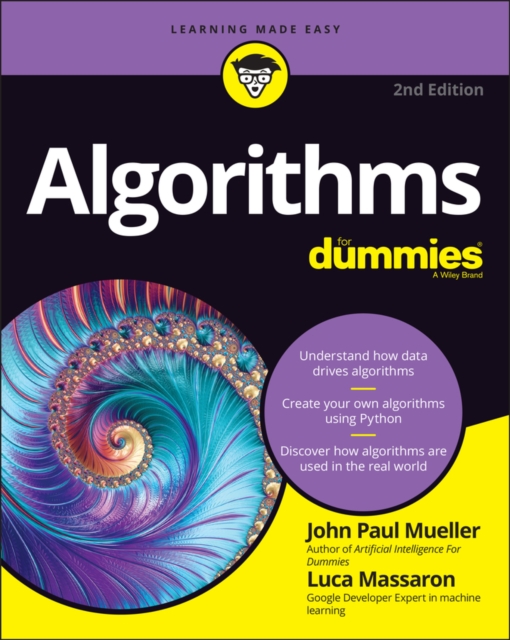
Algorithms for dummies
Your secret weapon to understanding--and using!--one of the most powerful influences in the world today From your Facebook News Feed to your most recent insurance premiums--even making toast!--algorithms play a role in virtually everything that happens in modern society and in your personal life.
eBook
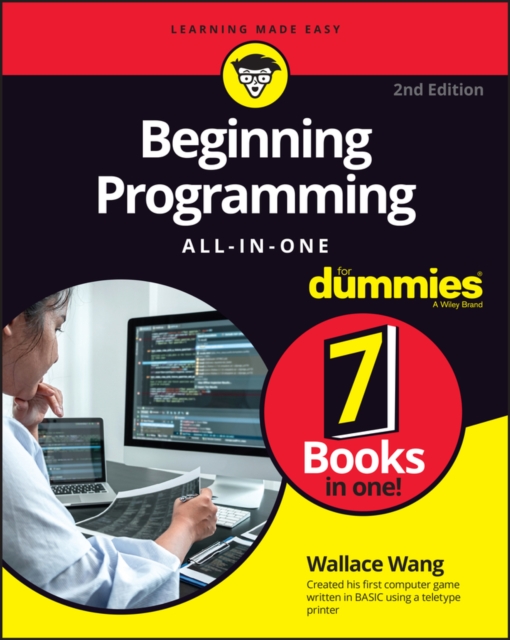
Beginning Programming All-in-One For Dummies
Let there be code! Beginning Programming All-in-One For Dummies offers one guide packed with 7 books to teach you programming across multiple languages. Coding can seem complex and convoluted, but Dummies makes it simple and easy to understand. You'll learn all about the principles of programming, algorithms, data structures, debugging programs, unique applications of programming and more while learning about some of the most popular programming languages used today. Move confidently forward in your computer science coursework or straight into the workforce. You'll come away with a rock-solid foundation in the programming basics, using data, coding for the web, and building killer apps. * Learn the basics of coding, including writing and compiling code, using algorithms, and data structures * Get comfortable with the syntax of several different programming languages * Wrap your mind around interesting programming opportunities such as conducting biological experiments within a computer or programming a video game engine * Develop cross-platform applications for desktop and mobile devices This essential guide takes the complexity and convolution out of programming for beginners and arms you with the knowledge you need to follow where the code takes you.
eBook