
Catalogue Search | MBRL


Are you sure you want to remove the book from the shelf?

{{itemTitle}}
16,866
result(s) for
"Computer science History."
Sort by:

The computing universe : a journey through a revolution
\"Computers now impact almost every aspect of our lives, from our social interactions to the safety and performance of our cars. How did this happen in such a short time? And this is just the beginning. In this book, Tony Hey and Gyuri Pâapay lead us on a journey from the early days of computers in the 1930s to the cutting-edge research of the present day that will shape computing in the coming decades. Along the way, they explain the ideas behind hardware, software, algorithms, Moore's Law, the birth of the personal computer, the Internet and the Web, the Turing Test, Jeopardy's Watson, World of Warcraft, spyware, Google, Facebook, and quantum computing. This book also introduces the fascinating cast of dreamers and inventors who brought these great technological developments into every corner of the modern world. This exciting and accessible introduction will open up the universe of computing to anyone who has ever wondered where his or her smartphone came from\"-- Provided by publisher.
Book
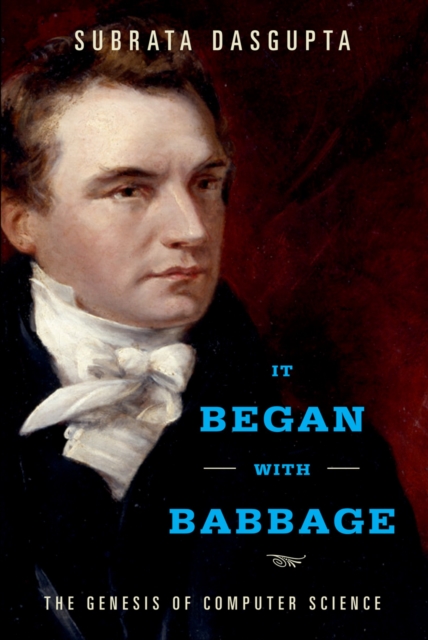
It began with Babbage : the genesis of computer science
As a field, computer science occupies a unique scientific space, in that its subject matter can exist in both physical and abstract realms. An artifact such as software is both tangible and not, and must be classified as something in between, or \"liminal.\" The study and production of liminal artifacts allows for creative possibilities that are, and have been, possible only in computer science. In It Began with Babbage, computer scientist and writer Subrata Dasgupta examines the distinct history of computer science in terms of its creative innovations, reaching back to Charles Babbage in 1819. Since all artifacts of computer science are conceived with a use in mind, the computer scientist is not concerned with the natural laws that govern disciplines like physics or chemistry; instead, the field is more concerned with the concept of purpose. This requirement lends itself to a type of creative thinking that, as Dasgupta shows us, has exhibited itself throughout the history of computer science. More than any other, computer science is the science of the artificial, and has a unique history to accompany its unique focus. The book traces a path from Babbage's Difference Engine in the early 19th century to the end of the 1960s by when a new academic discipline named \"computer science\" had come into being. Along the way we meet characters like Babbage and Ada Lovelace, Turing and von Neumann, Shannon and Chomsky, and a host of other people from a variety of backgrounds who collectively created this new science of the artificial. And in the end, we see how and why computer science acquired a nature and history all of its own.
eBook

The computer : a very short introduction
Computers have changed so much since the room-filling, bulky magnetic tape running monsters of the mid 20th century. They now form a vital part of most people's lives. And they are more ubiquitous than might be thought - you may have more than 30 computers in your home: not just the desktop and laptop but think of the television, the fridge, the microwave. But what is the basic nature of the modern computer? How does it work? How has it been possible to squeeze so much power into increasingly small machines? And what will the next generations of computers look like? In this Very Short Introduction, Darrel Ince looks at the basic concepts behind all computers; the changes in hardware and software that allowed computers to become so small and commonplace; the challenges produced by the computer revolution - especially whole new modes of cybercrime and security issues; the Internet and the advent of 'cloud computing'; and the promise of whole new horizons opening up with quantum computing, and even computing using DNA-- Source other than Library of Congress.
Book
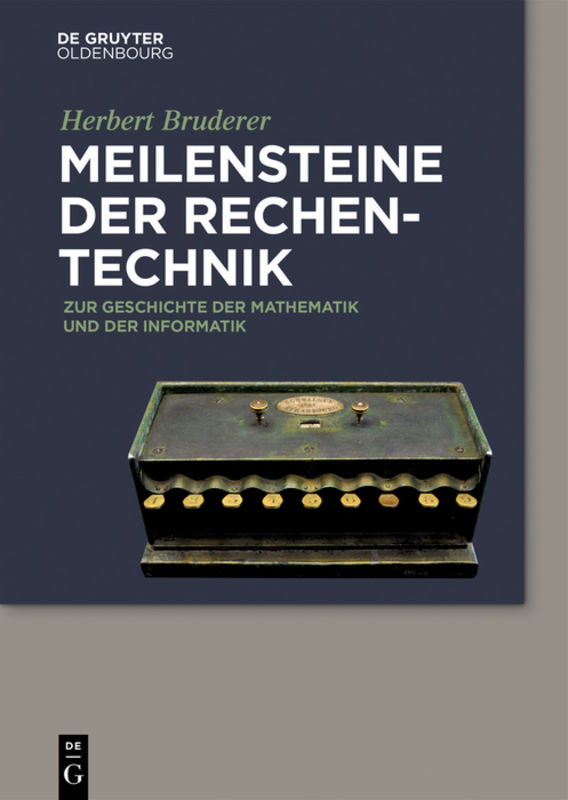
Meilensteine der Rechentechnik
Die Anfänge der Informatik liegen bereits im Dunkeln. In diesem Buch werden ausgewählte Meilensteine der Rechentechnik und der Frühzeit der Informatik vorgestellt. Grundlage dafür sind u. a. Aufsehen erregende Funde von Geräten und Schriften, die in den letzten Jahren gemacht wurden: historische Rechentische, weltgrößte Rechenwalze, weltweit älteste erhaltene Tastenaddiermaschine, bisher unbekannte Unterlagen zum Erfinder Zuse. Zur Sprache kommen Analog- wie Digitalrechner: Rechenrahmen, Rechentische, mechanische Rechenmaschinen, Rechenschieber, elektronische Rechner usw. Zahlreiche Tabellen vermitteln eine weltweite Übersicht über die ersten Digitalrechner. Einen Schwerpunkt bilden die deutschsprachigen Länder: Deutschland, Österreich, Schweiz, Liechtenstein, mit einer umfassenden Darstellung von mechanischen Rechenmaschinen aus der Schweiz. Zeittafeln geben einen Überblick über frühe amerikanische, britische und deutsche Rechenautomaten. Der Verfasser geht auch der heiklen Frage nach: Wer hat den Computer erfunden? Eine mehrsprachige Bibliografie mit über 3000 Einträgen rundet den Band ab. Das allgemein verständliche Werk richtet sich an alle, die sich mit der Geschichte der Rechentechnik und der Informatik befassen.
• Numerous recent discoveries of rare historical analog and digital calculators and previously unknown texts, drawings, and pictures from Germany, Austria, Switzerland, Liechtenstein, and France. • Worldwide, multilingual bibliography regarding the history of computer science with over 3000 entries. • 12 step-by-step set of instructions for the operation of historical analog and digital calculating devices. • 75 comparative overviews in tabular form. • 200 illustrations. • 20 comprehensive lists. • 7 timelines of computer history. During the 1970s mechanical calculating instruments and machines suddenly disappeared from the scene. They were replaced by electronic versions. Most of these devices developed since the 17th century – often very clever constructions – have been forgotten. Who can imagine today how difficult calculation was only a few decades ago? This book introduces the reader to selected milestones from prehistory and early history of computing. The Antikythera Mechanism This puzzling device was made around 200 BC. It was discovered around 1900 by divers off the Greek island of Antikythera. It is believed to be the oldest known analog (or rather hybrid) computing device. Numerous replicas have been built to unravel the mysteries of this calendar calculator. It is suspected that the machine came from the school of Archimedes. Androids, Music Boxes, Chess Automatons, Looms This treatise also explores topics related to computing technology: automated human and animal figures, mecha-nized musical instruments, music boxes, as well as punched tape controlled looms and typewriters. Also men-tioned are the chess playing machines of the highly gifted Spanish scholar Torres Quevedo (20th century), the magnificent androids (artificial humans) of the Neuchâtel clockmaker Jaquet-Droz (18th century), and his splen-did still functional programmable handwriting automaton \"The Writer\". A similar machine can also be seen in Vienna. Schickard, Pascal, and Leibniz During the 17th century broadly gifted geniuses from Germany and France tried to build calculating machines. Developing a mechanism to perform decimal carry was very challenging. Famous calculators are covered in the text and pictures. These ornate works of art, often circular in form, were popular presents for royalty. Only in the 19th century did makers succeed in producing useful four function calculators. The first successful, commercial-ly produced device was the Thomas Arithmometer, made in Paris. This book lists, for the first time, all the known Swiss makers of mechanical calculating machines and compares their products with one another. The most famous firms were Egli AG (maker of the \"Millionaire\" and the \"Madas\") and Pecisa AG. Both companies were located in Zurich. In the 1950s Heinz Rutishauser, the inventor of automatic programming, used a Madas at the ETH (Swiss Federal Institute of Technology) Zurich. Sectors, Proportional Compasses, Polar Planimeters, Pantographs, and Coordinatographs Here the discussion is about exceptionally versatile analog calculation instruments such as sectors and propor-tional compasses (dividers). Vanished and forgotten are the products of the world's former leading makers of mechanical integrators such as Amsler (Schaffhausen), Coradi (Zurich), and Ott (Kempten). They also made planimeters and pantographs. These were used in land surveying offices and the textile industry (knitting). Counting Boards During the middle ages and in more recent times many city halls had a beautiful carved counting board. These tables were used for performing calculations using coins. This method was later replaced by written calculation. Only a few counting boards have survived, mostly in Switzerland, Germany, and France. The Oldest Preserved Key-driven Adding Machine in World The most important international discovery concerns Jean-Baptiste Schwilgué, the creator of the astronomical clock in the Cathedral in Strasbourg. The oldest preserved keyboard adding machine in the world (19th century) came to light next to an early Thomas Arithmometer in the collection of the observatory at ETH Zurich. This machine is featured on the cover of this book. Two examples of this machine have survived, an older one in Strasbourg and a later one in Zurich. The latter is in far better condition. Process Computer for the Astronomical Clock at the Cathedral of Strasbourg An additional big surprise was the discovery (in December 2014) of a rare large adding machine in the Strasbourg Historical Museum. Research has indicated that this adding machine was used to calculate the settings for a very precise milling machine used to make the gears of the astronomical clock at the Cathedral of Strasbourg. The results of calculations were transcribed by hand to a paper tape. This was put in a small box with rollers which was attached to the milling machine. Thus this formed a simple \"process computer\". The Strasbourg discovery was shown at a special exhibition at the Arithmeum of the Bonn University in 2015. If the English mathematician Charles Babbage had known of the gear milling machine of his contemporary Schwilgué, perhaps he would have been able to complete his famous program controlled Analytical Engine (19th century), the forerunner of today's digital computers. Schwilgue's calculating machines are not covered by the authoritative publications about the history of computing. Until recently leading museums of science and tech-nology throughout the world knew nothing of Schwilgué. 24 Meter Loga Cylindrical Slide Rule Bruderer's book also describes the invention of the powerful 24-meter cylindrical slide rule, the largest and most precise slide rule in the world. These analog logarithmical tools were utilized in large quantities by banks and insurance companies, for example for currency calculations. Eighty scale sections, each 60 cm long, are mounted on a drum. The result is a scale that (because of overlapping) is 24 meters long. Curta, Technical Marvel from the Buchenwald Concentration Camp The Curta is the world's smallest mechanical calculating machine that is able to perform all four arithmetical operations. The story of the Curta is told in detail by the ingenious Austrian engineer Curt Herzstark, who drew the drawings for the device while he was in Buchenwald Concentration Camp. New minutes from Thüringen have come to light about his breakneck escape from Soviet pursuers. Affectionately known as the \"Peppermill\" and very photogenic, the Curta was manufactured in Liechtenstein. However, the inventor was cheated out of his life's work. Who Invented the Computer, the Compiler, and the Stored Program? This volume discusses the decade-long controversy over the invention of the stored program computer (von Neumann architecture). The debate between American and British historians of computing continues today. This debate has been stirred up recently by the attention given to the 100th birthday of Alan Turing, truly the most important founder of theoretical informatics. The Universal Turing Machine (1936) was a mathematical model of today's stored programmed digital computer. This book offers a worldwide overview of the first computers, the early relay-based, vacuum tube, and transistorized computers, the pioneers (both men and women) of calcu-lator technology and their masterpieces. There is further coverage of the developmental lineage of calculation aids and their life span. Alan Turing, Enigma and Colossus: at Bletchley Park The dramatic events at Bletchley Park (the former British Code-Breaking Center) are presented in detail. For decades even the existence of the electronic computer Colossus was concealed. For a long time it was rumored that after WWII Churchill ordered the destruction of the ten impressive machines. Vacuum tube computers were used to crack the Lorenz Machine SZ40/42 which was used by Hitler and the German High Command. The Co-lossus was designed and built by the British Post Office Research Station. Colossus Mark 2 was ready to use a few days before the landings in Normandy. The Colossus was programmed with a plugboard and qualified as the world's first large electronic computer. The \"Turing-Welchman Bombe\" was developed by Alan Turing in collaboration with Gordon Welchman. Over 200 copies of the bombe were manufactured. They helped to crack the German Enigma machine. The Navy's U-Boat Enigma, which was considered unbreakable, was decrypted largely due to Alan Turing. The German armed forces had some 100,000 Enigmas. Difficulties during the Construction of the Ermeth and its Marketing Failure Many previously unknown documents relating to the early history of informatics have been discovered in the archives of ETH Zurich.
eBook

The second age of computer science : from ALGOL genes to neural nets
Between the genesis of computer science in the 1960s and the advent of the World Wide Web around 1990, computer science evolved in significant ways. The author has termed this period the \"second age of computer science.\" This book describes its evolution in the form of several interconnected parallel histories.
eBook

The innovators : how a group of hackers, geniuses, and geeks created the digital revolution
\"Following his blockbuster biography of Steve Jobs, The Innovators is Walter Isaacson's revealing story of the people who created the computer and the Internet. It is destined to be the standard history of the digital revolution and an indispensable guide to how innovation really happens. What were the talents that allowed certain inventors and entrepreneurs to turn their visionary ideas into disruptive realities? What led to their creative leaps? Why did some succeed and others fail? In his masterly saga, Isaacson begins with Ada Lovelace, Lord Byron's daughter, who pioneered computer programming in the 1840s. He explores the fascinating personalities that created our current digital revolution, such as Vannevar Bush, Alan Turing, John von Neumann, J.C.R. Licklider, Doug Engelbart, Robert Noyce, Bill Gates, Steve Wozniak, Steve Jobs, Tim Berners-Lee, and Larry Page. This is the story of how their minds worked and what made them so inventive. It's also a narrative of how their ability to collaborate and master the art of teamwork made them even more creative. For an era that seeks to foster innovation, creativity, and teamwork, The Innovators shows how they happen\"-- Provided by publisher.
Book
Fundamental concepts in computer science
This book presents fundamental contributions to computer science as written and recounted by those who made the contributions themselves. As such, it is a highly original approach to a “living history” of the field of computer science. The scope of the book is broad in that it covers all aspects of computer science, going from the theory of computation, the theory of programming, and the theory of computer system performance, all the way to computer hardware and to major numerical applications of computers.
eBook

The Innovators : How a Group of Inventors, Hackers, Geniuses and Geeks Created the Digital Revolution
Following his blockbuster biography of Steve Jobs, The Innovators is Walter Isaacson's story of the people who created the computer and the Internet. It is destined to be the standard history of the digital revolution and a guide to how innovation really works. What talents allowed certain inventors and entrepreneurs to turn their disruptive ideas into realities? What led to their creative leaps? Why did some succeed and others fail? In his exciting saga, Isaacson begins with Ada Lovelace, Lord Byron's daughter, who pioneered computer programming in the 1840s. He then explores the fascinating personalities that created our current digital revolution, such as Vannevar Bush, Alan Turing, John von Neumann, J.C.R. Licklider, Doug Engelbart, Robert Noyce, Bill Gates, Steve Wozniak, Steve Jobs, Tim Berners-Lee and Larry Page. This is the story of how their minds worked and what made them so creative. It's also a narrative of how their ability to collaborate and master the art of teamwork made them even more creative. For an era that seeks to foster innovation, creativity and teamwork, this book shows how they actually happen.
Computing
The history of computing could be told as the story of hardware and software, or the story of the Internet, or the story of \"smart\" hand-held devices, with subplots involving IBM, Microsoft, Apple, Facebook, and Twitter. In this concise and accessible account of the invention and development of digital technology, computer historian Paul Ceruzzi offers a broader and more useful perspective. He identifies four major threads that run throughout all of computing's technological development: digitization--the coding of information, computation, and control in binary form, ones and zeros; the convergence of multiple streams of techniques, devices, and machines, yielding more than the sum of their parts; the steady advance of electronic technology, as characterized famously by \"Moore's Law\"; and the human-machine interface. Ceruzzi guides us through computing history, telling how a Bell Labs mathematician coined the word \"digital\" in 1942 (to describe a high-speed method of calculating used in anti-aircraft devices), and recounting the development of the punch card (for use in the 1890 U.S. Census). He describes the ENIAC, built for scientific and military applications; the UNIVAC, the first general purpose computer; and ARPANET, the Internet's precursor. Ceruzzi's account traces the world-changing evolution of the computer from a room-size ensemble of machinery to a \"minicomputer\" to a desktop computer to a pocket-sized smart phone. He describes the development of the silicon chip, which could store ever-increasing amounts of data and enabled ever-decreasing device size. He visits that hotbed of innovation, Silicon Valley, and brings the story up to the present with the Internet, the World Wide Web, and social networking.
eBook